


- Our universe may have formed from a bounce inside a black hole.
- The quantum exclusion principle prevents gravitational collapse from forming a singularity.
- The model predicts slight cosmic curvature, testable by ESA's Euclid telescope.
Enrique Gaztañaga at the University of Portsmouth had a question that most cosmologists considered settled.
What if the Big Bang was not the beginning?
His team's calculations, published in Physical Review D, propose a black hole universe model where our cosmos emerged not from nothing, but from a gravitational bounce inside a massive black hole.
The idea inverts standard thinking. Rather than assuming an explosive beginning, Gaztañaga asked what happens when matter collapses under its own gravity.
The answer, his team found, involves the quantum exclusion principle. This fundamental rule prevents particles from occupying the same quantum state. When applied to extreme densities, it halts the collapse before any singularity forms.
Key figure
25 billion years
The estimated age of the black hole that contains our universe
How a Bounce Replaces a Bang
The standard Big Bang model begins with a singularity, a point of infinite density where physics breaks down.
This has long troubled theorists. Gaztañaga and his collaborators, including K. Sravan Kumar and Swaraj Pradhan, found an exact mathematical solution showing that collapse can halt and reverse.
What is the quantum exclusion principle?
A fundamental quantum rule that prevents identical particles from occupying the same state simultaneously. It is what stops white dwarf stars from collapsing and, according to this model, what prevents the universe from crushing to a point.
The bounce produces something remarkably similar to our observed cosmos. It naturally generates both the early inflation phase and today's accelerating expansion, requiring no mysterious dark energy field.
The mathematics relies entirely on general relativity combined with quantum mechanics, with no exotic additions.
A Testable Prediction
What distinguishes this model from other alternatives is its testability. The black hole universe should have a slight positive curvature, approximately –0.07 ± 0.02. Our cosmos would curve like Earth's surface rather than being perfectly flat.
ESA's Euclid space telescope is currently gathering data that could confirm or rule out this prediction.
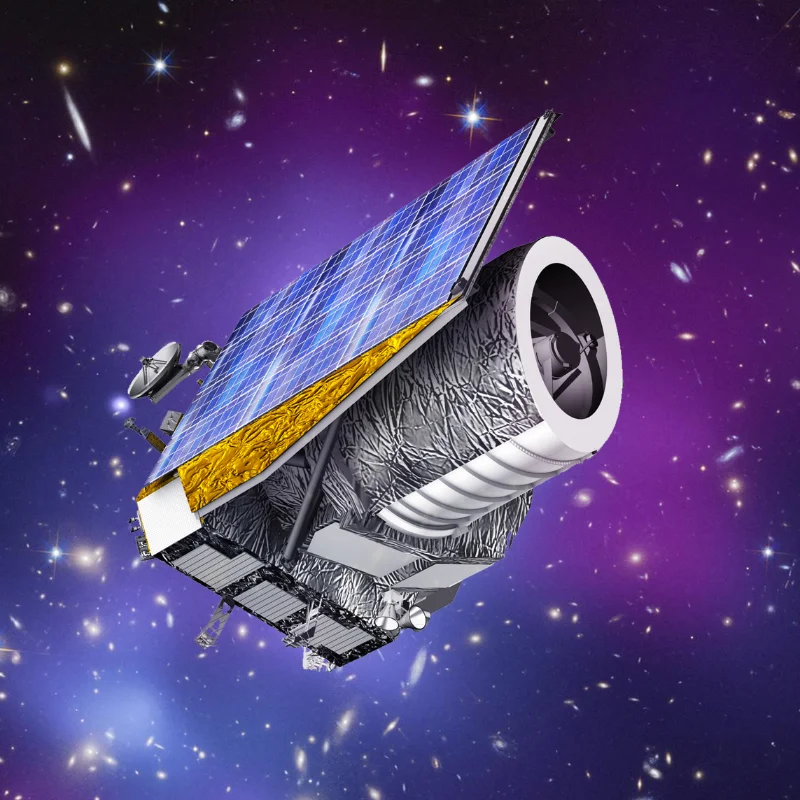
Do we live in a recycled black hole universe? The Euclid space telescope is looking for clues. (Science Reader)
Gaztañaga serves as Science Coordinator for the ARRAKIHS mission, which will study faint structures in galaxy outskirts where evidence of this bounce might survive.
The model also predicts relic black holes and neutron stars that formed during the collapsing phase and persisted through the rebound.
What This Means for Our Place in the Cosmos
More Cosmology

The Cosmic Expansion May Not Be Accelerating After All
A controversial finding by Korean cosmologists suggests that the expansion of the universe may be slowing down.
→The implications shift our cosmic perspective. In this framework, we are not witnessing the birth of everything from nothing. Our observable universe sits inside a black hole formed in some larger parent universe.
The Big Bang becomes a local event within a grander structure.
Whether future observations support this model remains uncertain. The standard Big Bang framework has decades of evidence behind it.
Yet Gaztañaga's calculations offer something unusual: a way to test whether our cosmos truly began, or merely bounced.
Sources
- Primary Research: Gravitational bounce from the quantum exclusion principle (Physical Review D)
- Additional Context:
- New theory challenges how our Universe was born (University of Portsmouth)
- Our Universe could be trapped inside a black hole (BBC Science Focus)

Fact Check: Claim-by-Claim Verification Verified
The article accurately represents the black hole universe model and its key predictions, with proper attribution of authors and publication details to peer-reviewed research.
Commentary
- The "25 billion years" figure refers to the age of the hypothetical parent black hole at the time of collapse, not the age of the universe itself or a direct prediction of the model. The article's phrasing could be clearer about this distinction.
- The predicted curvature value (-0.07 ± 0.02) represents a small negative spatial curvature (Ω_k), indicating a closed universe geometry. The article's description of this as "slightly positive curvature" is imprecise, though the geometric analogy to Earth's curved surface is conceptually useful for popular science.
- While the model is mathematically rigorous, it remains speculative and currently unconstrained by observations—appropriately contextualized by acknowledging that "the standard Big Bang framework has decades of evidence behind it."
- The article correctly notes this is from peer-reviewed research and includes appropriate hedging about future observational tests.
Sources used for verification
Academic/Peer-reviewed:
- Gravitational bounce from the quantum exclusion principle - Physical Review D
- Gravitational Bounce from the Quantum Exclusion Principle - arXiv
- Cosmological bounce relics: Black holes, gravitational waves, and dark matter - Physical Review D
Other reliable sources:
- New theory challenges how our Universe was born - University of Portsmouth
- Enrique Gaztanaga profile - University of Portsmouth
- Universe was not formed in big bang but 'bounced' out of black hole – new study - Evening Standard
- Euclid - Mapping the Geometry of the Dark Universe Mission - eoPortal
- ARRAKIHS Mission Official Site - arrakihs-mission.eu
Fact-checked by Perplexity Sonar Pro on 2026-02-15


