


- The Dark Energy Survey's final results are the most precise measurements of cosmic expansion to date.
- The w parameter came in at -0.80, consistent with dark energy being a cosmological constant.
- Dark energy may still vary with time, hinting at physics beyond current models.
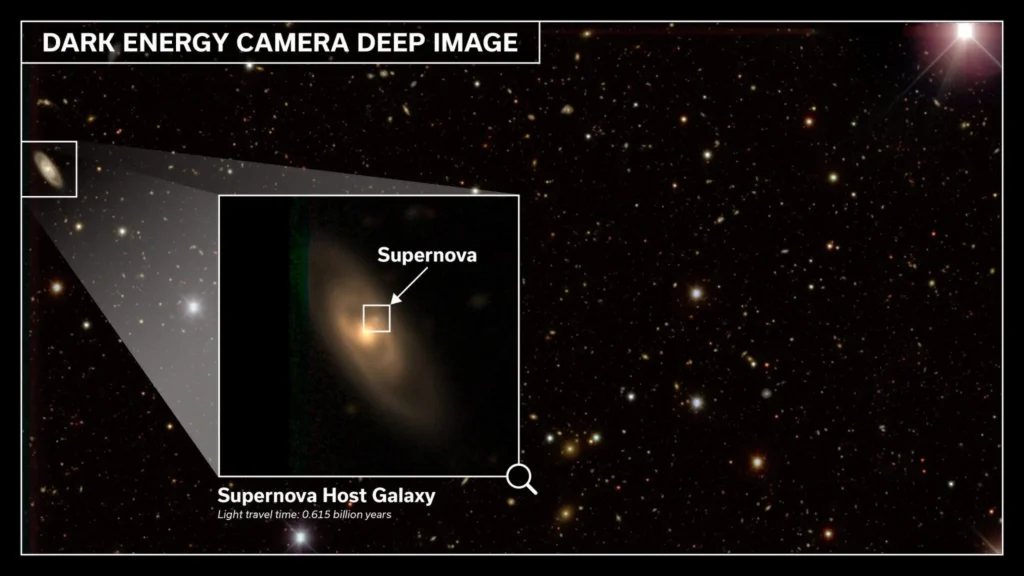
The Dark Energy Survey (DES) has unveiled its final supernova results, offering new insights into the universe. This survey, a significant effort in astrophysics, has been diligently observing the night sky to unravel some of the cosmos' most intriguing mysteries.
The DES's work is particularly focused on understanding dark energy, a mysterious force that is driving the accelerating expansion of the universe. By studying supernovae, the survey aims to shed light on how this expansion has changed over time, offering clues about the nature of dark energy and the universe's future.
This is our best attempt at explaining how the universe is working.
Dillon Brout, assistant professor at Boston University
The Mystery of Dark Energy and Cosmic Expansion
Back in the late 1990s, scientists made a groundbreaking discovery: the universe isn't just expanding; it's doing so at an accelerating pace. This revelation was surprising because gravity, the force pulling everything together, should have been slowing this expansion down. The mysterious force behind this acceleration was named dark energy. This research was awarded the Nobel Prize in Physics in 2011.
Dark energy is a fascinating yet puzzling component of our universe. It's invisible and undetectable by traditional means, but its effects are profound, influencing the universe's fate. Understanding dark energy is not just about satisfying scientific curiosity; it's about comprehending our place in the cosmos.
Using Supernovae as Cosmic Milestones
To investigate this expansive acceleration, scientists turn to type Ia supernovae. These are specific kinds of stellar explosions that occur under well-understood conditions, making them incredibly consistent in their brightness. This consistency is crucial because it allows astronomers to use them as 'standard candles' to measure distances in space.
By observing the apparent brightness of these supernovae from Earth, astronomers can calculate how far away they are. The further a supernova is, the faster it's moving away from us due to the universe's expansion. By studying a large number of these supernovae at various distances, the DES provides a detailed map of how the universe's expansion rate has evolved over billions of years.
Constraining the Universe's Expansion
The DES's observations have led to some significant findings. By analyzing the light from numerous supernovae, the survey has offered the most precise measurements of the universe's expansion to date. This is key to understanding the nature of dark energy and how it has influenced the universe's growth.

One of the critical outcomes of this research is the measurement of the 'w parameter'. This parameter is a way to describe how dark energy affects the universe's expansion. The DES results suggest that this parameter is close to -1, which supports the theory that dark energy could be a cosmological constant, a constant energy density filling space homogeneously.
Implications of W Parameter and the Nature of Dark Energy
"As the universe expands, the matter density goes down," said DES director and spokesperson Rich Kron, who is a Fermilab and University of Chicago scientist. "But if the dark energy density is a constant, that means the total proportion of dark energy must be increasing as the volume increases."
The researchers found w = –0.80 +/- 0.18 using supernovae alone. Combined with complementary data from the European Space Agency’s Planck telescope, w reaches –1 within the error bars.
"w is tantalizingly not exactly on –1, but close enough that it’s consistent with –1," said Tamara Davis, a professor at the University of Queensland in Australia and co-convener of DES’s supernova working group. "A more complex model might be needed. Dark energy may indeed vary with time."
If true, it would revolutionize our understanding of the universe and could lead to new physics beyond our current theories.

Advanced Techniques: From Photometry to Machine Learning
The methods used in the DES are as fascinating as the findings. The survey employed advanced photometric techniques, using a 570-megapixel digital camera to capture the light from distant supernovae. This process involves measuring the intensity and color of light to understand the properties of these faraway explosions.
Moreover, the DES team incorporated machine learning into their analysis. Machine learning algorithms were trained to sift through the massive amounts of data collected, helping to identify and classify the supernovae accurately. This integration of cutting-edge technology represents a significant step forward in astronomical research.

Paving the Way for Further Cosmic Exploration
The end of the DES marks the beginning of a new era in cosmic exploration. Future projects, like the Rubin Observatory's Legacy Survey of Space and Time (LSST) and NASA's Nancy Grace Roman Space Telescope, are set to build on the DES's findings. These upcoming surveys will have even more advanced instruments and will observe the sky with unprecedented detail.
More On Cosmic Expansion

The Cosmic Expansion May Not Be Accelerating After All
A controversial finding by Korean cosmologists suggests that the expansion of the universe may be slowing down.
→These future projects will continue to probe the mysteries of dark energy and the universe's expansion. With more sensitive equipment and larger datasets, astronomers hope to refine the measurements of the w parameter further and unravel the nature of dark energy. The journey of discovery is far from over, and the next chapters promise to be as exciting as the ones we've already seen.
"This new supernova result is exciting because this means we can really tie a bow on it and hand it out to the community and say, 'This is our best attempt at explaining how the universe is working,'" said Dillon Brout, an assistant professor at Boston University who co-led the cosmological analysis of the DES Supernova sample.
These constraints will now be the gold standard in supernova cosmology for quite some time.

Fact Check: Claim-by-Claim Verification Verified
The article accurately reports the Dark Energy Survey's final supernova results, quotes, w parameter measurements, and context from reliable primary sources without factual errors or misrepresentations.
Commentary
- The article appropriately hedges on dark energy possibly varying (w not exactly -1), reflecting source statements without overstating.
- Future missions like Rubin LSST and Roman Telescope are correctly noted as successors building on DES techniques.
Sources used for verification
Academic/Peer-reviewed:
Other reliable sources:
- Final supernova results from Dark Energy Survey offer unique insights into the expansion of the universe - fnal.gov
- The Nobel Prize in Physics 2011 Press Release - nobelprize.org
- What is Dark Energy? - nasa.gov
- Planck Mission - esa.int
- Dark Energy Survey - noirlab.edu
Fact-checked by Perplexity Sonar Pro on 2026-03-10


