Jet Propulsion: How Thrust Powers Flight and Space Travel
Jet propulsion generates forward thrust by expelling mass in the opposite direction, applying Newton's third law of motion.


54 glossary terms
Physics and mathematics are the languages scientists use to describe the structure of reality. The terms here range from the familiar (prime numbers, Planck length) to concepts that still unsettle physicists a century after they were proposed, such as wave-particle duality and quantum entanglement. Mathematics runs alongside, not because physics cannot stand without it, but because so many physical ideas become precise only when expressed in the shorthand of equations. This glossary covers the quiet workhorses of classical physics, the strangeness of quantum mechanics, and the mathematical structures that let theorists probe phenomena no instrument can yet reach.
Jet propulsion generates forward thrust by expelling mass in the opposite direction, applying Newton's third law of motion.
Quantum mechanics is the branch of physics that describes how matter and energy behave at atomic and subatomic scales, where the rules of classical physics break down.
Massless particles have zero invariant mass and must travel at the speed of light in vacuum. The photon is the only confirmed example.
The uranium decay series is the chain of 14 radioactive transformations through which uranium-238 converts into stable lead-206.
Fusion energy confinement methods hold plasma at extreme temperatures long enough for atomic nuclei to fuse, using magnetic fields or rapid compression to contain matter hotter than the Sun's core.
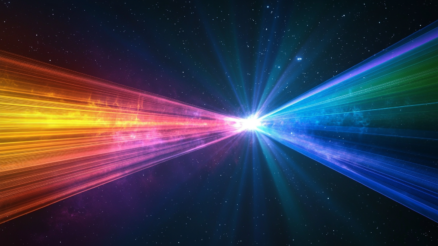
The electromagnetic spectrum is the full range of electromagnetic radiation, from radio waves to gamma rays, with each region used in communication, medicine, and science.
The electromagnetic spectrum is the full range of electromagnetic radiation, ordered by wavelength and frequency, from the longest radio waves to the shortest gamma rays.
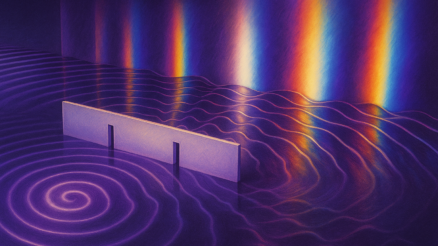
The double slit experiment shows that light and matter behave as both waves and particles. First performed by Thomas Young in 1801, it remains quantum mechanics' most revealing test.
Fermions are half-integer spin particles that obey the Pauli exclusion principle, building all ordinary matter.
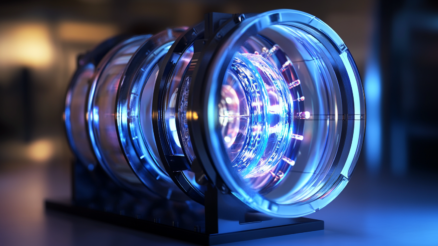
A cyclotron is a particle accelerator that uses a magnetic field and an oscillating electric field to drive charged particles along a spiral path, increasing their energy with each revolution.