- Photons are the only confirmed massless particles.
- Massless particles must travel at exactly the speed of light.
- Neutrinos were reclassified as massive after 1998.
A massless particle is an elementary particle with zero invariant mass that travels at the speed of light in vacuum. The photon, carrier of electromagnetic force, is the only confirmed massless particle in nature.
Why It Matters
Key figure
299,792,458 m/s
Speed of all massless particles in vacuum
The behavior of massless particles underpins two pillars of modern physics: electromagnetism and the strong nuclear force. Photons carry every electromagnetic interaction, from radio transmission to gamma radiation. Gluons bind quarks into protons and neutrons, holding atomic nuclei together.
Without these two massless force carriers, matter as we know it could not exist.
The distinction between massive and massless particles also shaped one of the biggest surprises in recent physics. The Standard Model originally treated neutrinos as massless.
In 1998, the Super-Kamiokande experiment in Japan detected neutrino oscillations, proving that neutrinos switch between flavors during flight. That switching is only possible if neutrinos carry mass.
Takaaki Kajita and Arthur McDonald shared the 2015 Nobel Prize in Physics for the discovery, which forced revisions to the Standard Model.
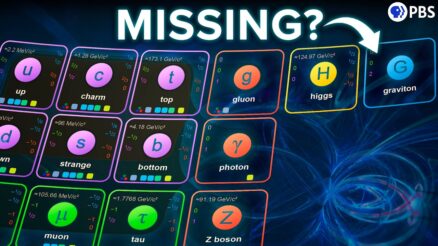
Understanding which particles are massless also connects to open questions in gravitational physics. The hypothetical graviton, proposed as the carrier of gravity, would need to be massless to produce gravity's infinite range. No experiment has detected one.
How It Works
Einstein's special relativity provides the framework. The full energy-momentum relation for any particle is E² = (mc²)² + (pc)², where m is rest mass and p is momentum. For a massless particle, m = 0, and the equation simplifies to E = pc.
Energy depends entirely on momentum.
This creates an unusual constraint. A massless particle at rest would have both zero mass and zero momentum, giving it zero energy. A particle with no energy does not exist.
Massless particles therefore have no choice: they must always move, and they must always move at exactly the speed of light, 299,792,458 meters per second.
Key figure
1998
Year neutrinos were proven to have mass
That speed is the same in every reference frame, a consequence of special relativity that Albert Einstein established in 1905. Massless particles also experience no proper time. From the photon's frame, emission and absorption happen simultaneously, regardless of the distance traveled.
The Higgs mechanism explains why some force carriers have mass and others do not. W and Z bosons, which mediate the weak nuclear force, interact with the Higgs field and acquire masses of roughly 80 and 91 GeV respectively.
Photons and gluons do not couple to the Higgs field, so they remain massless.
Key Context
Albert Einstein's 1905 paper on the photoelectric effect established that light behaves as discrete packets of energy, later named photons by the chemist Gilbert Lewis in 1926. James Clerk Maxwell's equations had predicted in the 1860s that electromagnetic waves travel at the speed of light, but the particle interpretation took four more decades.
Gluons occupy a peculiar position among massless particles. Although the Standard Model predicts they have zero mass, gluons can never be observed in isolation. The strong force increases with distance (a property called color confinement), so pulling a gluon away from a quark generates enough energy to create new quark-gluon pairs instead. Their masslessness remains theoretical, supported by particle collision data but never directly measured.
FAQ
Are photons the only massless particles?
Photons are the only experimentally confirmed massless particles. Gluons are predicted to be massless by the Standard Model, but because they cannot exist as free particles due to color confinement, their zero mass has not been directly measured. The hypothetical graviton would also be massless if it exists.
How can massless particles carry momentum without having mass?
In special relativity, momentum does not require mass. The relation E = pc shows that a massless particle's momentum equals its energy divided by the speed of light. A photon's momentum is real and measurable: solar sails use radiation pressure from photon momentum to propel spacecraft.
Why were neutrinos once considered massless?
The original Standard Model assumed neutrinos had zero mass because no experiment had detected neutrino mass. The 1998 Super-Kamiokande discovery of neutrino oscillations proved otherwise. Oscillation between neutrino flavors requires mass differences between neutrino types, meaning at least two of the three neutrino types must have nonzero mass.
What is the difference between massless particles and dark matter?
They are opposite in almost every way. Massless particles travel at the speed of light and interact through known forces like electromagnetism and the strong force. Dark matter has mass, moves at non-relativistic speeds, and interacts gravitationally but not electromagnetically. Dark matter constitutes roughly 27% of the universe's energy content; massless particles carry energy but contribute negligibly to its total mass.
Related Reading


Sources
- Primary Research: Are there any massless particles? (Dr. Christopher Baird, West Texas A&M University)
- Additional Context:
- Massless particles can't be stopped (Symmetry Magazine, Fermilab/SLAC)
- Massless Particles Traveling at the Speed of Light (University of Illinois Physics)
- Super-Kamiokande neutrino mass evidence (IceCube Neutrino Observatory)
- The Standard Model (CERN)

Fact Check: Claim-by-Claim Verification Verified
All 10 claims verified against authoritative physics sources. No corrections needed.
Sources used for verification
- Are there any massless particles? - wtamu.edu
- Massless particles can't be stopped - symmetrymagazine.org
- Massless Particles and Speed of Light - illinois.edu
- Super-Kamiokande neutrino mass - icecube.wisc.edu
- The Standard Model - cern