- Two cichlid species share preferences but diverge in decision rules.
- Over 5,000 choice trials ran underwater on wild, untrained fish.
- One species weighs several features; the other follows a single cue.
Two featherfin cichlid species sharing a stretch of lakebed in Lake Tanganyika make the same simple choices, but appear to diverge in how they decide once the options conflict.
Published on 12 August in the peer-reviewed Proceedings of the National Academy of Sciences, the finding rests on more than 5,000 choice trials run underwater on wild fish. There was no training and no captivity.
It suggests the decision rule itself can differ between species that last shared an ancestor less than 2 million years ago, even where their preferences match.
Aulonocranus dewindti and Cyathopharynx furcifer share the same sandy bays on the Zambian shore. Males of both build sand bowers to attract females, and both clear any foreign object that lands in one.
A diver placed 3D-printed objects varying in color, size and shape into a male's bower, and logged whichever he removed first as his preferred. Thirty-four responsive males were tested at Isanga Bay in April and May 2024.
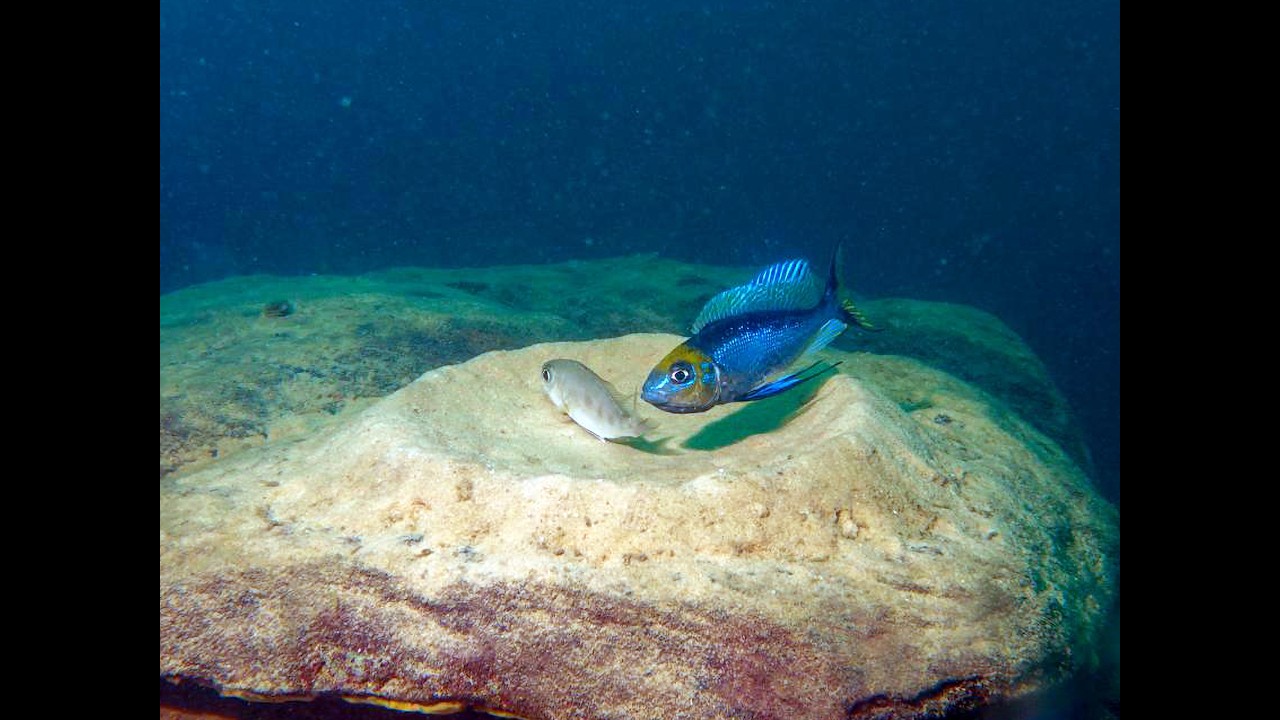
The two species agreed when choices were simple
In simple choices between objects differing in one attribute, the species were nearly indistinguishable. Both preferred the larger object, their color preferences matched, and only 2 of 11 combinations differed between them.
"They could see the same things, they were equally motivated, and they agreed when the choices were simple. Only when we made the decisions more demanding did they suddenly diverge," said Maëlan Tomasek, the study's first author, in a Max Planck Society statement. Tomasek did the work for his doctoral thesis at the Université Clermont Auvergne and the Max Planck Institute of Animal Behavior.
Key figure
1,110
Trials in which size and color were set against each other, across 29 wild fish. This is where the two species stopped agreeing.
Two decision rules, one set of preferences
Size and color were then set against each other, in 1,110 trials with 17 A. dewindti and 12 C. furcifer.
Offered a 2.5 cm brown shell in the preferred size against a 2 cm orange shell in the preferred color, A. dewindti showed no group preference. Of 16 individuals, 1 favored the brown and 2 the orange. Among C. furcifer, 6 of 8 took the orange.
A second pairing set a 3 cm orange shell in the preferred size against a smaller shell in the preferred color. C. furcifer was again decisive, 6 of 8 individuals, but this time it followed size rather than color.

The paper describes C. furcifer as going by "a single dominant feature" rather than one fixed attribute. It cites that "inconsistent prioritization of features" as a reason to prefer an attentional explanation.
What is the decoy effect?
Adding a third option that nobody picks can change which of the other two people choose, if the new option is obviously worse than one of them but not the other. Marketers use it in wine lists and subscription tiers, to steer a choice without touching the original pair.
A. dewindti was then tested for that bias and did not take the bait. In the size version, 3 of 14 individuals shifted, 2 toward the target and 1 against it. In the color version, none of 12 switched.
It "did not decide randomly," the authors write, and appeared to hold several features in mind at once.
The test could not be run on C. furcifer, whose strong preferences broke the requirement that individuals start out indifferent.
They start out with the same capacities, but it appears evolution has changed the decision rule to solve similar problems in different ways.
Alex Jordan, co-senior author, Max Planck Institute of Animal Behavior
One species slowed down, the other sped up
Decision times pointed the same way. A. dewindti took significantly longer in the conflicting-feature trials than in the simple ones. C. furcifer, "and against expectation" in the paper's phrase, was quicker under the harder condition.
At low load the two species showed no significant difference, the control that makes the contrast interpretable. The paper reports Cox regression estimates rather than mean latencies.
That speed-up points to a difference in how the species deploy attention rather than how much they have.

Three explanations compete for that pattern. A brain running out of attentional capacity slows down, and C. furcifer sped up.
An overwhelmed animal would choose closer to random, and C. furcifer chose strongly and consistently. And less than 2 million years is a short window in which to evolve more or less attentional capacity, so redeployment is the more parsimonious reading.
Which one is right stays open. "Current data cannot definitively distinguish between these alternatives," the authors write, meaning capacity against prioritization.
The authors also stress they are not claiming fish possess human-like versions of Daniel Kahneman's 'fast and slow' thinking.
"Humans and fish might not think in the same way, but both face the same computational challenge of selecting the most relevant information from a complex world," said co-author Dylan Naceur, a doctoral student in cognitive psychology at the Université Clermont Auvergne.
The cause is still not clear
The study covers one site, one season, adult males only, and one behavior. The headline divergence rests on 16 A. dewindti against 8 C. furcifer per combination, and the second pairing reaches significance only with one outlier removed, which the authors disclose.
As far as Science Reader can tell, no researchers outside the study have yet publicly assessed the work.
What drives it remains unsettled. One ecological account is offered, though only as a postulate: A. dewindti builds among complex rock faces, C. furcifer on flat sand or rock.
More on animal cognition

Bird Brains Reveal Why Consciousness Evolved in the First Place
Crows, pigeons, and even roosters pass self-awareness tests that rewrite our understanding of conscious minds.
→That complexity could favor holding several features in mind, the paper says. Different life experiences could equally explain it, the Max Planck statement adds.
"One integrates broadly before deciding, while the other rapidly focuses on what matters most," said co-senior author Alex Jordan, who leads an independent research group at the Max Planck Institute of Animal Behavior.
"Comparative cognition has often focused on ranking species by their cognitive aptitude, their 'cleverness'," said co-senior author Valérie Dufour, research director in social and cognitive psychology at the Université Clermont Auvergne and the CNRS.
"Our results suggest a different perspective. Closely related species may solve the exact same problem using different cognitive strategies, but one strategy is not necessarily better than the other," adds Dufour.
The two featherfins settle nothing about which species is smarter. They suggest, instead, that closely related animals can inherit the same problem and still evolve different ways of solving it.
Sources
- Primary Research: Decision rules diverge between sympatric Featherfin cichlids despite shared preferences, ecology, and evolutionary history (Tomasek, Dunster, Goverts, Naceur, Dufour & Jordan, Proceedings of the National Academy of Sciences, 2026)
- Additional Context:
- Wild fish reveal different ways of making decisions (Max Planck Society, 13 August 2026)

Fact Check: Claim-by-Claim Verification Verified
Every quotation, affiliation and qualitative finding in this article checks out verbatim against the Max Planck Institute of Animal Behavior release, and the core finding, that two sympatric featherfin cichlids share preferences but diverge in decision rule under conflicting features, is accurately reported and correctly hedged. One numeric imprecision was found and fixed: the divergence estimate for Aulonocranus dewindti and Cyathopharynx furcifer is published as an upper bound of under 2 million years, not as a point estimate of about 2 million years, and the article has been corrected in both places where the figure appears.
Commentary
- The article's central interpretive claim, that the two species differ in how they deploy attention rather than in how much they have, is the authors' own reading and is attributed as such throughout. The paper states it cannot definitively separate capacity from prioritization, and the article says so.
- Sample sizes behind the headline divergence are small, 16 against 8 individuals per combination, and the article states this rather than burying it.
- An earlier bioRxiv preprint of this work carries materially different trial counts and combination numbers. External verification tools reach the preprint but not the paywalled version of record, so several numeric claims here are traceable to the published paper alone. This is the main reason confidence is MEDIUM rather than HIGH.
- The ecological explanation is a postulate in the paper, not a tested result, and the release offers different life experience as an equally live alternative. Both framings survive in the article.
- The Kahneman analogy is disclaimed rather than asserted, following the authors' own guardrail.
Sources used for verification
Academic/Peer-reviewed:
- Decision rules diverge between sympatric Featherfin cichlids despite shared preferences, ecology, and evolutionary history - pnas.org
- Bower building and substrate use in Tanganyikan featherfin cichlids - pmc.ncbi.nlm.nih.gov
- Ronco et al., Drivers of species diversity in Lake Tanganyika cichlids - nature.com
- Cognitive flexibility in Aulonocranus dewindti - link.springer.com
- bioRxiv preprint of the present study (superseded) - biorxiv.org
- Schedel, phylogeny and divergence times of African cichlids - edoc.ub.uni-muenchen.de
Other reliable sources:
- Wild fish reveal different ways of making decisions - ab.mpg.de
- Max Planck Society statement - mpg.de
- FishBase, Aulonocranus dewindti - fishbase.se
- SeriouslyFish, Cyathopharynx furcifer - seriouslyfish.com
Fact-checked by Perplexity Sonar Pro on 2026-08-14