


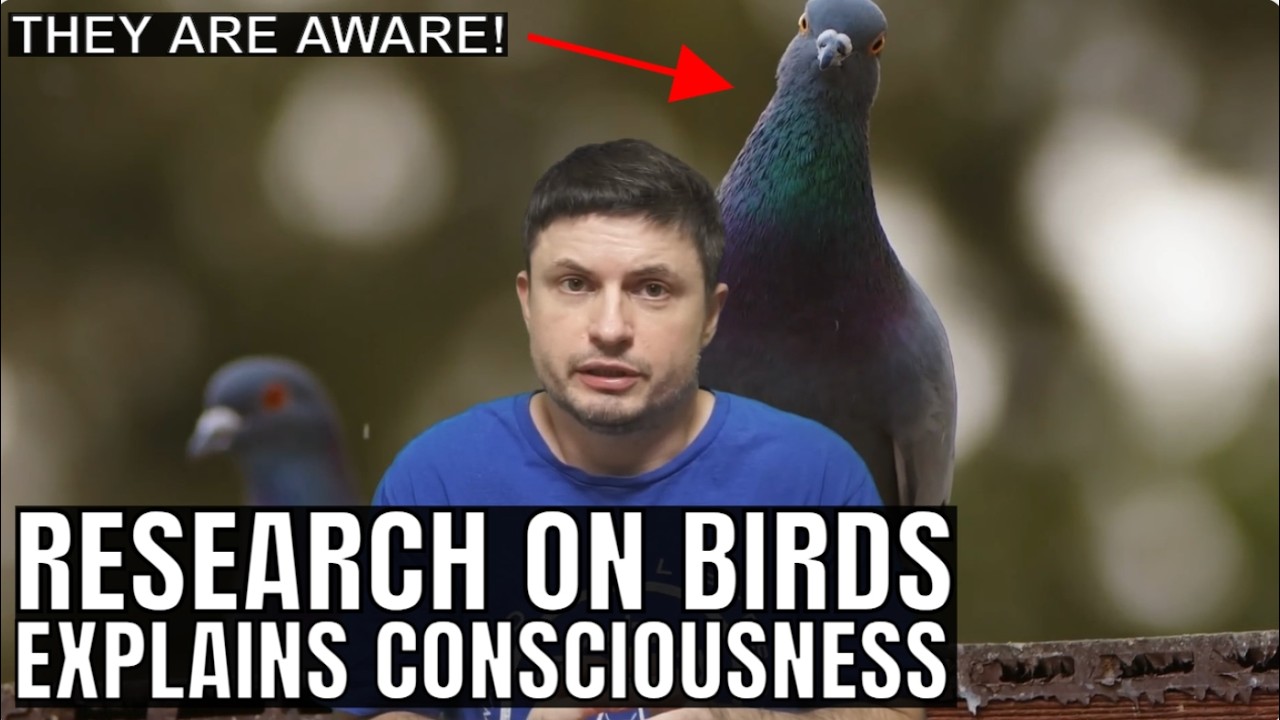

- Bird brains achieve consciousness through the nidopallium caudolaterale, which functions like the human prefrontal cortex.
- Magpies pass the mirror mark test, proving self-recognition does not require a mammalian cortex.
- Birds evolved consciousness independently, using neuronal density up to four times higher than mammals.
When a crow uses a stick to fish insects from tree bark, something remarkable happens in its brain. The same neural patterns that fire in human consciousness light up in a region called the nidopallium caudolaterale, the bird brains' version of our prefrontal cortex.
What is the nidopallium caudolaterale?
The nidopallium caudolaterale (NCL) is a region in bird brains that handles complex thinking, decision-making, and awareness of internal and external states. It plays the same role as the prefrontal cortex in mammals, even though bird brains are structured entirely differently. Scientists now consider it a key seat of avian consciousness.
Anton Petrov explores how recent neuroscience discoveries are forcing scientists to completely rethink consciousness itself.
Key figure
4×
higher neuronal density in bird forebrains compared to mammals of equivalent brain mass
The Mirror Test Revolution
For decades, consciousness seemed exclusive to mammals with complex layered cerebral cortex. Birds were dismissed because their brains looked structurally different.
Then magpies started passing the mirror test.
Scientists placed red dots on magpies that could only be seen in mirrors. The birds immediately tried to remove the spots while looking at their reflections - clear evidence of self-recognition.
But the surprises kept coming. Pigeons learned to use mirrors to locate objects. Roosters gave different alarm calls when they saw predators versus their own reflections, staying silent only when alone with a mirror.
Different Wiring, Same Results
Bird brains achieve consciousness through convergent evolution - developing the same function using completely different architecture. Their secret weapon is neuronal density up to four times higher than typical mammals.
As Petrov explains, consciousness involves being aware of internal states like feelings or anxieties, and of course of various external objects in your environment.
Birds process this awareness through their nidopallium caudolaterale, which as mentioned above functions like our prefrontal cortex - despite being wired entirely differently.
The implications are staggering.
Why Consciousness Evolved
Consciousness arose as an evolutionary advantage that emerged 300 million years ago. Self-awareness provides advanced learning, long-term planning, and essential survival strategies in changing environments.
Nature discovered multiple architectural blueprints for the same subjective experience. It's not about specific brain regions - it's about how neural circuits process and integrate information.
The 2012 Cambridge Declaration of Consciousness officially recognized that mammals and birds possess the neural basis for consciousness. But scientists are now testing even smaller creatures, like how some ants appear to recognize themselves in mirrors and try removing artificial markings.
Future studies will determine if consciousness operates as a multi-level process or an on-off switch, searching for the minimal requirements for self-awareness across the animal kingdom.

Fact Check: Claim-by-Claim Verification Verified
The recap accurately summarizes the source video's content, with all major claims supported by peer-reviewed studies on bird cognition and consciousness.
Commentary
- Pigeons use mirrors to locate hidden objects after training, indicating mirror understanding but not classic self-recognition.
- Consciousness timeline of ~300 million years aligns with evolutionary divergence but varies by model (e.g., some trace to Cambrian ~540 Ma).
- Ant self-recognition claims in source are preliminary and debated; not central to bird focus.
Sources used for verification
- Mirror-Induced Behavior in the Magpie (PLoS Biology)
- Neural Correlates of Executive Control in the Avian Brain (PLoS Biology)
- Roosters do not warn the bird in the mirror (PubMed/PLOS One)
- Birds have primate-like numbers of neurons (PubMed/PNAS)
- Cambridge Declaration on Consciousness
- Source Video: Why Did Consciousness Evolve? (Anton Petrov)
Fact-checked by Perplexity Sonar Pro on 2025-12-17


