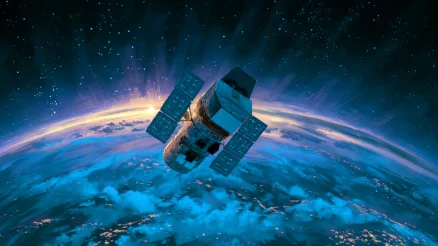
- JWST survived 250 single-point failures during its six-month deployment.
- Engineers polished beryllium mirrors to virus-scale precision at cryogenic temperatures.
- Performance exceeded specifications by up to 30 times.
Christmas morning 2021, neighbours knocked on Mark Clampin's door. They had watched the James Webb Space Telescope launch on television and wanted to congratulate him. Clampin, who had spent roughly fourteen years as JWST's Observatory Project Scientist, thanked them politely.
He knew the hard part had not started yet.
In a Royal Institution lecture, Clampin described what lay ahead with characteristic understatement. JWST had some 250 single-point failures to survive: 50 major deployments, scores of release mechanisms, motors, and more than 600 pulley assemblies. Every one had to work perfectly, in sequence, with no possibility of repair.
"Some of us called it Six Months of Terror," he told the audience. "And you'll see why."
What is a single-point failure?
A component with no backup. If it fails, the entire mission fails.
Polishing Mirrors to the Width of a Virus
The telescope's eighteen beryllium mirror segments each measure 1.5 metres across. Engineers polished them to 20 nanometres of precision, roughly the size of a single virus particle.
That alone would have been remarkable.
But beryllium changes shape when cooled. The team had to polish the mirrors deliberately wrong at room temperature, so the segments would reach their correct figure only at operating temperature: a frigid minus 233 degrees Celsius.
Getting the shape right required a technique with an unlikely origin. When Hubble launched in 1990 with a flawed mirror, NASA developed phase retrieval, a method for diagnosing optical errors from starlight alone.
Clampin noted the irony with evident relish. "We used to joke that the ghost of Edwin Hubble was sitting on our shoulder," he said. Hubble's celebrated failure became the very tool that made JWST's mirrors work.
Some of us called it Six Months of Terror, and you'll see why.
Mark Clampin, NASA Director of Astrophysics
Six Months of Terror, Then Silence
Every deployment succeeded. Every motor fired. Every latch released.
The results were, by any engineering measure, extraordinary. Image quality came in 2x better than specifications. Jitter measured 7x lower than predicted, and 7x better than Hubble. Sensitivity exceeded requirements by a factor of 30.
Key figure
30x
JWST's sensitivity gain over its own design requirements
Clampin showed the audience one of JWST's early deep-field images: thousands of galaxies compressed into a patch of sky you could cover with a grain of sand held at arm's length. "People were doing science with this image hours after it was taken," he said.
It is still producing new papers in the literature.
The telescope spotted the most distant galaxy then known, at redshift 14.3, pushing observations back to just after the first stars ignited.
It captured water erupting from Saturn's moon Enceladus in plumes so vast they seed the planet's entire E-ring. Fuel reserves suggest JWST could operate for 20 years or more, roughly doubling its planned ten-year mission.
Picometer Mirrors and the Search for Another Earth
Clampin now serves as NASA's Director of Astrophysics. His current focus is the Habitable Worlds Observatory, the next flagship telescope recommended by the 2020 Decadal Survey.
More On Astronomy

The Million-Solar-Mass Mystery Astronomers Found by Looking at Nothing
Researchers detected an invisible object 10 billion light-years away by noticing a tiny flaw in distorted starlight–but whether it's dark matter or something else remains…
→HWO will need to do something JWST never attempted: directly photograph Earth-sized planets orbiting other stars and analyse their atmospheres for signs of life. That demands mirror stability roughly 1,000 times better than JWST, held at the picometer level, a scale smaller than individual atoms.
Maintaining that precision requires continuous active correction, not the set-and-forget alignment JWST uses. The engineering task is formidable: hold a mirror steady to sub-atomic tolerances while a telescope orbits 1.5 million kilometres from Earth.
Clampin did not mention cost. JWST's budget grew from roughly $1 billion to nearly $10 billion over two decades. HWO will face similar scrutiny, and the Decadal recommendation carries no funding guarantee.
An Awful Waste of Space
He closed his lecture with Carl Sagan's quiet observation. "The universe is a pretty big place. If it's just us, that seems like an awful waste of space."
The telescope that will test that idea needs mirrors precise to sub-atomic tolerances. The engineer overseeing its design is the same one who guided hundreds of single-point failures safely through six months of terror.
HWO's preliminary design review is expected before the end of this decade.
Sources
- Primary Source: The James Webb Space Telescope: Exploring the Infrared Universe (Mark Clampin, Royal Institution lecture)
- Additional Context:

Fact Check: Claim-by-Claim Verification Verified
The article accurately summarizes key facts from Mark Clampin's Royal Institution lecture and supporting scientific sources, with minor approximations like years served and exact single-point failure count that do not alter factual integrity.
Commentary
- Article cites "250 single-point failures"; sources mention 344 or lecture's ~250 total—likely Clampin's phrasing, acceptable for popular summary.
- "Fifteen years" slightly rounds NASA's "~14 years"; negligible discrepancy.
- Operating temp -233°C approximates 40K (-233.15°C); precise enough for context.
Sources used for verification
Academic/Peer-reviewed:
- Setting the stage for the search for life with the Habitable Worlds Observatory - arXiv
- Looking at Hubble Through the Eyes of JWST - ntrs.nasa.gov
- A Year of Wavefront Sensing with JWST in Flight - arXiv
Other reliable sources:
- Dr. Mark Clampin - NASA Science - science.nasa.gov
- How the James Webb Space Telescope was designed - with Mark Clampin - youtube.com (Royal Institution)
- NASA's James Webb Space Telescope Finds Most Distant Known Galaxy - science.nasa.gov
- Webb Maps Surprisingly Large Plume Jetting From Saturn's Moon Enceladus - science.nasa.gov
- Optics Performance and Stability - JWST User Documentation - stsci.edu
Fact-checked by Perplexity Sonar Pro on 2026-03-11