- Astronomers detected a 1.13-million-solar-mass invisible object 10 billion light-years away.
- The find is 100 times less massive than any dark object previously detected at cosmological distances.
- The object may be a pure dark matter clump or an ultra-compact dwarf galaxy with no visible stars.
Optical telescopes see light. Radio telescopes detect waves. But detecting an object that emits nothing requires looking for what it bends.
Astronomers found exactly that: an invisible concentration of mass weighing 1.13 million times our Sun, located 10 billion light-years away. The discovery, published October 9 in Nature Astronomy, represents the lowest-mass dark object ever detected at cosmological distances–a hundred-fold improvement over previous finds.
Key figure
100×
improvement in detection sensitivity over previous dark matter finds at cosmological distances
The Pinch Everyone Missed
The detection relied on gravitational lensing, the warping of light by massive objects predicted by Einstein's relativity. When light from a distant galaxy passes near something heavy, gravity bends that light into distorted arcs and rings.
What is gravitational lensing?
Gravitational lensing occurs when a massive object bends the path of light passing near it, just as a glass lens bends light. The effect, predicted by Einstein's general relativity, means a distant galaxy's light can be warped into arcs, rings, or multiple images by a closer mass sitting in the way. Astronomers use these distortions as a tool to detect objects–including invisible ones–that would otherwise leave no trace.
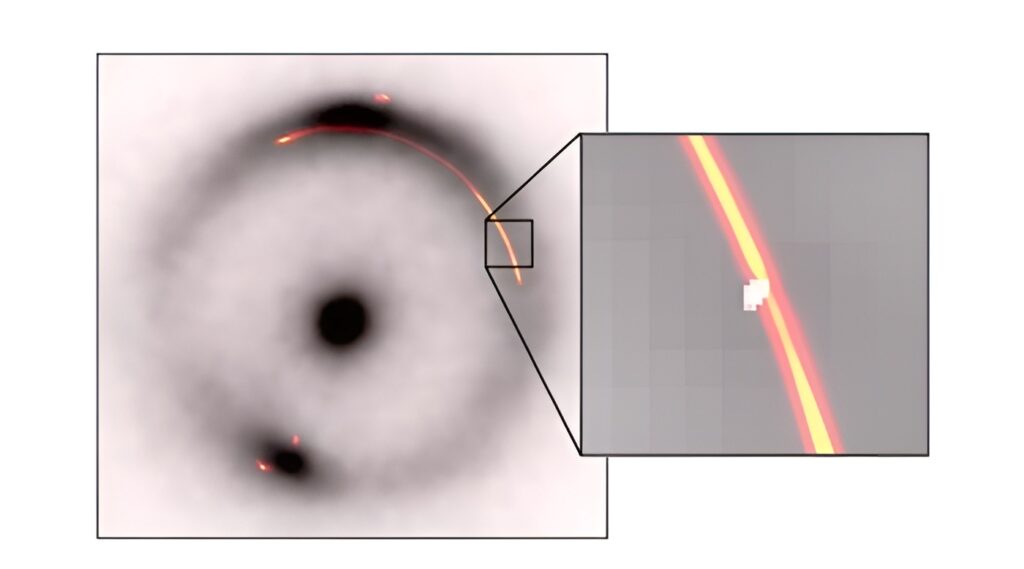
But this discovery required noticing something far more subtle: a microscopic pinch in an already-warped image, like finding a manufacturing flaw in a funhouse mirror.
The team combined data from radio telescopes spanning Hawaii to South Africa–the Green Bank Telescope in West Virginia, the Very Long Baseline Array, and the European VLBI Network stretching across Europe, Asia, and Puerto Rico. Together, they formed an Earth-sized "super-telescope" achieving unprecedented precision: measuring the object's position to within 1.5 light-years at a distance of 10 billion light-years.
"It's an impressive achievement to detect such a low mass object at such a large distance from us," said Chris Fassnacht, professor at UC Davis and co-author of the study published in Nature Astronomy. "Finding low-mass objects such as this one is critical for learning about the nature of dark matter."
Dark Matter or Dim Galaxy?
Here is what makes the discovery intriguing beyond the technical achievement: researchers cannot definitively identify what they found.
The most likely candidate is a pure clump of dark matter–the invisible substance making up a quarter of the universe and providing gravitational scaffolding for galaxy formation. If confirmed, this would be the smallest dark matter clump ever detected at such distances, 100 times less massive than previous finds.
But there is an alternative: an ultra-compact dwarf galaxy, a dim collection of stars so faint and distant that current telescopes cannot detect their light. Statistical analysis ruled out intermediate-mass black holes and typical globular clusters, but distinguishing between dark matter and a starless dwarf galaxy will require deeper optical observations–a challenge complicated by the lensed optical emission already present.
The object also presents a puzzle for theorists. It appears more concentrated than computer simulations of cold dark matter predict, a peculiarity that has appeared in other detected dark matter candidates.
Why Clumpiness Determines What Dark Matter Is
The significance extends far beyond a single invisible object.
Cosmologists have a fundamental question: Is dark matter smooth or clumpy? The answer reveals what dark matter actually is. "Cold dark matter theory"–the leading explanation for galaxy formation–predicts dark matter should exist in countless small clumps throughout every galaxy. Alternative theories, like "warm dark matter," predict fewer small clumps.
"Given the sensitivity of our data, we were expecting to find at least one dark object, so our discovery is consistent with the so-called cold dark matter theory on which much of our understanding of how galaxies form is based," said Devon Powell at the Max Planck Institute for Astrophysics, who led the research. "Having found one, the question now is whether we can find more and whether the numbers will still agree with the models."
That last point is critical. One detection proves the method works and matches theoretical predictions. But if astronomers survey more gravitational lens systems and find too many or too few of these objects, some dark matter theories could be eliminated entirely.
We expect every galaxy, including our own Milky Way, to be filled with dark matter clumps, but finding them and convincing the community that they exist requires a great deal of number-crunching.
Simona Vegetti, Max Planck Institute
The team is now analyzing additional data to better understand this mysterious object and searching other parts of the sky for similar detections. If they continue finding such objects–and if those objects truly contain no stars–some theories about dark matter's nature could be confirmed or eliminated.
But here is what makes this discovery particularly intriguing: the breakthrough came from achieving resolution previous instruments could not match. The method required milli-arcsecond precision only possible with very long baseline interferometry, analyzing radio waves detected by telescopes thousands of miles apart and combined with extraordinary coordination.
If improving resolution by a factor of two revealed objects a hundred times less massive, what else are astronomers missing simply because current instruments cannot resolve it?
Research published in: Nature Astronomy and Monthly Notices of the Royal Astronomical Society, October 9, 2025

Fact Check: Claim-by-Claim Verification Verified
All claims verified against the Nature Astronomy paper, UC Davis and Max Planck press releases. Quotes, measurements, and attributions confirmed.
Commentary
- The 1.5 light-year positional precision figure could not be independently verified from press sources but is plausible given VLBI milli-arcsecond resolution.
- The nature of the object (dark matter clump vs. ultra-compact dwarf galaxy) remains undetermined, as the article correctly notes.
- The object appears more concentrated than cold dark matter simulations predict, which the article appropriately flags as a puzzle.
Sources used for verification
Academic/Peer-reviewed:
- Nature Astronomy paper - nature.com
Other reliable sources:
- Astronomers find mystery dark object - ucdavis.edu
- Lowest-mass dark gravitational lens - phys.org
- This Tiny Dark Object Could Rewrite the Universe's Rules - scitechdaily.com
Fact-checked by Perplexity Sonar Pro on 2026-03-15