HomeThe New IntelligenceAfter 1,700 Autonomous Decisions, NASA's Swift telescope is coming down
News Brief 4 min read

After 1,700 Autonomous Decisions, NASA's Swift telescope is coming down

NASA's gamma-ray observatory deorbits in October after a commercial rescue failed, ending a 20-year unacknowledged experiment in machine judgment that preceded the public debate about it.

Friday, October 2, 2026 · Edited by Tormod Guldvog · ✓ Fact-checked
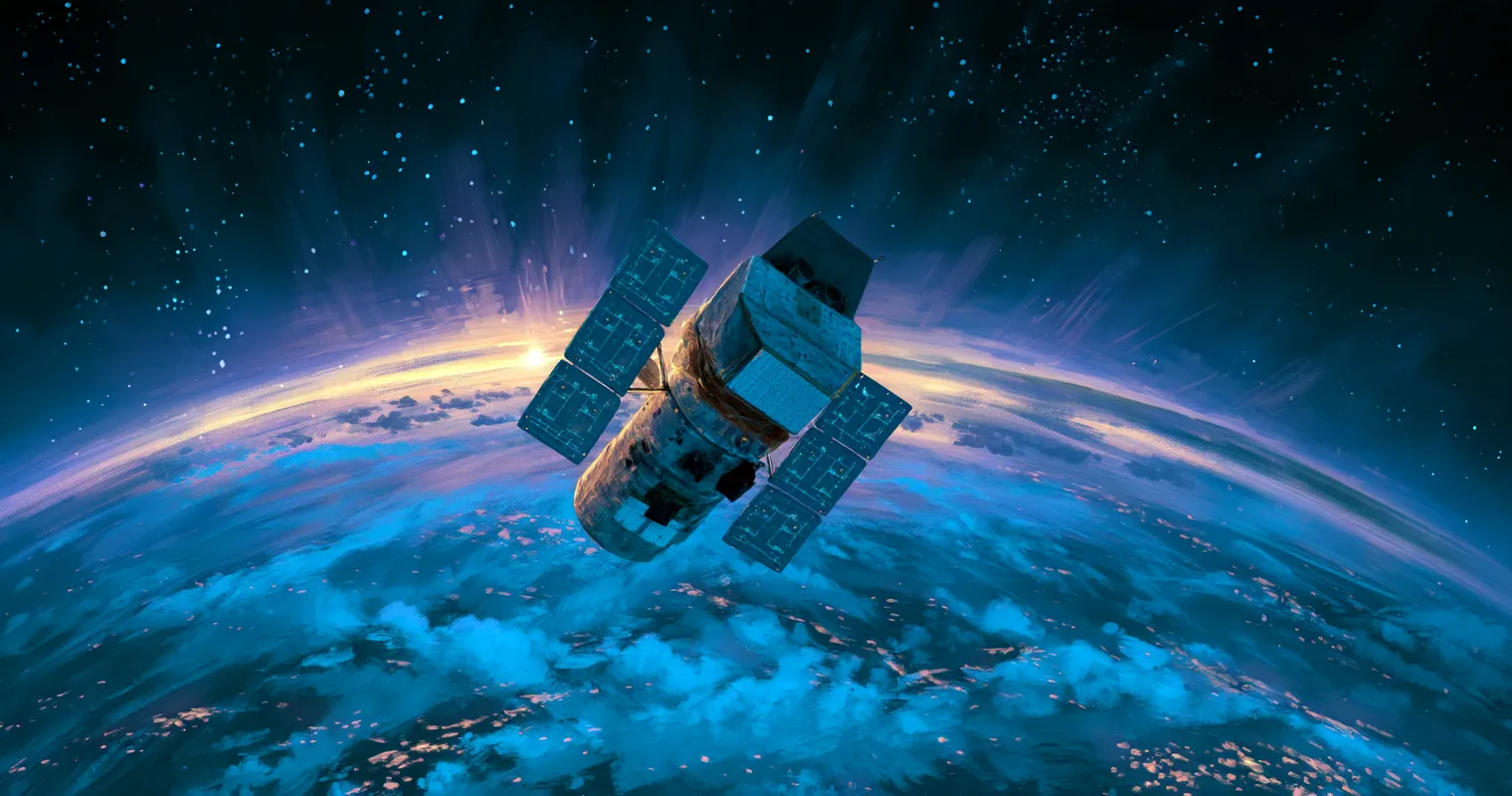
Image showing a space telescope in Earth orbit, about to fall.Space and astronomyAfter a failed rescue attempt, NASA's SWIFT telescope is heading for deorbit.
After a failed rescue attempt, NASA's SWIFT telescope is heading for deorbit.
Share

When a star dramatically collapses into a black hole, or two neutron stars tear each other up violently, who is there to watch?

For more than two decades, the answer has been the Neil Gehrels Swift Observatory, better know as Swift.

It was operated by a set of coded thresholds aboard a 1,470-kilogram spacecraft in low Earth orbit, which detected the burst, computed its position, and swung the telescope onto target in under ninety seconds, autonomously.

More than 1,700 bursts were detected. The decision to reorient itself was the spacecraft's own every time, though for some the Earth, Sun or Moon stood in the way and the follow-up had to wait.

Key figure

1,700+

gamma-ray bursts detected by Swift, each one an onboard decision to slew

Swift is now reaching it's end. It will dip below 185 miles altitude in early-to-mid October, at which point science observations will likely cease, according to the NASA Science blog posted on September 25.

A commercial rescue by Katalyst Space Technologies ended in September after its servicing robot, LINK, lost two of its three reaction wheels in late July, went into a spin, and burned the fuel it needed for the capture.

Swift's two decades of autonomous operation is has made important scientific contributions.

Science Reader Recommended
Recommended video · 8:53
youtube.com
Over the past decade, NASA's Swift Gamma-ray Burst Explorer has proven itself to be one of the most versatile astrophysics missions ever flown. It remains th...
Editor's note: NASA Goddard scientists explain how SWIFT works, and share memorable moments from their work.

Ninety seconds with no human in the loop

Swift's Burst Alert Telescope watches about sixteen percent of the sky at any moment. In the 2005 instrument paper, Scott Barthelmy of NASA Goddard and his co-authors set out the architecture. A gamma-ray burst anywhere in that field is localized to within one to four arcminutes in roughly twenty seconds, and the spacecraft slews so that its narrow-field X-ray and ultraviolet instruments are on target within twenty to seventy seconds.

NASA's mission page describes a spacecraft that swiftly and autonomously repoints itself in under ninety seconds. The Swift blog, writing this September about restarting the slewing system, used the same mission language: "Swift is designed to interrupt the plan and automatically point its Ultraviolet/Optical and X-ray telescopes at the outburst."

Swift is designed to interrupt the plan and automatically point its Ultraviolet/Optical and X-ray telescopes at the outburst.

NASA Science, Swift blog

That problem sat at the heart of Swift's design. Gamma-ray bursts fade in minutes. A human at a console cannot react that fast. The engineers removed the human from the loop.
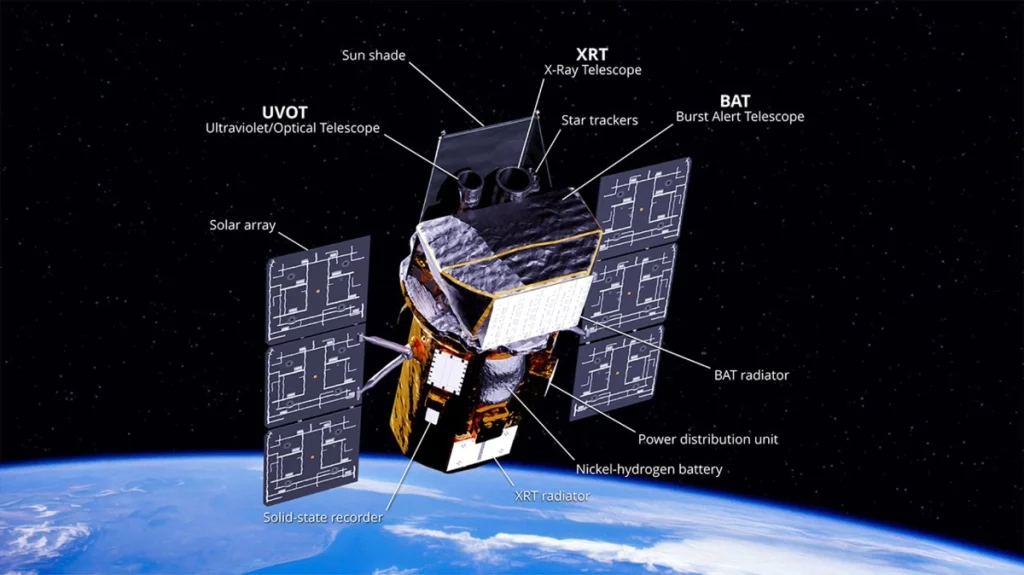
SWIFT and it's various components.
An artist’s concept of the Neil Gehrels Swift Observatory in orbit with spacecraft elements identified. Image credit: NASA’s Goddard Space Flight Center Conceptual Image Lab

The kilonova case

The decisive case came in August 2017. LIGO and Virgo detected gravitational waves from a neutron-star merger, GW170817, and a worldwide follow-up campaign scrambled. Swift's ultraviolet telescope caught the kilonova's blue flash roughly fifteen hours after the gravitational-wave trigger.

That slew was not the autonomous kind. The merger was hidden behind the Earth when it happened, and the pointing was commanded from the ground once ground-based telescopes had found the optical counterpart.
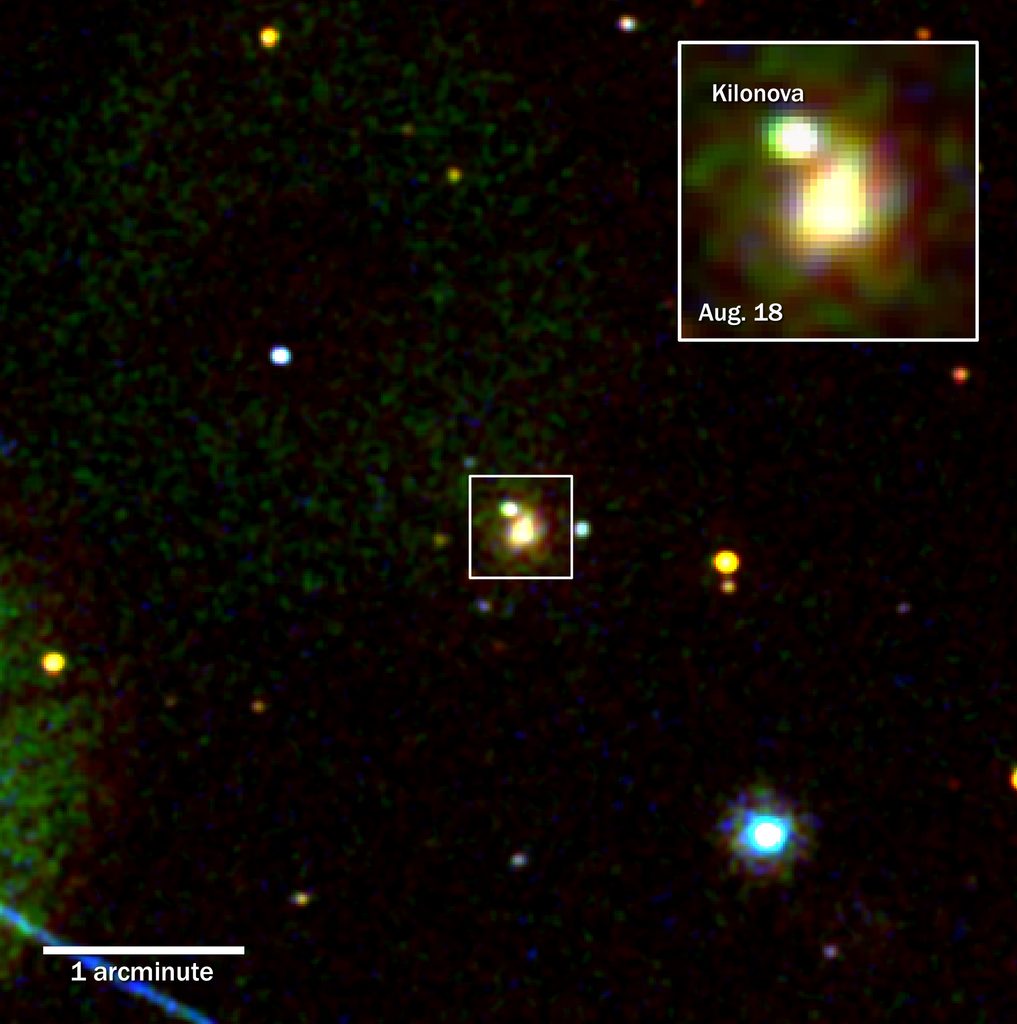
Swift170817 with inset
Swift's Ultraviolet/Optical Telescope imaged the neutron-star-merger kilonova in galaxy NGC 4993 (box) on Aug. 18, 2017. The source was unexpectedly bright in ultraviolet. This false-color composite combines three UV filters; the inset magnifies the galaxy. Image credit: NASA/Swift

Kilonova

A brief, intense explosion produced when two neutron stars collide; it brightens and fades over days to a couple of weeks and is one of the universe's main sources of heavy elements such as gold.

According to the eighteen-year review by Eleonora Troja, an astrophysicist who ran Swift's guest investigator program at NASA Goddard before moving to the University of Rome Tor Vergata, those early photons are among the discoveries that Swift's rapid follow-up made possible.

For the short gamma-ray bursts that fill the rest of Troja's review, the pattern is the same each time: a burst, an alert, a response window measured in seconds, and a telescope already pointed before any observatory on Earth could have asked it to.

Swift's autonomy is threshold-triggered task automation. It applies coded rules: detect the burst, compute the position, slew the telescope. By that measure, the architecture Barthelmy designed sits closer to a radar interceptor than to any contemporary AI system.

Neil Gehrels, the mission's principal investigator from development until his death in 2017, championed that architecture because the science depended on it. NASA renamed the observatory in his honor.

The future of space will require spacecraft that can do more once they get there.

Ghonhee Lee, Katalyst Space Technologies

A debate that has already been in orbit

This particular form of machine decision-making has been running in the service of frontier science for two decades. The public argument about letting machines act without human permission has been growing in many domains, for example AI in killer drones or whether AI agents can be trusted to make decisions on behalf of humans in the modern workplace.

The decisions Swift substitutes for, observe this, not that; now, not later, were designed by engineers to approximate what a human expert would choose, eighty to a hundred times a year, faster than any human could.

The spacecraft is coming down. The debate about whether machines should be allowed to decide has been running, in one form, for twenty years. Swift has been the experiment. Whether it settles anything is still being argued.

Edited by Tormod Guldvog. News briefs report one new finding in about 600 words. For the long view, read our Explorers. How we check.

✓ Fact-checked 2 Oct 2026 · 18 claims checked, 18 supported Show the claims ▾
Supported (corrected)
Swift is a 1,470-kilogram spacecraft in low Earth orbit.
NASA's launch press kit and the mission infobox give a launch mass of 1,470 kg.
Supported
Swift detects a burst and repoints its telescopes autonomously in under ninety seconds.
NASA's Swift mission page describes autonomous repointing in approximately 90 seconds or less. This is a design figure; individual events vary.
Supported
The Burst Alert Telescope sees about sixteen percent of the sky at a time.
NASA's September 25, 2026 Swift update states that BAT "sees 16% of the sky at a time."
Supported (corrected)
BAT localizes a burst to 1 to 4 arcminutes within about 20 seconds; the narrow-field instruments are on target within 20 to 70 seconds.
The abstract of Barthelmy et al. 2005 says BAT "localizes the burst direction to an accuracy of 1-4 arcmin within 20 sec" and initiates a slew to point the narrow-field instruments "within 20-70 sec."
Supported (corrected)
Swift has detected more than 1,700 gamma-ray bursts, each one an onboard decision to slew.
The Swift GRB table statistics list 1,764 BAT-detected bursts as of June 2025. NASA's GCN mission page describes the onboard "Slew or Not" decision; some slews are prevented or delayed by Earth, Sun or Moon constraints.
Supported
Swift will drop below 185 miles in early-to-mid October 2026, at which point science observations will likely cease.
NASA's September 25 update: "Below 185 miles (300 kilometers), spacecraft operations become more difficult and science observations will likely cease." Orbital decay estimates depend on solar activity.
Supported (corrected)
Katalyst's LINK rescue ended in September 2026 after the robot lost two of three reaction wheels in late July, went into a spin and burned the fuel needed for capture.
Katalyst's September 25, 2026 statement describes an electrical fault that took two of three reaction wheels offline, a multi-axis spin, heavy thruster use and insufficient propellant for the capture. NASA's July 28 commissioning update first reported the wheel loss.
Supported
Ghonhee Lee of Katalyst said "The future of space will require spacecraft that can do more once they get there."
The quote appears verbatim in Katalyst's mission-conclusion statement, attributed to CEO Ghonhee Lee.
Supported
The Swift blog wrote that Swift "is designed to interrupt the plan and automatically point its Ultraviolet/Optical and X-ray telescopes at the outburst."
Verbatim in NASA's September 25, 2026 post, which also records that automated slewing was suspended from February 2026 and resumed on September 21.
Supported
In August 2017 LIGO and Virgo detected gravitational waves from the neutron-star merger GW170817.
Evans et al. 2017, Science and the LIGO-Virgo discovery papers; the event was detected on August 17, 2017.
Supported (corrected)
Swift's ultraviolet telescope caught the kilonova roughly fifteen hours after the trigger, in pointing commanded from the ground after ground telescopes found the optical counterpart; the merger was hidden behind the Earth from Swift.
NASA's visualization page: UVOT imaged the kilonova "about 15 hours after gravitational waves and the gamma-ray burst were detected." Evans et al. 2017 report UVOT detection at T0+15.3 hours as Target-of-Opportunity follow-up of the counterpart SSS17a; the source was Earth-occulted for Swift at merger time.
Supported (corrected)
Eleonora Troja ran Swift's guest investigator program at NASA Goddard before moving to the University of Rome Tor Vergata, and her 2023 review covers eighteen years of Swift kilonova work.
"Eighteen Years of Kilonova Discoveries with Swift" (submitted May 2023, special issue "18 Years of Science with the Neil Gehrels Swift Observatory"). Her biography and CV list a Goddard postdoc under Neil Gehrels (2009-2012), Swift Guest Investigator Program Lead (2013-2021) and Tor Vergata from 2021.
Supported
For the short gamma-ray bursts in Troja's review, Swift's autonomous slew put the telescope on target before any ground observatory could have asked.
Troja's abstract credits Swift's rapid localization of short GRBs with enabling kilonova searches; the BAT-triggered slew is the mechanism described in Barthelmy et al. 2005.
Supported (corrected)
A kilonova brightens and fades over days to a couple of weeks and is one of the universe's main sources of heavy elements such as gold.
NASA describes gold and platinum forged in merger debris. AT2017gfo's optical emission faded over about ten days and its infrared emission over two to three weeks.
Supported
Neil Gehrels was Swift's principal investigator from development until his death in 2017, and NASA renamed the observatory in his honor.
Gehrels was the original PI; he died on February 6, 2017. NASA announced the renaming to the Neil Gehrels Swift Observatory on January 10, 2018 (NASA Swift spacecraft page).
Supported (corrected)
Swift makes such decisions eighty to a hundred times a year.
1,764 bursts over roughly 21 years averages about 84 per year; the design rate was more than 100 per year, with recent years lower (61 in 2024, 71 in 2025).
Supported
Swift's autonomy is rule-based task automation, not contemporary AI.
NASA's GCN mission page describes the onboard decision as "Slew or Not" driven by trigger thresholds and merit rules. The radar-interceptor comparison is the author's analogy.
Supported
Swift has operated for more than two decades.
Launched November 20, 2004 (mission record).

Fact-checked by Perplexity Sonar Pro on 2026-10-02

Share