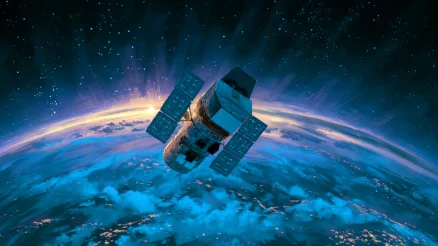
- Dark matter makes up 27% of the universe but emits no light.
- Fritz Zwicky proposed it in 1933; Vera Rubin confirmed it in the 1970s.
- No particle detector has found dark matter directly yet.
Dark matter is matter that does not emit, absorb, or reflect light, making it invisible across the electromagnetic spectrum, yet detectable through its gravitational pull on visible matter, galaxies, and the large-scale structure of the universe.
Why It Matters
Dark matter accounts for roughly 27% of the universe's total mass-energy content, according to measurements from the European Space Agency's Planck satellite published in 2018. Ordinary matter, the atoms that build stars, planets, and people, contributes just 4.9%. The remaining 68% is dark energy.
Key figure
26.8%
Share of the universe's mass-energy made up by dark matter (Planck, 2018)
This imbalance means visible matter is a minority ingredient in the cosmos. The galaxies, stars, and nebulae that telescopes photograph represent less than a fifth of all matter. Identifying what dark matter consists of remains one of the central unsolved problems in physics.
Dark matter also shaped the universe's architecture. In the first few hundred million years after the Big Bang, its gravity pulled ordinary matter into dense pockets where the first stars and galaxies could form. Without that gravitational scaffolding, the cosmic web of filaments and voids that astronomers observe today would not exist.
One striking example: astronomers have found Cloud-9, a dark matter halo so massive it should have formed a galaxy but never did.
How It Works
The original evidence came from galaxy motions. In 1933, Swiss-American astronomer Fritz Zwicky at the California Institute of Technology measured the velocities of galaxies in the Coma Cluster. They were moving too fast for the cluster's visible mass to hold them together.
Zwicky concluded that unseen matter, which he called "dunkle Materie," must provide the extra gravity. The astronomical community largely dismissed his finding for more than three decades.
Key figure
1933
Year Fritz Zwicky first proposed dark matter to explain fast-moving galaxies
The case became undeniable in the 1970s. Vera Rubin and Kent Ford at the Carnegie Institution measured the rotation speeds of stars in spiral galaxies. Stars at the outer edges orbited just as fast as those near the center, violating predictions based on visible mass alone.
Rubin and Ford studied more than 60 spiral galaxies and found the same pattern in every one. Their data showed that galaxies contain roughly ten times more dark mass than luminous mass.
Today, three independent lines of evidence reinforce the case. Galaxy rotation curves remain the most intuitive. Gravitational lensing, where light from distant objects bends around massive foreground clusters, reveals dark matter concentrations with no visible source. And the cosmic microwave background, the oldest light in the universe, carries an imprint of dark matter's influence on the density fluctuations that seeded galaxy formation.
Key Context
No experiment has directly detected a dark matter particle. The leading candidates are WIMPs (weakly interacting massive particles), predicted to have 1 to 1,000 times the mass of a proton, and axions, hypothetical particles roughly one ten-trillionth the mass of an electron.
The LUX-ZEPLIN (LZ) experiment, a 10-tonne liquid xenon detector buried a kilometer underground in South Dakota, published its latest results in December 2025. After 417 live days of data collection, LZ found no WIMPs between 3 and 9 GeV but set the most stringent exclusion limits ever achieved. The experiment will continue collecting data until 2028.
Alternative explanations exist. Modified Newtonian dynamics (MOND) proposes that gravity itself behaves differently at galactic scales, removing the need for unseen matter. MOND accounts for some galaxy rotation curves but struggles to explain gravitational lensing observations and the cosmic microwave background data that the dark matter model handles consistently. Most physicists consider MOND incomplete rather than a replacement.
Sabine Hossenfelder has examined the state of dark matter detection on Science Reader, explaining why several recent announcements fell short of the evidence threshold.
FAQ
Is dark matter the same as dark energy?
No. Dark matter is matter with gravitational pull that holds galaxies together. Dark energy is a separate phenomenon that drives the accelerating expansion of the universe. Dark matter attracts; dark energy pushes apart. Together they account for roughly 95% of the universe's mass-energy content.
Can dark matter pass through ordinary matter?
Yes. Dark matter interacts through gravity but barely (if at all) through the electromagnetic or strong nuclear forces. Billions of dark matter particles may pass through your body every second without any detectable effect. This is precisely what makes direct detection so difficult.
Why can't we detect dark matter with telescopes?
Telescopes detect electromagnetic radiation: light, radio waves, X-rays. Dark matter does not emit, absorb, or reflect any of these. It is invisible to every wavelength. The only way to detect it is through its gravitational influence on objects that do emit light.
Could dark matter not exist at all?
It is possible but increasingly unlikely. Multiple independent observations, including galaxy rotation curves, gravitational lensing, and the cosmic microwave background, all point to the same conclusion: roughly 85% of all matter in the universe is non-luminous. No single alternative theory accounts for all these observations as consistently as dark matter does.
Related Reading


Sources
- Primary Data: Planck 2018 results. VI. Cosmological parameters (Planck Collaboration, 2018)
- Additional Context:
- Dark Matter (NASA Science)
- Dark Matter (CERN)
- DOE Explains: Dark Matter (U.S. Department of Energy)
- LZ Sets a World's Best in the Hunt for Galactic Dark Matter (Lawrence Berkeley National Laboratory, 2025)
- Dark Matter (Encyclopaedia Britannica)

Fact Check: Claim-by-Claim Verification Verified
All 12 factual claims verified against Planck 2018 data, NASA, CERN, DOE, Britannica, and Lawrence Berkeley National Laboratory. No corrections required.