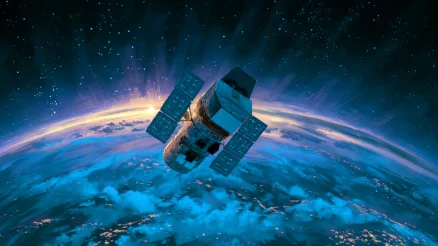
- Cloud-9 is the first confirmed starless dark matter halo that never formed stars.
- Hubble found no stars in the cloud's densest region, only background galaxies.
- Its 5-billion-solar-mass dark matter halo sits just below the galaxy formation threshold.
For years, astronomers suspected the universe was hiding something: dark matter halos so small they never ignited into galaxies.
Theory predicted these "failed galaxies" should exist. But nobody could find one.
Now, a team using the Hubble Space Telescope has confirmed what radio telescopes in China first glimpsed three years ago - a starless cloud of hydrogen and dark matter representing a primordial building block frozen in time.
The object, nicknamed Cloud-9, sits 14 million light-years away on the outskirts of spiral galaxy Messier 94. It contains about a million solar masses of hydrogen gas and an estimated five billion solar masses of dark matter.

Yet when Hubble's Advanced Camera for Surveys examined the region where radio telescopes detected the densest gas, it found nothing but background galaxies.
The cloud that should have become a dwarf galaxy simply... didn't. Here are 5 things to know.
1. The name is boring, but the object isn't
Cloud-9 sounds whimsical, but the name carries no special meaning.
China's Five-hundred-meter Aperture Spherical Telescope (FAST) simply catalogued it as the ninth gas cloud detected around Messier 94. What makes it remarkable is its classification as a RELHIC - a Reionization-Limited H I Cloud.
In plain terms: a natal hydrogen cloud from the universe's early days that never progressed to form stars.
Scientists had predicted such objects for decades. Finding one proved extraordinarily difficult.
What is a RELHIC?
A dark matter halo filled with neutral hydrogen gas, held in thermal equilibrium with the cosmic ultraviolet background. This radiation - streaming from all stars and active black holes - keeps the gas too warm to collapse into stars, freezing these objects in a pre-galactic state.
2. Hubble's job was proving an absence
Ground-based telescopes couldn't rule out the possibility that Cloud-9 was simply a very faint dwarf galaxy.
"Before we used Hubble, you could argue that this is a faint dwarf galaxy that we could not see with ground-based telescopes," explained lead author Gagandeep Anand of the Space Telescope Science Institute.
Hubble's sensitivity changed that.
The team found hints of perhaps one star - but simulations suggest the cloud couldn't host more than about 3,000 solar masses worth of stars. That's far too meager for any known dwarf galaxy.
3. Its dark matter halo sits at a critical threshold
Cloud-9 exists at a critical threshold.
At roughly 5 billion solar masses, its dark matter halo has just enough gravitational pull to hold onto its gas - but not quite enough to force that gas to collapse and form stars.
Key figure
5 billion
solar masses of dark matter estimated in Cloud-9 - just below the threshold needed to ignite star formation
If it were much larger, gravity would have triggered star formation long ago. If smaller, the gas would have dispersed entirely.
This makes Cloud-9 a physical benchmark that validates theoretical predictions about the minimum mass threshold for galaxy formation.
4. Not everyone is convinced
While the discovery excited cosmologists, some researchers urge caution.
Jacco van Loon, an astrophysicist at Keele University in England, notes that another hydrogen cloud in the same study - called FAST J0139+4328 - was recently found to be a very faint galaxy after all. Its stellar mass turned out ten times higher than expected.
Could Cloud-9 harbor an even fainter stellar population that Hubble missed?
Kristine Spekkens of Queen's University, who observed Cloud-9 with the Green Bank Telescope, notes that the object's shape isn't quite as smooth as astronomers would expect from theory.
Among our galactic neighbors, there might be a few abandoned houses out there.
Rachael Beaton, Space Telescope Science Institute
5. What happens next in galaxy formation?
Cloud-9 might still become a galaxy - eventually.
If it accumulates more mass, the gas could collapse and star formation could begin. A cosmic late bloomer.
But it faces another fate too. Its proximity to Messier 94 puts it at risk of ram-pressure stripping - having its gas torn away as it moves through the surrounding medium.
Team member Andrew Fox describes the scenario simply: the gas "gets stripped like a cloud in a wind tunnel until the cloud ceases to exist."
For now, astronomers are hunting for similar objects to determine whether Cloud-9 is an oddball or the first confirmed member of a hidden population.
Go Deeper
- Cloud-9: a new celestial object found by Hubble - ESA announcement
- Starless 'Cloud-9' Is an Entirely New Astrophysical Object - Independent expert commentary
- Astronomers are on "Cloud 9" with a new, starless gas cloud - FAST telescope's role
- The First RELHIC? Cloud-9 is a Starless Gas Cloud - Original research paper
- Radio Telescopes Help Reveal Cloud-9 - NRAO on Green Bank/VLA contributions

Fact Check: Claim-by-Claim Verification Verified
The article closely follows the Cloud-9 discovery paper and major institutional press releases, with only minor simplifications and framing choices typical for popular science.
Commentary
- The article sometimes phrases theoretical implications (for example, “validates decades of theory” or “just below the threshold needed to ignite star formation”) more definitively than the paper’s cautious language, but these remain reasonable popularizations rather than factual errors.
Sources used for verification
Academic/Peer-reviewed:
- The First RELHIC? Cloud-9 is a Starless Gas Cloud - arxiv.org
- The First RELHIC? Cloud-9 is a Starless Gas Cloud (ADS entry) - ui.adsabs.harvard.edu
- The First RELHIC? Cloud-9 is a Starless Gas Cloud (ApJ Letters) - iopscience.iop.org
- NASA’s Hubble Examines Cloud-9, First of New Type of Object - science.nasa.gov
Other reliable sources:
- Hubble examines Cloud-9, first of new type of object - esahubble.org
- Hubble telescope discovers a new type of cosmic object, and astronomers are on Cloud-9 - space.com
- Hubble telescope discovers 'Cloud-9,' a dark and rare 'failed galaxy' - livescience.com
- Why not finding stars has astronomers on Cloud-9 - astronomy.com
- Astronomers are on “Cloud 9” with a new, starless gas cloud - bigthink.com
- Starless ‘Cloud-9’ Is an Entirely New Astrophysical Object - scientificamerican.com
Fact-checked by Perplexity Sonar Pro on 2026-01-11