- The CMB is thermal radiation released 380,000 years after the Big Bang.
- Its tiny temperature variations seeded all galaxies and cosmic structure.
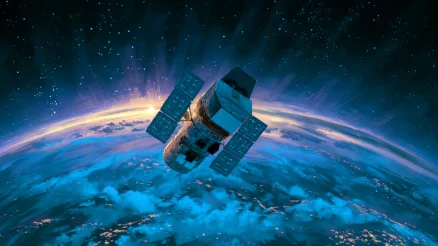
- Planck satellite data pins the universe's age, shape, and composition.
The cosmic microwave background (CMB) is thermal radiation released approximately 380,000 years after the Big Bang, when the universe cooled enough for electrons and protons to combine into neutral hydrogen atoms and light to travel freely for the first time. It fills all of observable space at a nearly uniform temperature of 2.725 kelvin.
Why the cosmic microwave background matters
Key figure
2.725 K
Current temperature of the CMB, the most precisely measured blackbody spectrum in nature
The CMB is the oldest light in the observable universe. It provides a direct snapshot of conditions when the cosmos was roughly 0.003% of its current age, making it the most distant observable surface in any direction.
Tiny temperature variations in the CMB, on the order of one part in 100,000, map the density fluctuations that grew into galaxies, galaxy clusters, and the large-scale structure visible today. These fluctuations encode the physical conditions of the early universe with remarkable precision.
The CMB constrains fundamental cosmological parameters. Data from the European Space Agency's Planck satellite (final results released 2018) pin the age of the universe at 13.797 billion years, its geometry as flat to within 0.4%, and the proportions of ordinary matter (4.9%), dark matter (26.8%), and dark energy (68.3%).
In March 2025, the Atacama Cosmology Telescope (ACT) collaboration released its final data set, producing CMB maps with five times the angular resolution of Planck. The ACT results independently confirmed the Hubble tension, the persistent disagreement between CMB-derived and locally measured expansion rates.
How the cosmic microwave background formed
In the first few hundred thousand years after the Big Bang, the universe was a dense, opaque plasma of protons, electrons, and photons. Photons scattered continuously off free electrons through a process called Thomson scattering, keeping matter and radiation tightly coupled.
Key figure
380,000 years
Age of the universe at recombination, when the CMB was released
As the universe expanded and cooled to roughly 3,000 kelvin, electrons combined with protons to form neutral hydrogen atoms. Cosmologists call this transition recombination. Neutral atoms do not scatter photons efficiently, so light traveled freely for the first time.
That moment of release is called the surface of last scattering.
The photons released during recombination have been traveling ever since. The expansion of the universe has stretched their wavelengths by a factor of roughly 1,100, shifting them from visible light into the microwave portion of the electromagnetic spectrum. What was once a 3,000 K glow now registers at 2.725 K.
Pigeon droppings and a Nobel Prize
In 1948, physicists Ralph Alpher and Robert Herman predicted that remnant radiation from the Big Bang should permeate the universe, estimating its temperature at roughly 5 K. Their prediction attracted little attention for over a decade.
In 1964, radio astronomers Arno Penzias and Robert Wilson at Bell Labs in Holmdel, New Jersey, detected an unexplained excess noise of 3.5 K in their horn antenna. They had exhausted every possible explanation, including cleaning pigeon droppings from inside the instrument.
Princeton physicists Robert Dicke and Jim Peebles, who had been independently searching for such radiation, recognized the signal as the predicted cosmic remnant. Penzias and Wilson received the 1978 Nobel Prize in Physics for the discovery.
Three satellite missions then transformed the CMB into precision cosmology's primary tool. NASA's COBE satellite (1989) confirmed the blackbody spectrum. WMAP (2001) mapped temperature fluctuations across the full sky. Planck (2009) measured those fluctuations to a precision of a few parts per million.
Ground-based telescopes have since pushed further. The South Pole Telescope released measurements in 2025 that exceed Planck's precision on fine angular scales, while ACT's final data release sharpened constraints on cosmological models. A next-generation observatory, CMB-S4, is planned to begin observations in the late 2020s.
FAQ
Can you see the cosmic microwave background?
Not with the naked eye. The CMB peaks in the microwave range of the electromagnetic spectrum, far below the frequencies visible to humans. Detecting it requires radio telescopes or satellite instruments tuned to microwave wavelengths, typically around 160 GHz.
Why is the CMB almost the same temperature everywhere?
Before recombination, photons and matter were tightly coupled and in thermal equilibrium across the observable universe. This produced a nearly uniform temperature. The tiny variations (about one part in 100,000) reflect density differences that later grew into galaxies and galaxy clusters.
What is the Hubble tension and how does the CMB relate to it?
The Hubble tension is the disagreement between two ways of measuring how fast the universe is expanding. CMB-based measurements from Planck and ACT give a Hubble constant of about 67-68 km/s/Mpc, while local measurements using supernovae and other distance markers yield roughly 73 km/s/Mpc. No accepted explanation for the discrepancy exists yet.
How is the CMB different from other background radiation?
The CMB is specifically the thermal radiation from recombination, 380,000 years after the Big Bang. Other cosmic backgrounds exist at different wavelengths: the cosmic infrared background comes from dust-heated starlight, and the cosmic X-ray background comes from active galactic nuclei. The CMB is the oldest of these signals.
Related Reading



Sources
- Primary: Planck and the cosmic microwave background (European Space Agency)
- Additional:
- The Atacama Cosmology Telescope: DR6 Power Spectra, Likelihoods and LCDM Parameters (Atacama Cosmology Telescope, 2025)
- Cosmic Microwave Background (Harvard Center for Astrophysics)
- Nobel Lecture: The Cosmic Microwave Background Radiation (Robert W. Wilson, 1978)

Fact Check: Claim-by-Claim Verification Verified
All major claims verified against authoritative sources. CMB temperature, recombination epoch timing, Planck cosmological parameters, discovery history, and ACT DR6 findings all confirmed.
Sources used for verification
- Planck and the CMB - esa.int
- ACT DR6 Power Spectra - arxiv.org
- Cosmic Microwave Background - cfa.harvard.edu
- Wilson Nobel Lecture - nobelprize.org