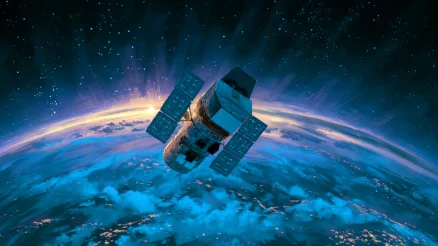
- Dark matter was detected in cosmic filaments near the Coma galaxy cluster via gravitational lensing.
- Early galaxy brightness patterns could provide the first observational test of dark matter theories.
- Black holes from the early universe shaped galaxy formation and the distribution of matter.
1. Dark Matter in Cosmic Filaments
Researchers have reported a detection of the elusive dark matter in cosmic filaments near the Coma galaxy cluster, utilizing gravitational lensing techniques. This discovery, published in Nature Astronomy, validates theoretical models suggesting that galaxy clusters grow at the intersections of cosmic filaments, which are vast bridges of dark matter that connect galaxy clusters across the universe.
What is gravitational lensing?
Gravitational lensing occurs when the gravity of a massive object – such as a galaxy cluster – bends light passing near it, much like a glass lens bends light. Astronomers use this effect to detect invisible matter by observing how background galaxies appear distorted. Because dark matter has mass but emits no light, lensing is one of the few ways to map where it actually is.
Finding dark matter in these filaments gives us important information about the structure of the universe on a large scale. It also backs up the κCDM (Lambda Cold Dark Matter) model, which says that dark matter is a key part of how cosmic structures are put together.
2. Bright Galaxies and Dark Matter
An international team of astrophysicists have published recent simulations tracking the formation of early galaxies after the Big Bang, where they have incorporated previously neglected interactions between gas and dark matter. The new models find that bright patches of small galaxies in the infant universe could offer the first real observational test for theories about the nature of dark matter.
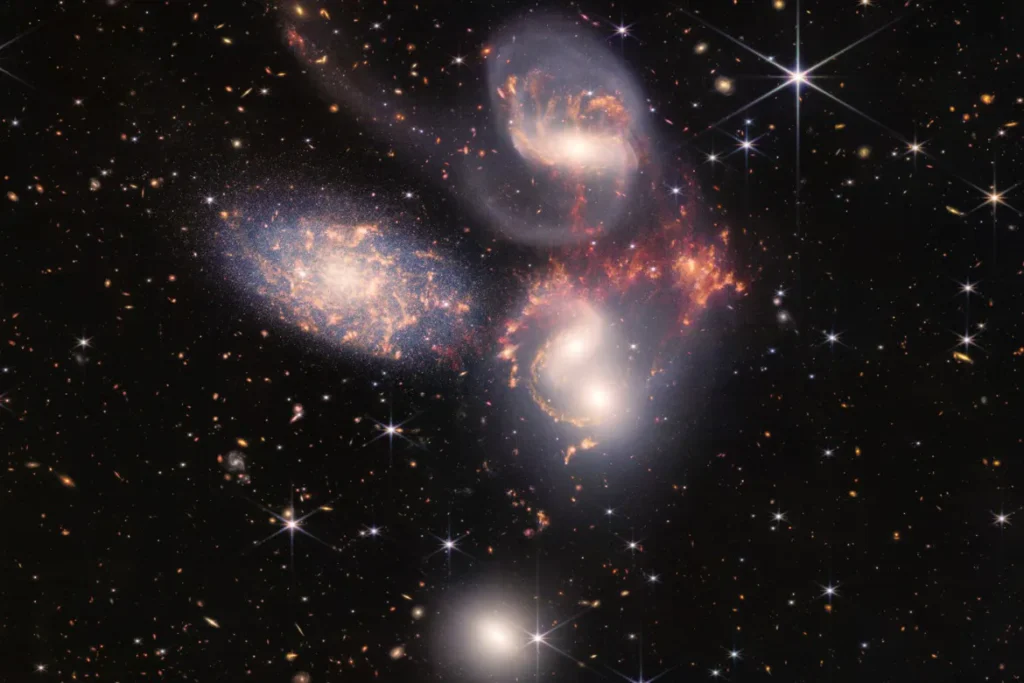
If the James Webb Space Telescope fails to detect these exceptionally luminous infant galaxies, then scientists may have to completely rethink their ideas about what dark matter is.
The scientists suggest that by finding or ruling out the existence of these potential "bright patches," the Webb telescope can provide critical insights into one of the biggest open mysteries in physics and cosmology.
3. Black Holes in the Early Universe
A focused effort is underway to uncover the mysteries of black holes in the early universe. This pursuit, aiming to understand the formation and influence of these enigmatic objects in cosmic evolution, could fundamentally alter our comprehension of celestial phenomena and the fabric of spacetime.
By studying the early universe, scientists hope to reveal how black holes, particularly those formed through direct collapse or as remnants of the first stars, contributed to galaxy formation, cosmic reionization, and the distribution of matter across the cosmos.
This research not only seeks to identify the nascent stages of black hole formation but also to better understand the mechanisms through which these cosmic predators shape their surroundings.
4. Expansion of the Universe and Dark Energy
The Dark Energy Survey's latest study, utilizing nearly 1,500 supernovae and advanced machine learning techniques, offers new support for the standard model of a universe undergoing accelerated expansion. This research marks a significant contribution to our understanding of dark energy, a mysterious force driving the acceleration of the universe's expansion.
Key figure
~1,500
supernovae analyzed in the Dark Energy Survey's latest study
By analyzing type Ia supernovae, which serve as cosmic distance markers, scientists have been able to probe the nature of dark energy and its effect on the universe more deeply than ever before.
The findings suggest that the overall density of dark energy in the universe is likely constant, reinforcing the current understanding of its role in cosmic evolution.
This study provides some of the strongest evidence yet for the accelerated expansion of the universe.
More On Cosmic Expansion

The Cosmic Expansion May Not Be Accelerating After All
A controversial finding by Korean cosmologists suggests that the expansion of the universe may be slowing down.
→
Fact Check: Claim-by-Claim Verification Verified
All claims verified: dark matter in cosmic filaments (Nature Astronomy), Dark Energy Survey supernovae analysis, JWST testing CDM theories.
Commentary
- Compilation post covering multiple recent cosmology results.
Fact-checked by Perplexity Sonar Pro on 2026-03-15