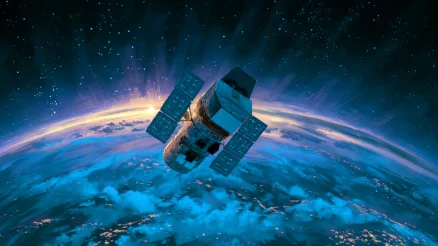
- Aerogel is up to 99.8% air yet insulates better than fiberglass
- Nanopores smaller than air's mean free path suppress heat transfer
- NASA used aerogel blankets on Mars rovers and the Stardust mission
Aerogel insulation properties describe the thermal characteristics of aerogels, ultralight synthetic solids composed of up to 99.8% air that achieve some of the lowest thermal conductivity values of any known material. A typical silica aerogel conducts heat at roughly 0.01 to 0.02 W/(m·K), two to three times lower than conventional fiberglass or polystyrene foam.
Why Aerogel Insulation Matters
Key figure
99.8%
Maximum air content by volume in silica aerogel
Few materials combine extreme lightness with extreme thermal resistance. Aerogels do both. Their insulation properties have made them essential in environments where weight and space are limited but heat management is not optional.
NASA relied on aerogel insulation blankets to protect electronics on the Mars Exploration Rovers, Spirit and Opportunity, from nighttime surface temperatures that drop below minus 80 °C. The same material lined components of the Stardust spacecraft, which used aerogel panels to capture comet dust particles traveling at six times the speed of a rifle bullet without destroying them.
On Earth, aerogel insulation properties matter most where thin profiles are required. A 10 mm aerogel blanket can match the thermal resistance of 30 mm of mineral wool, according to testing by the W. L. Gore research group. Building retrofits in historic structures, where wall cavities are too narrow for bulk insulation, increasingly rely on aerogel-based panels.
How Aerogel Insulation Works
Aerogel's thermal performance stems from its nanoporous structure. The material consists of a network of silicon dioxide (or other oxide) nanoparticles, typically 2 to 5 nanometers across, connected in an open framework. The pores between them average 20 to 40 nanometers in diameter.
That pore size matters. It is smaller than the mean free path of air molecules at atmospheric pressure (roughly 70 nanometers). When gas molecules cannot travel freely between pore walls, a phenomenon called the Knudsen effect suppresses gaseous conduction. Air trapped inside aerogel conducts heat less effectively than air in an open room.
Key figure
0.01 W/(mu00b7K)
Typical silica aerogel thermal conductivity
Aerogel insulation also limits heat transfer by conduction through its solid framework. The nanoparticle chains are so thin and tortuous that the path heat must follow through the solid phase is long relative to the material's thickness. Convection is effectively eliminated because the pore structure prevents any bulk movement of gas.
Radiation transfer remains the one channel that standard silica aerogels handle less well, particularly at temperatures above 200 °C. Industrial aerogel blankets often incorporate opacifiers (carbon black or titanium dioxide particles) to scatter infrared radiation and extend the material's useful temperature range.
Key Context
American chemist Samuel Kistler created the first aerogel in 1931, reportedly after a bet with colleague Charles Learned over whether the liquid inside a gel could be replaced with gas without collapsing the structure. Kistler's solution, supercritical drying, removed the liquid by converting it to a supercritical fluid that exerts no surface tension on the gel network. The technique he published in the journal Nature remains the conceptual basis for aerogel production today.
A silica aerogel produced at NASA's Jet Propulsion Laboratory held the Guinness World Record for lowest-density solid at 3 mg/cm³, roughly three times the density of air. Commercial insulation-grade aerogels are denser (typically 100 to 200 kg/m³) because they are reinforced with fiber matrices for mechanical strength, but they still weigh a fraction of equivalent insulating materials.
FAQ
Is aerogel the best insulator available?
Aerogel ranks among the best solid insulators, with thermal conductivity as low as 0.01 W/(m·K). Vacuum insulation panels can achieve even lower values, but they lose performance if punctured. Aerogel maintains its insulation properties even when cut or shaped, which makes it more practical for many applications.
Why is aerogel called frozen smoke?
The nickname comes from aerogel's translucent, bluish appearance and near-weightless feel. Silica aerogel scatters short-wavelength light (Rayleigh scattering), giving it a hazy, smoke-like look. It is sometimes also called solid air or solid smoke.
Can aerogel be used in home insulation?
Yes. Aerogel insulation blankets and panels are commercially available for residential use. They are especially useful in retrofit projects where wall cavities are too narrow for conventional insulation. The main barrier is cost: aerogel insulation typically costs five to ten times more per square meter than fiberglass batts.
How is aerogel different from Styrofoam?
Both are lightweight and porous, but aerogel's pores are nanometer-scale (20 to 40 nm), while Styrofoam's are millimeter-scale. The nanopores in aerogel are smaller than the mean free path of air molecules, which suppresses gas-phase heat conduction through the Knudsen effect. This gives aerogel two to four times the insulating power per unit thickness.
Sources
- Primary Sources:
- Aerogel: Density, Heat Capacity, Thermal Conductivity (Material Properties)
- Thermal Conductivity of Aerogel (Thermtest Instruments)
- Additional Context:
- Aerogel (Wikipedia)
- Thermal Insulation Performance of Aerogel Nano-Porous Materials (PMC, 2023)
- Aerogel Insulation for Improved Thermal Protection (Gore)

Fact Check: Claim-by-Claim Verification Verified
All major claims verified against authoritative sources. One density figure (originally 1.9 mg/cm3) was corrected to 3 mg/cm3 based on the actual JPL Guinness record.
Sources used for verification
- Thermal Conductivity of Aerogel - thermtest.com
- Aerogel Properties - material-properties.org
- APS History: First Aerogel - aps.org
- JPL Aerogel Record - jpl.nasa.gov
- Aerogel Nano-Porous Materials Review - PMC