


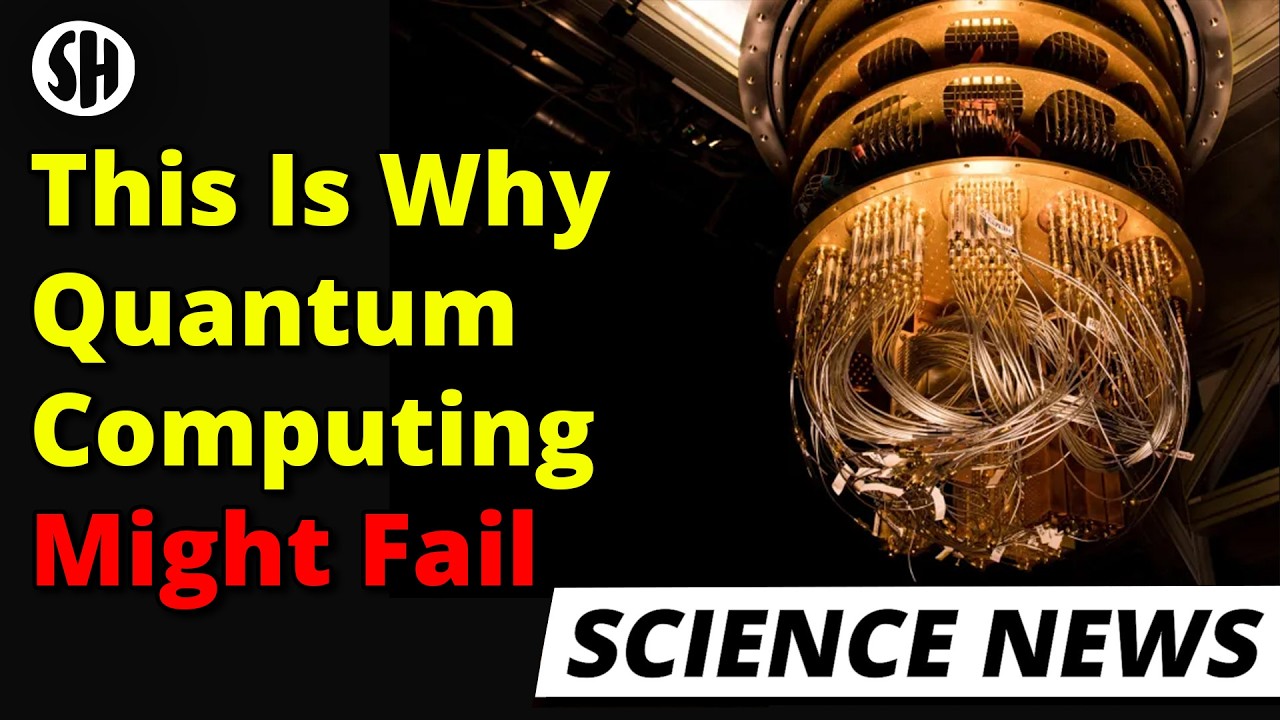

- Quantum computers have never been tested at the scale needed for useful computation.
- Physicists like Gil Kalai argue unavoidable noise will cancel any quantum advantage.
- Some models predict a million-qubit machine would decohere in just one millisecond.
Quantum computers have attracted billions in investment with promises of revolutionary computing power.
But physicist Sabine Hossenfelder reveals an uncomfortable truth: a small group of credentialed scientists believes these machines will never deliver.
The skepticism runs deeper than typical technical challenges.
Key figure
1 millisecond
predicted decoherence time for a quantum computer with one million superconducting qubits
The Untested Territory Problem
Hossenfelder explains the core issue with striking clarity. "We have no evidence that quantum computers will indeed work as quantum physics predicts. This is untested territory," she notes in her latest video.
The problem is scale.
We have no evidence that quantum computers will indeed work as quantum physics predicts.
Sabine Hossenfelder, Physicist
Current quantum computers work with tiny prototype versions using quantum bits that rely heavily on entanglement. But we've never measured such large amounts of entanglement before.
What we do know is troubling: when objects become larger, their quantum effects disappear.
And we don't understand why.
What is quantum decoherence?
Quantum decoherence is the process by which a quantum system loses its fragile quantum properties – such as superposition and entanglement – through interaction with its environment. Once a system decoheres, it behaves like an ordinary classical object. For quantum computers, keeping qubits coherent long enough to complete a calculation is the central engineering challenge, and skeptics argue it may become physically impossible at large scales.
The Scientific Skeptics
The critics aren't random voices.
Mathematician Gil Kalai argues that inevitable noise will prevent quantum computers from achieving true advantages over conventional machines.
Physics professor Robert Alicki contends that realistic noise modeling makes error correction impossible.
Leonid Levin takes it further, arguing that tiny disturbances from neutrinos or gravitational waves will make maintaining coherence impossible at the required precision.
Then there are physicists who question quantum mechanics itself.
Steven Wolfram believes the world is fundamentally discrete, making quantum advantages unlikely.
Gerard 't Hooft's cellular automaton theory suggests factoring numbers with millions of digits will remain impossible.
The Numbers Game
Tim Palmer's calculations are particularly sobering. He believes quantum physics must ultimately be discrete, limiting us to 500-1,000 logical qubits.
Most estimates put commercially interesting applications around 100-150 logical qubits. If Palmer is right, there's only a narrow window where quantum computers might work at all.
Spontaneous localization models predict even grimmer limits. A quantum computer with a million superconducting qubits would have a decoherence time of just one millisecond - potentially spoiling any practical computation.
Hossenfelder acknowledges this represents a small minority view. Most physicists dismiss such skepticism.
Most physicists dismiss such skepticism.
But she draws a crucial parallel: tectonic plate drift and jump theory were once fringe opinions that proved correct.
The quantum computing industry might be building on assumptions that don't hold at scale.
The stakes are enormous, with billions invested in technology that operates in genuinely untested territory.

Fact Check: Claim-by-Claim Verification Verified
The recap accurately summarizes the claims and quotes from Sabine Hossenfelder's YouTube video, with all key arguments, names, and skeptic positions matching the source transcript.
Commentary
- Skeptic views represent a minority, as acknowledged in both recap and source; mainstream physicists expect scalable quantum computers.
- Spontaneous localization refers to speculative objective collapse models, appropriately presented as predictions rather than established fact.
Sources used for verification
Academic/Peer-reviewed:
- Testing Quantum Mechanics with Quantum Computers: Qubit Information Capacity - arXiv
- Quantum error correction fails for Hamiltonian models - arXiv
- The Argument Against Quantum Computers - Quanta Magazine
Other reliable sources:
Fact-checked by Perplexity Sonar Pro on 2026-01-06


