


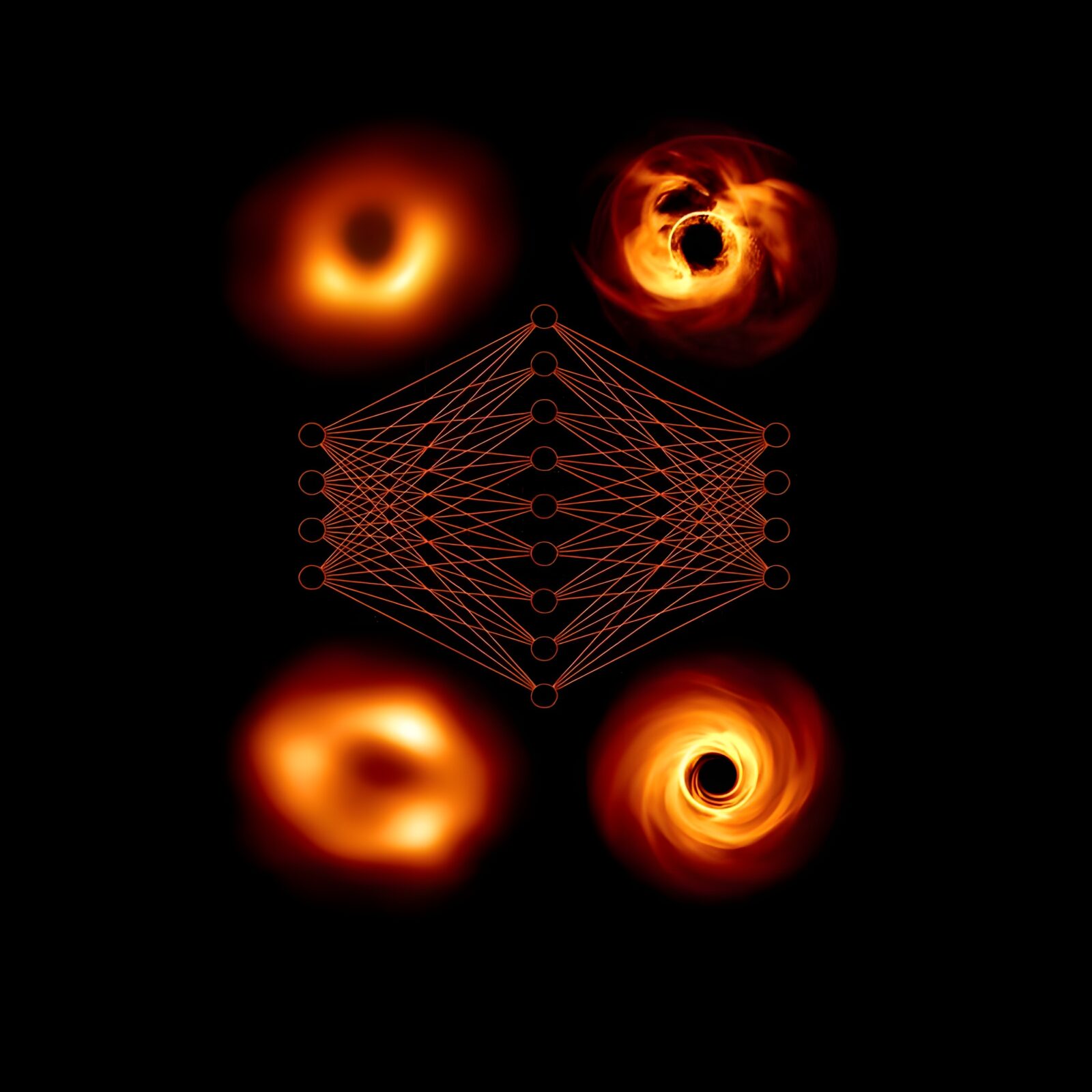

- Sagittarius A* spins at 0.8–0.9 of its theoretical maximum speed.
- A neural network trained on millions of simulated black holes made this measurement possible.
- Radiation near the black hole comes from the accretion disk, not a polar jet.
Michael Janssen had a problem most astrophysicists would envy.
The Event Horizon Telescope had captured images of two supermassive black holes, but the data behind those famous pictures contained patterns too complex for conventional analysis. His solution: train an artificial intelligence on millions of simulated black holes until it learned to see what humans couldn't.
The results, published in Astronomy & Astrophysics, suggest that Sagittarius A*, the black hole at our galaxy's center, spins at nearly maximum velocity.
Its rotation axis points almost directly toward Earth.
Key figure
Millions
synthetic black hole datasets used for training, versus a handful in previous EHT analyses
Previous Analyses Used a Handful of Models
The Radboud University astrophysicist and his international team developed ZINGULARITY, a neural network framework that processes telescope measurements directly. Earlier EHT studies compared observations against only a handful of simulated scenarios. This approach compared them against millions.
What is a Bayesian neural network?
Unlike standard AI that outputs a single answer, Bayesian neural networks report a range of likely answers with uncertainty estimates. When the sky is variable and telescopes capture only brief snapshots, knowing the confidence level matters as much as the prediction itself.
The computational scale required coordinated resources across multiple institutions. CyVerse handled data storage. The OSG OS Pool distributed calculations across thousands of computers. Germany's Max Planck Computing Facility trained the neural networks.
"You need storage capacity, a supercomputer, a software pipeline, and a program that distributes the work," notes co-researcher Jordy Davelaar of Princeton University.
The Black Hole Spin Findings Defy Expectations
ZINGULARITY's analysis points to a spin parameter between 0.8 and 0.9, where 1.0 represents the theoretical maximum for a rotating black hole.
The network also determined that the intense radiation near Sagittarius A* comes primarily from superheated electrons in the surrounding accretion disk. This contradicts models predicting a powerful jet of material shooting from the black hole's poles.
Perhaps more intriguing: the magnetic fields in the accretion disk behave differently than standard theories predict.
That we are defying the prevailing theory is of course exciting.
Michael Janssen, Astrophysicist, Radboud University and Max Plank Institute
Not everyone is convinced. Reinhard Genzel, who won the 2020 Nobel Prize in Physics for his work on Sagittarius A*, expressed caution about the methodology.
"I'm very sympathetic and interested in what they're doing," he told Live Science. "But artificial intelligence is not a miracle cure."
Why Black Hole Spin Direction Matters for Physics
A fast-spinning black hole isn't merely a cosmic curiosity.
Spin determines how energy can be extracted from the hole's rotation and how particles accelerate near the event horizon. If confirmed, these findings constrain models of how matter falls into black holes and how jets form.
The team also analyzed M87*, the supermassive black hole at the center of galaxy M87. They found it spins rapidly but less extremely than Sagittarius A*.
Notably, M87* rotates in the opposite direction to its infalling gas. This could be the signature of a past galaxy merger.
Janssen views these results as a starting point.
The Africa Millimetre Telescope, currently under construction in Namibia, will add new baseline measurements to the EHT network.
The team projects this will reduce parameter uncertainties by a factor of three for certain models, enabling more stringent tests of general relativity.
Sources
- Primary Research: Deep learning inference with the Event Horizon Telescope III (Astronomy & Astrophysics, June 2025)
- Additional Context:
- Self-learning neural network cracks iconic black holes (Radboud University)
- Nobel laureate raises questions about AI-generated image (Live Science)

Fact Check: Claim-by-Claim Verification Verified
All major claims are accurately supported by the peer-reviewed research paper and reliable institutional sources; names, dates, institutions, and findings match primary sources.
Commentary
- The headline "spins near maximum speed" is appropriate for popular science communication; the peer-reviewed data states 0.8–0.9 on a 0–1 scale, which is accurately characterized as "near maximum"
- Genzel's cautious quote in the article reflects genuine scientific skepticism about AI methodology. This is appropriately balanced reporting, not an error
- The article appropriately hedges by noting findings "suggest" and "point to" rather than stating conclusively, matching the preliminary nature of parameter inference from observations
Sources used for verification
Academic/Peer-reviewed:
- Deep learning inference with the Event Horizon Telescope III - Astronomy & Astrophysics
- Deep learning inference with the Event Horizon Telescope II: Zingularity - arXiv
- The Nobel Prize in Physics 2020 - NobelPrize.org
Other reliable sources:
Fact-checked by Perplexity Sonar Pro on 2026-01-23


