
- Spinning black holes tear their accretion disks apart, feeding in months not centuries.
- Misaligned disks create nozzle shocks and streamers that drive rapid gas infall.
- Accretion runs 10 to 100 times faster than classical theory predicts.
Nick Kaaz was running one of the most demanding simulations in astrophysics when his accretion disk did something nobody expected. It tore itself apart.
Kaaz, a graduate student at Northwestern University, had set out to model how gas spirals into supermassive black holes. Classical theory said this process should take hundreds to hundreds of thousands of years. His simulation completed the cycle in months.
The study, published in The Astrophysical Journal, reveals that spinning black holes don't wait politely for their dinner. They twist the fabric of space-time itself, ripping apart the swirling disk of gas that feeds them.
What is an accretion disk?
An accretion disk is a flattened spiral of gas and debris that orbits a black hole before falling in. Think of water circling a drain, except the "drain" warps space and time around it. These disks power some of the brightest objects in the universe.
How Black Holes Tear Their Own Food Apart
Previous models assumed accretion disks were orderly structures. Gas particles would swirl in the same plane as the black hole's spin, gradually spiraling inward over centuries. The assumption seemed reasonable. It was also wrong.
Using Summit, one of the world's largest supercomputers, Kaaz and his team ran a 3D simulation that included something earlier models had ignored: misalignment. Real gas falling toward a black hole has no way of knowing which direction the black hole spins. Why would it line up perfectly?
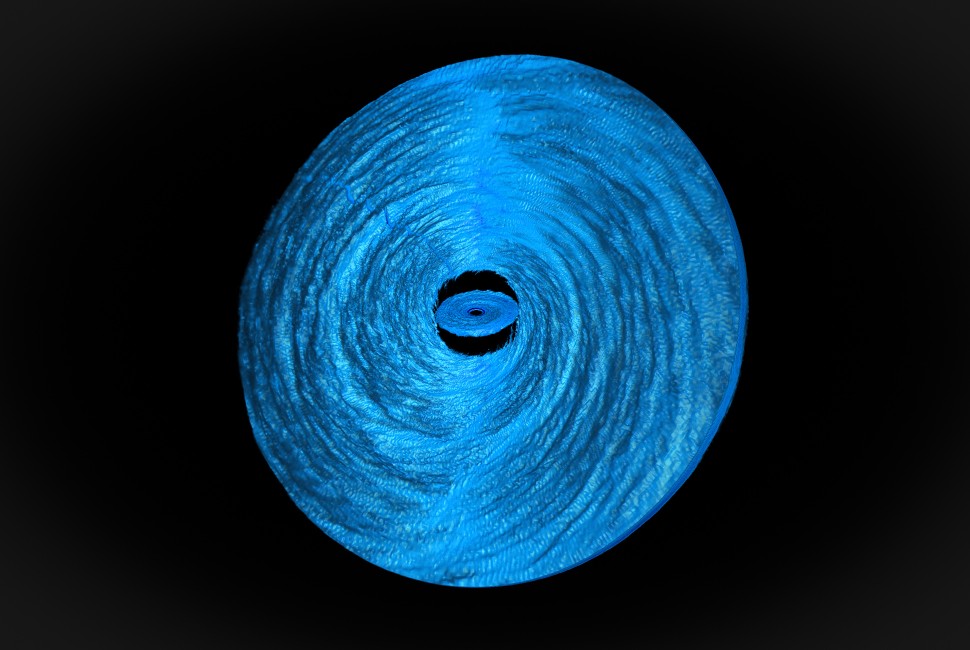
When a tilted disk encounters a spinning black hole, the consequences are violent. The black hole's rotation drags space-time along with it - a phenomenon called frame-dragging. This creates a tug-of-war between the inner and outer regions of the disk.
The Eat-Refill-Eat Cycle
The inner disk wants to wobble faster than the outer disk can follow. Eventually, the disk tears in two.
Once separated, the inner subdisk precesses independently - wobbling at its own speed and angle like wheels in a gyroscope. The black hole devours this inner ring. Then debris from the outer disk spills inward to refill the gap. The cycle repeats.
Kaaz's team identified two mechanisms driving this rapid feeding. First, the warped disk compresses and expands twice per orbit, creating "nozzle shocks" that dissipate energy and push material inward. Second, at the tearing point itself, colliding gas loses angular momentum and falls directly toward the black hole in streams they call "streamers."
Together, these processes drive accretion 10 to 100 times faster than classical theory predicts.
Key figure
10-100x
faster accretion than classical theory predicts
Solving the Quasar Puzzle
The finding offers a potential answer to one of astrophysics' persistent mysteries: changing-look quasars.
Quasars are the brightest objects in the universe, powered by supermassive black holes consuming enormous quantities of gas. Some quasars dramatically brighten and dim over mere months - far too fast for classical accretion theory to explain. Astronomers have struggled to account for this rapid variability.
The disk-tearing mechanism fits the observations. When the inner disk gets consumed, the quasar dims. When debris refills the gap, it brightens again.
The inner region of an accretion disk, where most of the brightness comes from, can totally disappear - really quickly over months
Nick Kaaz, Northwestern University
"Classical theory doesn't have any way to explain why it disappears in the first place, and it doesn't explain how it refills so quickly," says Kaaz.
What Comes Next
The team plans to test whether different disk thicknesses and tilt angles produce similar behavior.
If disk tearing proves general across different conditions, it would fundamentally change how astrophysicists model black hole feeding - and help explain why the universe's brightest objects flicker like candles in the cosmic wind.
Sources
- Primary Research: Kaaz, N., et al. (2023). Nozzle Shocks, Disk Tearing, and Streamers Drive Rapid Accretion in 3D GRMHD Simulations of Warped Thin Disks. The Astrophysical Journal, 955(1), 72.
- Additional Context:
- Black holes eat faster than previously expected (EurekAlert/Northwestern University)
- Black holes feed faster than previously expected (NSF)

Fact Check: Claim-by-Claim Verification Verified
The article accurately represents the research findings, correctly describing the disk-tearing mechanism, timescales, identified physical processes, and the connection to changing-look quasars.
Commentary
- The article appropriately simplifies the physics for a general audience while maintaining accuracy—the actual mechanism involves misalignment between disk and black hole spin (65° tilt in the simulation), but this complexity is introduced naturally in context
- The "eat-refill-eat cycle" terminology is Science Reader's own phrasing but accurately captures the recurring accretion-gap-refill pattern described in the research
- The article correctly hedges the quasar explanation as "potential" and "may explain," appropriate given the research demonstrates a mechanism that could explain observations rather than conclusive proof
- The study involved extreme-resolution 3D simulations of thin, highly warped disks around rapidly rotating black holes—the article appropriately conveys that this represents cutting-edge computational modeling without overstating generalizability
Sources used for verification
Academic/Peer-reviewed:
- Nozzle Shocks, Disk Tearing, and Streamers Drive Rapid Accretion in 3D GRMHD Simulations of Warped Thin Disks - The Astrophysical Journal
- Nozzle Shocks, Disk Tearing and Streamers Drive Rapid Accretion in 3D GRMHD Simulations of Warped Thin Disks - arXiv
- The first high-redshift changing-look quasars - Monthly Notices of the Royal Astronomical Society
Other reliable sources:
- Black holes feed faster than previously expected - NSF
- Black holes eat faster than previously expected - Northwestern University
Fact-checked by Perplexity Sonar Pro on 2026-01-12