




- Columbia physicists created the first Bose-Einstein condensate made from molecules.
- Microwave shielding made molecules repel each other, solving a 20-year collision problem.
- The molecular BEC contained about 200 sodium-cesium molecules cooled to five nanokelvin.
A Bose-Einstein condensate is a state of matter where particles cooled to near absolute zero merge into a single quantum entity. Physicists have made them from atoms for decades. Making one from molecules was supposed to be impossible.
Sebastian Will's lab at Columbia University did it anyway.
Key figure
5 nK
Temperature of the first molecular Bose-Einstein condensate – five nanokelvin, just above absolute zero
What Is a Bose-Einstein Condensate?
In 1924, physicists Satyendra Nath Bose and Albert Einstein predicted that particles cooled to near absolute zero would collapse into a shared quantum state – behaving not as individuals but as one giant atom.
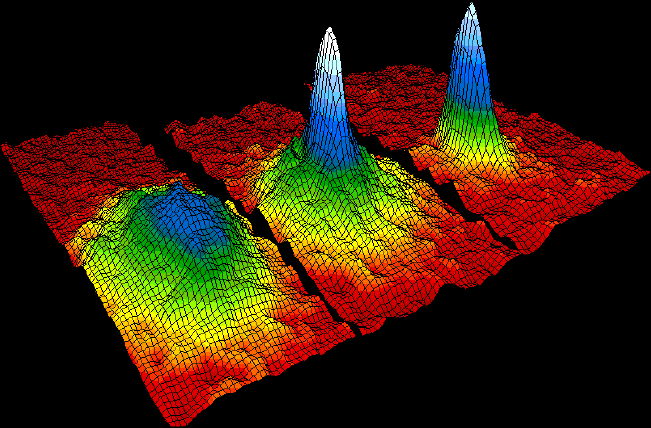
Velocity distribution of rubidium atoms showing Bose–Einstein condensate formation. Left: just before condensation. Center: just after. Right: nearly pure condensate after further evaporation. Image source: Wikipedia
It took 70 years to prove them right. The first atomic BECs were created in 1995, earning their creators the Nobel Prize in 2001.
A BEC is neither gas, liquid, nor solid. It's a fifth state of matter.
The Molecular Problem
Atomic BECs are relatively simple. But molecules have a problem: they react with each other. Cool them down, and they collide and stick together, destroying the sample before it can reach quantum temperatures.
For two decades, physicists tried to solve this. The molecules kept reacting.
The Microwave Solution
Will's team used microwaves – the same radiation that heats your food – to create shields around sodium-cesium molecules. The microwave field makes the molecules spin, and spinning molecules repel each other instead of colliding.
What is microwave shielding?
Microwave shielding is a technique that bathes ultracold molecules in a carefully tuned microwave field, causing them to spin in a way that creates a repulsive barrier around each molecule. This prevents the molecules from getting close enough to react with one another. Without this shield, molecules collide and stick together before they can reach the temperatures needed to form a condensate.
The trick required building a custom antenna. Two antennas, in fact. The first reduced two-body collisions by a factor of 200. The second eliminated the three-body collisions that appeared once two-body losses were suppressed.
"By controlling these dipolar interactions, we hope to create new quantum states and phases of matter," said co-author Ian Stevenson.
We've reached an exciting milestone, but it's just the kick-off.
Five Nanokelvin
The result: a Bose-Einstein condensate of about 200 sodium-cesium molecules, cooled to five nanokelvin, roughly -459.66°F. It lasted 1.8 seconds.
That's long enough to test decades of theoretical predictions.
"Molecular Bose-Einstein condensates open up whole new areas of research, from understanding truly fundamental physics to advancing powerful quantum simulations," said Will.
"We've reached an exciting milestone, but it's just the kick-off."
Sources
- Bigagli, N., et al. (2024). Observation of Bose-Einstein Condensation of Dipolar Molecules. Nature, 631, 289–293. https://doi.org/10.1038/s41586-024-07492-z
- Columbia News (June 3, 2024). The Coldest Lab in New York Has a New Quantum Offering. https://news.columbia.edu/news/coldest-lab-new-york-has-new-quantum-offering

Fact Check: Claim-by-Claim Verification Verified
The recap accurately represents the source article and peer-reviewed paper with correct details on the achievement, methods, and quotes.
Commentary
- Article simplifies temperature to "five nanokelvin" from paper's 6(2) nK measurement, acceptable for popular science.
- Calls BEC a "fifth state of matter," common phrasing despite plasma as fourth; aligns with source's "unique state of matter."
Sources used for verification
Fact-checked by Perplexity Sonar Pro on 2025-12-18


