



- Brains compute via hybrid, scale-inseparable, metabolically grounded processes unlike digital computers.
- In biological systems, the algorithm is the physical substrate — they cannot be cleanly separated.
- Scaling digital AI may not produce consciousness if it relies on the wrong computational style.
Right now, the debate about consciousness feels stuck. One side says cognition is just abstract information processing. Get the right functional organization, and consciousness emerges, regardless of what material runs it.
The other insists biology isn't just a vehicle for mind; it's inseparable from what mind actually is.
A new paper in Neuroscience & Biobehavioral Reviews offers a third path that might break the stalemate: biological computationalism.
What is biological computationalism?
Biological computationalism is the theory that brains compute in a fundamentally different way from digital computers – through hybrid, scale-inseparable, and energy-constrained processes where the physical substrate and the algorithm are one and the same. It argues that mind-like computation cannot be separated from the specific physical organization that produces it.
The framework argues that brains don't compute like conventional computers at all. If we want to build synthetic consciousness, we need to stop treating them as though they do.
Key figure
3
properties that set biological computation apart from conventional computing
What Makes Biological Computation Different
The researchers identify three properties that set brains apart from traditional computing.
First, biological computation is hybrid. Neurons spike in discrete events, but those spikes emerge from continuous dynamics–evolving voltage fields, chemical gradients, ionic diffusion.
The brain isn't digital or analog. It's both at once, in constant feedback.
Second, it's scale-inseparable. In conventional computing, you can cleanly separate software from hardware. In brains, there's no such boundary. Ion channels influence circuits, circuits shape whole-brain dynamics, and changing one level reshapes the others. The algorithm is entangled with its physical substrate at every scale.
Third, biological computation is metabolically grounded. The brain operates under severe energy constraints, and that shapes everything–what it can represent, how it learns, which dynamics remain stable. This isn't a footnote. It's an optimization strategy that makes robust intelligence possible within tight limits.
The Algorithm Is the Substrate
These properties lead to an uncomfortable conclusion for anyone used to thinking in classical computational terms: in brains, the algorithm is the substrate. The physical organization doesn't just support computation–it constitutes it.
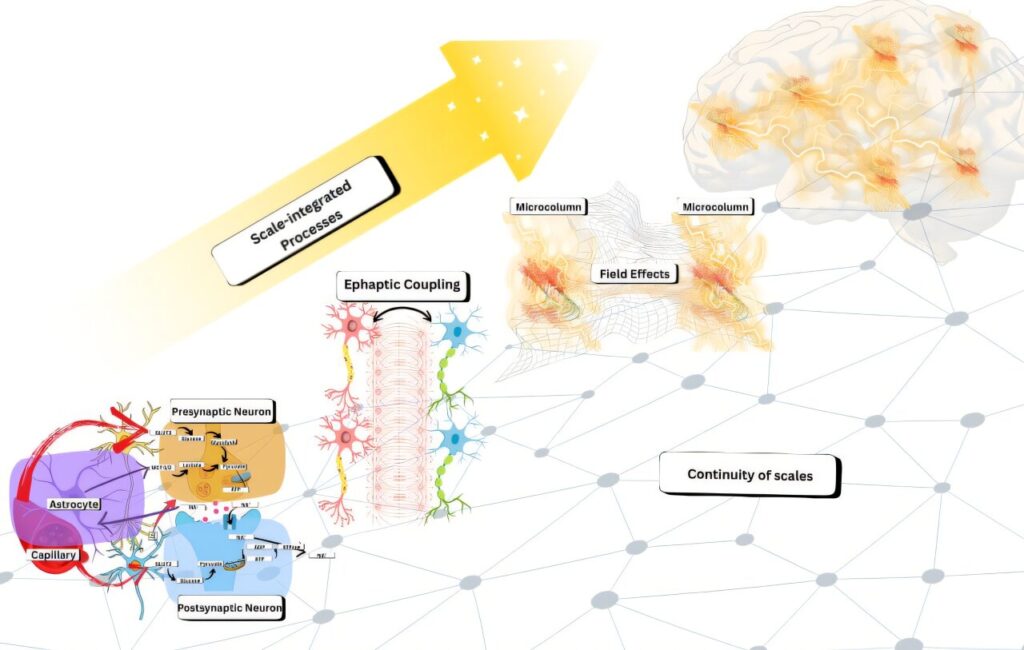
Brains don't run programs. They are a specific kind of physical process that performs computation by unfolding in time. Continuous fields, ion flows, dendritic integration, and electromagnetic interactions aren't biological details you can ignore while extracting an abstract algorithm. They're the computational primitives of the system.
This reframes how we should think about current AI. Today's systems simulate functions–they approximate input-output mappings, often impressively, but the computation remains a digital procedure executed on hardware designed for a different computational style entirely. Brains instantiate computation in physical time, and that difference matters.
What This Means for Synthetic Consciousness
The researchers aren't claiming consciousness is exclusive to carbon-based life. Their argument is more specific: if consciousness depends on this kind of computation, then it may require biological-style computational organization–even if implemented in new substrates.
The crucial question isn't whether the substrate is literally biological, but whether the system instantiates hybrid, scale-inseparable, energetically grounded computation. That shifts the target for anyone building synthetic minds.
Scaling digital AI alone may not be sufficient. Not because digital systems can't become more capable, but because we might be optimizing the wrong thing–improving algorithms while leaving the underlying computational ontology untouched.
To engineer genuinely mind-like systems, we may need to build new kinds of physical machines: systems where computing isn't layered neatly into software on hardware, but distributed across levels, dynamically coupled, and grounded in the constraints of real-time physics and energy.
The problem isn't "What algorithm should we run?" It's "What kind of physical system must exist for that algorithm to be inseparable from its own dynamics?"
That's the shift biological computationalism demands: moving from a search for the right program to a search for the right kind of computing matter.

Fact Check: Claim-by-Claim Verification Verified
The recap accurately represents the source press release, which itself summarizes the key claims from the original paper on biological computationalism.
Commentary
- The recap uses punchy phrasing like "Brains Don't Run Software—They Are the Algorithm," which is interpretive but aligns with source's core idea that "the algorithm is the substrate."
- Source is a press release; full peer-reviewed paper confirms matching content via abstracts and previews, though direct access limited.
Sources used for verification
Academic/Peer-reviewed:
- On biological and artificial consciousness: A case for biological computationalism - PubMed
- On biological and artificial consciousness: A case for biological computationalism - ScienceDirect
Other reliable sources:
- A new theory of biological computation might explain consciousness - EurekAlert.org
- Consciousness May Require a New Kind of Computation - NeuroscienceNews.com
- A third path to explain consciousness: Biological computationalism - Phys.org
Fact-checked by Perplexity Sonar Pro on 2025-12-24


