Extremophile: Life That Thrives in Earth's Harshest Environments
An extremophile is an organism that thrives in conditions lethal to most life, including extreme heat, acidity, salinity, and pressure.


57 glossary terms
Biology and life sciences cover everything from the molecular machinery inside a single cell to the evolutionary forces that shape whole ecosystems. The terms in this section span genetics, anatomy, microbiology, ecology, and the frontier where biology meets chemistry and computation. Some are classroom staples like the double helix or photosynthesis. Others capture ideas you may never have encountered, from horizontal gene transfer to zygotic gene activation. Together they form the vocabulary scientists use to describe how life works, how it began, and how it continues to surprise us.
An extremophile is an organism that thrives in conditions lethal to most life, including extreme heat, acidity, salinity, and pressure.
Fossilization is the set of physical and chemical processes preserving organisms in Earth's crust, typically within sedimentary rock.
The founder effect is a type of genetic drift in which a small group separates from a larger population and establishes a new colony with reduced genetic variation.
CRISPR gene editing is a molecular biology technique that uses a bacterial protein called Cas9, directed by guide RNA, to alter specific DNA sequences in living organisms.
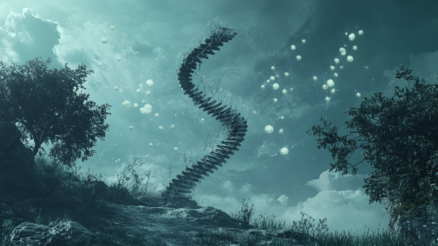
The double helix is the twisted-ladder shape formed by two strands of DNA wound around each other, encoding genetic instructions for all living organisms.
Capillary action is the movement of a liquid through narrow spaces against gravity, driven by adhesion, cohesion, and surface tension. In plants, it draws water upward through the xylem.
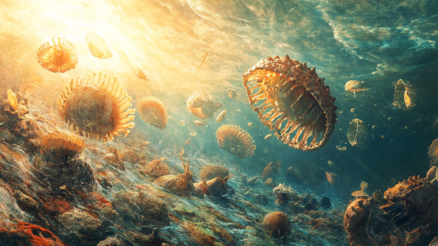
The Cambrian Explosion is the rapid diversification of animal life that began approximately 538.8 million years ago, producing most major animal body plans within roughly 13 to 25 million years.
The bottleneck effect is a form of genetic drift in which a population's size drops sharply, leaving survivors with only a fraction of the original genetic variation.
A base pair mutation is a change in one or more nucleotide bases within a DNA sequence, affecting gene function and shaping both disease and evolution.
Bacterial conjugation is the transfer of genetic material from one bacterial cell to another through direct physical contact, typically mediated by a hair-like structure called a pilus.