


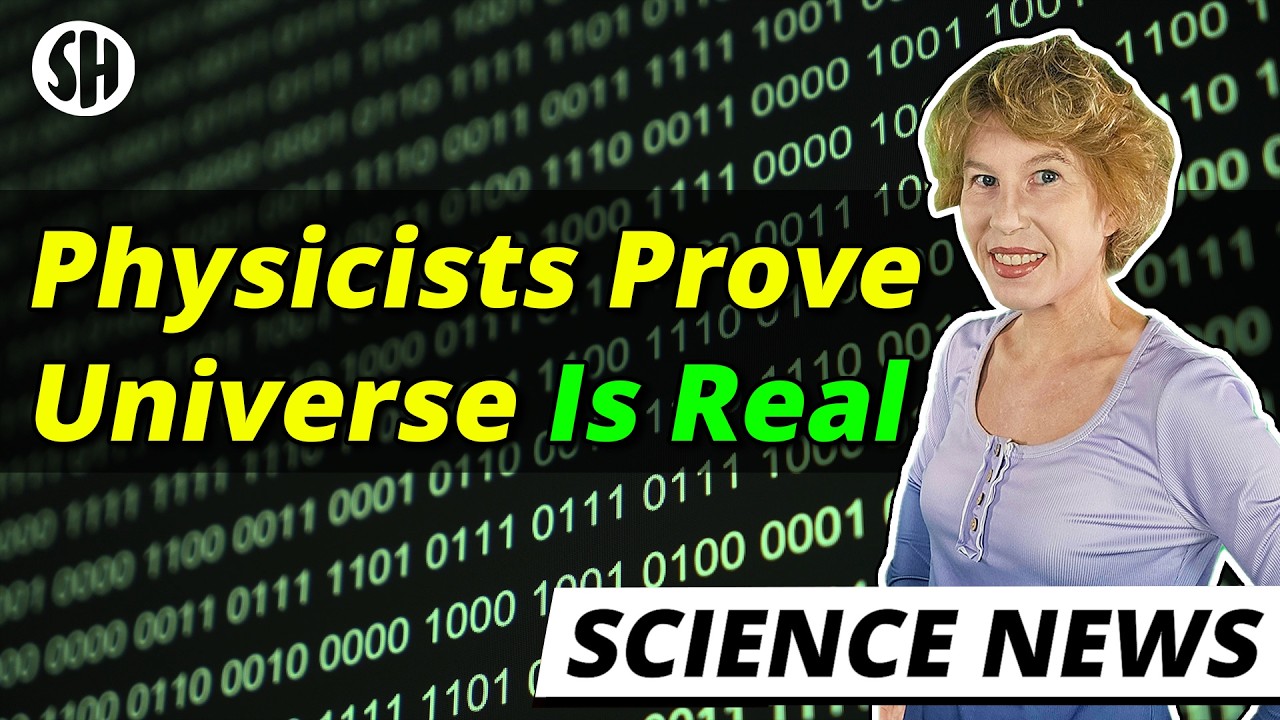

- Gödel's incompleteness theorems show some truths lie beyond any algorithm's reach.
- Any simulation is algorithmic, so it cannot fully describe physical reality.
- The argument targets the simulation hypothesis specifically, not the nature of reality broadly.
Mir Faizal was applying mathematical logic to quantum gravity when he realized something unexpected. The simulation hypothesis, long dismissed as untestable philosophy, might actually have a mathematical answer.
Faizal, an adjunct professor at UBC Okanagan, led a team that includes physicist Lawrence Krauss. Their paper argues that the universe cannot be a simulation because reality contains truths that no algorithm can reach.
The argument rests on Kurt Godel's incompleteness theorems from 1931.
Key figure
1931
The year when Godel proved that some truths cannot be proven by any logical system
What Godel Proved About Logic
Godel showed that any consistent mathematical system contains statements that are true but cannot be proven within that system. These "Godelian truths" exist beyond the reach of step-by-step logical operations.
The team applied this principle to quantum gravity, where physicists believe space and time emerge from deeper structures of information.
What is non-algorithmic understanding?
Computers follow instructions step by step. Non-algorithmic understanding grasps truths that no sequence of logical steps can reach. Godel proved such truths exist within any sufficiently complex mathematical system.
The Simulation Problem
Any computer simulation must follow programmed rules. It processes inputs through algorithms to generate outputs.
But Faizal's team demonstrated that a complete description of reality requires what they call "non-algorithmic understanding." Some aspects of physical reality remain computationally undecidable.
"We have demonstrated that it is impossible to describe all aspects of physical reality using a computational theory of quantum gravity," Faizal explains.

It is impossible to have a complete algorithmic description of the universe. Therefor our universe can't be a simulation. (Science Reader)
Why This Matters for Physics
The simulation hypothesis, popularized by philosopher Nick Bostrom in 2003, suggested that advanced civilizations might create simulated universes. If such simulations were possible, the argument went, we would likely be living in one.
Krauss, known for his work on cosmology, frames the finding in terms of fundamental physics. The laws of physics cannot be contained within space and time because they generate space and time.
The paper does not claim to prove the universe is "real" in some philosophical sense. It argues specifically that the universe cannot be a simulation because simulations are inherently algorithmic.
Critics may note that the argument depends on applying pure mathematical theorems to physical reality. Whether Godel's results about formal systems translate directly to physics remains debated among philosophers.
Still, the work represents a shift. The simulation hypothesis moved from philosophy to mathematics.
Sources
- Primary Research: Consequences of Undecidability in Physics on the Theory of Everything (arXiv, July 2025)
- Additional Context:
- UBCO study debunks the idea that the universe is a computer simulation (UBC Okanagan News)
- Physicists prove the Universe isn't a simulation after all (ScienceDaily)

Fact Check: Claim-by-Claim Verification Verified
The Science Reader article accurately represents the claims, authors, affiliations, arguments, and quotes from the primary arXiv paper and UBC press release.
Commentary
- Article appropriately notes critics may debate applying formal math theorems directly to physics, reflecting ongoing philosophical discussion.
- Source YouTube likely covers the same UBC press release content, but primary paper and institutional release confirm accuracy.
Sources used for verification
Academic/Peer-reviewed:
Other reliable sources:
Fact-checked by Perplexity Sonar Pro on 2026-01-27


