


- A small subset of immune cells actively prevents the body from attacking itself.
- Shimon Sakaguchi identified regulatory T cells in 1995, overturning the central-tolerance consensus.
- Mary Brunkow and Fred Ramsdell found that FOXP3 mutations cause fatal autoimmunity in mice and humans.
Mary Brunkow was studying a sickly mouse strain at a Seattle biotech company when she traced their fatal immune system disorder to a two-base-pair deletion in an uncharacterized gene. She named it FOXP3.
That gene would become the molecular key to understanding regulatory t cells - the reason why most people never develop serious autoimmune diseases.
The 2025 Nobel Prize in Physiology or Medicine goes to Brunkow, Fred Ramsdell, and Shimon Sakaguchi for discovering how peripheral immune tolerance prevents the immune system from harming healthy tissue.
Their work revealed that immune regulation extends far beyond what scientists previously understood.
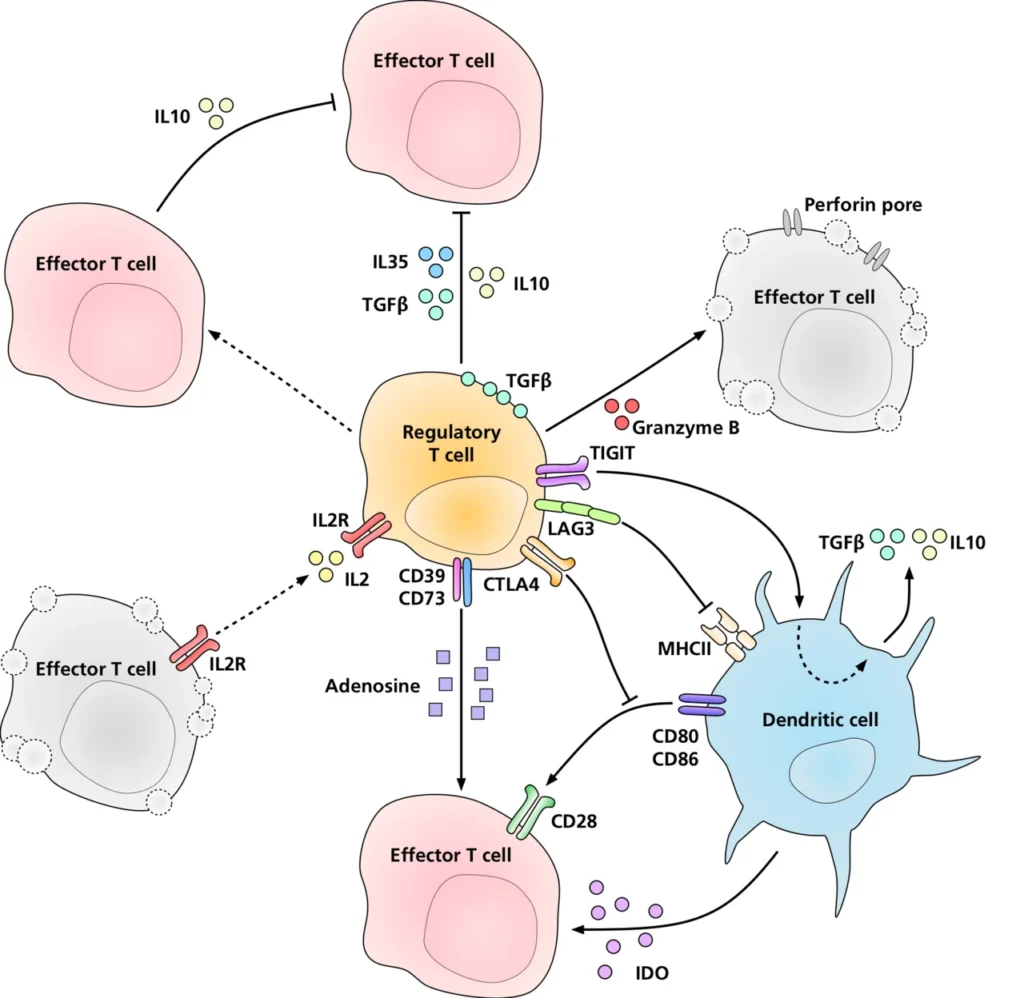
The immune system's secret guards at work: regulatory T cells use several tactics to keep effector T cells in check. Credit: Gwilz, CC BY-SA 4.0 via Wikimedia Commons
Key figure
5-10%
Fraction of CD4+ T cells that are regulatory T cells, yet this small population controls immune self-tolerance throughout the body
The Discovery That Changed Immunology
In 1995, the scientific consensus held that immune tolerance developed primarily through central tolerance. This process eliminates potentially harmful immune cells in the thymus before they can cause damage.
Shimon Sakaguchi at Osaka University challenged this view.
His research identified a previously unknown class of immune cells that actively prevent autoimmune diseases throughout the body. He named them regulatory T cells.
What is peripheral tolerance?
Central tolerance trains immune cells in the thymus to recognize "self" before they enter the bloodstream. Peripheral tolerance is a second layer of protection: specialized cells patrolling tissues and suppressing any immune responses that target the body's own cells.
These regulatory T cells function as monitors within the immune system. They patrol tissues and suppress immune responses that target the body's own cells.
A Mouse Strain Reveals the Master Switch
Many researchers were skeptical of Sakaguchi's regulatory T cells.
They wanted more proof before accepting his discovery.
Key evidence came from an unexpected source. At Darwin Molecular in Seattle, Brunkow and Ramsdell were studying a mouse strain that had emerged from Cold War radiation experiments at Oak Ridge National Laboratory.
The male mice developed scaly skin, enlarged spleens, and lived only weeks.
In 2001, the pair identified the genetic culprit: a mutation in what they named the FOXP3 gene.
They also showed that mutations in the human equivalent cause IPEX syndrome, a devastating pediatric autoimmune disorder.
Two years later, Sakaguchi connected these findings. He proved that FOXP3 controls the development of the regulatory T cells he had discovered in 1995.
It was an awesome time and an awesome team. We knew we were doing something important.
Mary Brunkow, reflecting on the FOXP3 discovery at ISB
Why This Changes Medicine
The laureates' work launched a new field.
Understanding how regulatory T cells operate has enabled fresh approaches to treating cancer and autoimmune diseases.
In cancer, tumors recruit regulatory T cells to suppress anti-tumor immunity. Therapies informed by this pathway aim to release those brakes so the immune system can attack cancer.
For autoimmune diseases and transplantation, the opposite strategy applies: boost regulatory T cells to promote tolerance. Several treatments based on these discoveries are now in clinical trials.
What remains to be determined is how these regulatory mechanisms can be precisely controlled to treat specific diseases without compromising overall immune function.

Sources
- Primary: Nobel Prize Press Release (Nobel Assembly at Karolinska Institutet)
- Additional Context:
- ISB Nobel Prize coverage (Institute for Systems Biology)
- The 2025 Nobel Prize in Medicine - a bridge to peripheral immune tolerance (PMC)
- Nobel Prize in Physiology or Medicine 2025 (Nature collection)

Fact Check: Claim-by-Claim Verification Verified
Limits and uncertainties
All major historical and scientific claims are strongly supported by the official Nobel press release and popular science background, peer-reviewed editorial in J Clin Invest, and institutional release from ISB. Claims on therapeutic implications (Treg modulation for cancer/autoimmunity/transplants in trials) match Nobel statements exactly. The 5-10% figure is a minor approximation; Tregs are ~5-10% of CD4+ T cells depending on tissue/site. Readers should note the field has advanced since 2003 with clinical trials ongoing, but core discovery is foundational and undisputed. No reliance on secondary journalism alone; prioritized Nobel primary sources.
Bottom line
The article accurately summarizes the 2025 Nobel discoveries on regulatory T cells and FOXP3 with no significant errors. It reliably conveys the science for general readers.
Fact-checked by Perplexity Sonar Pro on 2026-01-23


