



Updated March 29, 2026
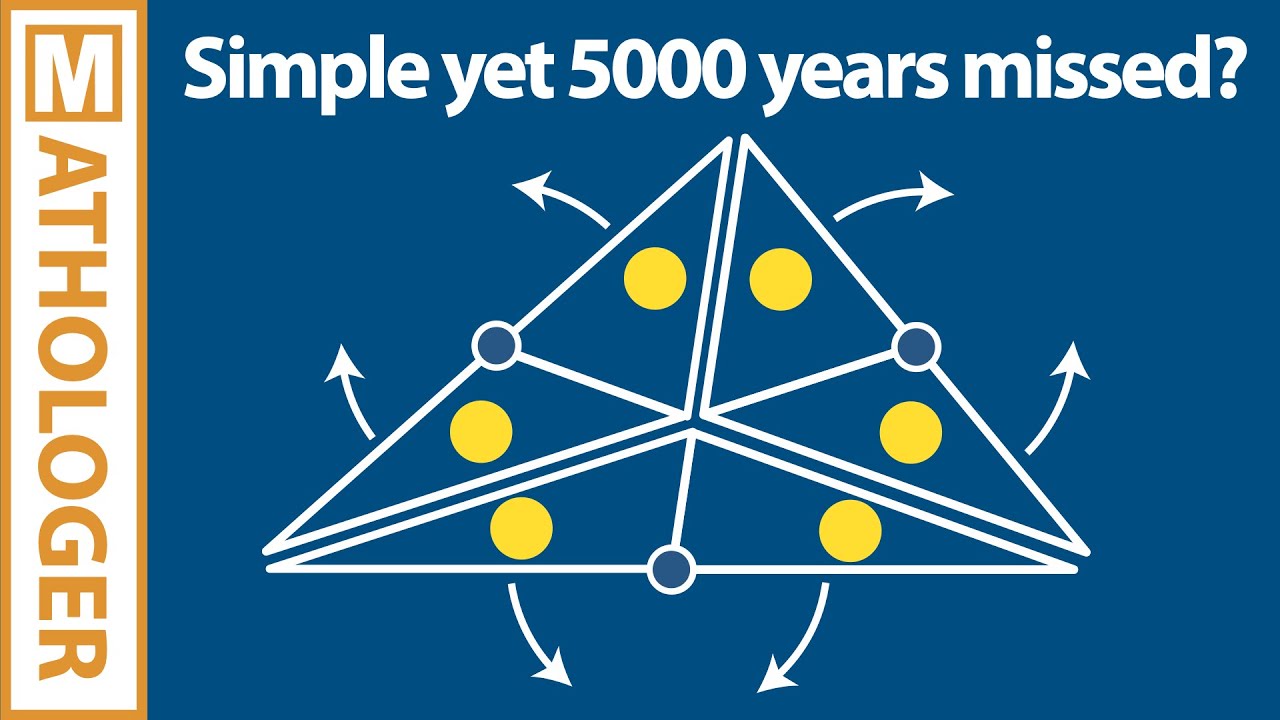
- Every triangle contains three hidden congruent triangles formed by folding median sub-triangles.
- Self-taught mathematician Lee Sallows published the proof in a single page in 2014.
- The result follows from the centroid's 2:1 property known for centuries.
Lee Sallows left school at seventeen without diplomas. He taught himself electronics, moved to the Netherlands, and worked for decades as an engineer at Radboud University Nijmegen, spending his spare hours playing with numbers and shapes. He invented golygons, devised geomagic squares, and published occasionally in recreational mathematics journals.
Colleagues knew him as someone drawn to the elementary. Where trained mathematicians chased deep abstractions, Sallows lingered over simple objects, turning them in his hands, looking for what had been overlooked. Triangles, as it turned out, still had something to say.
In 2014, five years into retirement, he published a one-page paper in Mathematics Magazine that made geometers pause.
Triangle Median Properties Everyone Overlooked
Every triangle has three medians, the lines connecting each vertex to the midpoint of the opposite side. They meet at a single point, the centroid, which divides each median in a 2:1 ratio.
The six smaller triangles formed by those medians all share the same area. These properties appear in every geometry textbook.
Medians and the Centroid
The three medians of a triangle always intersect at a single point called the centroid, which sits two-thirds of the way along each median from vertex to midpoint. The six sub-triangles created by the medians have equal areas, a fact known for centuries.
Students learn them, apply them, move on. Mathematicians have studied triangle geometry for centuries, and the topic felt thoroughly explored.
Sallows noticed something everyone else had missed.
Three Identical Triangles, Hiding in Plain Sight
Take any neighboring pair of those six sub-triangles, two that share a median edge. Rotate the pair around their shared midpoint until the two triangles close up into one. The result is a single, larger triangle.
Key figure
3
The number of congruent triangles concealed inside every triangle, one for each pair of neighboring sub-triangles folded at the median midpoint
Here is the remarkable part. Do this for all three pairs and you get three triangles that are perfectly congruent, identical in shape and size. The starting triangle could be scalene, isosceles, anything.
The three folded triangles always match. Sallows proved it in a single page.
And so it really is still possible even today after thousands of years of triangle spotting to discover new simple and beautiful mathematics in this area.
Burkard Polster, Monash University
Folding as a Mirror
Burkard Polster, a mathematician at Monash University who runs the Mathologer YouTube channel, later offered his own elegant visual proofs. The result, he showed, follows almost directly from the centroid's 2:1 property. No advanced tools required. The ingredients had been sitting there for centuries, apparently waiting for someone to try.
The operation Sallows described, this "folding," turns out to be something precise: an inversion with scaling. Fold the three congruent triangles again and you produce a triangle similar to the original, with one-ninth the area.
Fold again, one-eighty-first. The process nests inward indefinitely, each iteration a smaller echo of the starting shape.
Some special cases sharpen the picture. An isosceles triangle folds to an isosceles triangle. An equilateral folds to an equilateral.
But a right triangle does not fold to a right triangle, a small asymmetry in an otherwise tidy pattern.
The Amateur's Eye
The theorem is uncontested. It is proven geometry, published and verified. The surprise is sociological: how did generations of professional geometers, working with the same definitions and the same diagrams, not see this?
One possibility is that expertise creates channels. Trained mathematicians approach medians with particular questions, typically about ratios, areas, and centroids. Sallows, self-taught and unconstrained by disciplinary habit, simply tried something no one had tried.
He folded.
More On Geometry

Quantum Metric: Hidden Geometry Warps Electrons Like Gravity Bends Light
Quantum metric was pure math for 20 years. Now it's real in everyday materials.
→His career suggests a pattern. Golygons, geomagic squares, and now this: Sallows gravitates toward structures that are elementary in their ingredients but overlooked in their combinations, much like the shape that should be impossible in polyhedra. It is reminiscent of how Ramanujan, another outsider, saw relationships in numbers that credentialed mathematicians walked past daily.
The professional literature had no reason to ask what happens when you rotate neighboring sub-triangles together. So nobody did, until a retired engineer in Nijmegen asked the question and answered it in a single page.
Polster, characteristically thorough, noted that the folding operation opens further questions. What other properties does the folded triangle inherit? What happens in higher dimensions?
Well-mapped territories, it seems, hold secrets still.
They just require a different kind of looking.
Sources
- Primary Research: The hidden satisfsatisfying satisfying beauty of triangles (Mathologer, YouTube)
- Additional Context:
- Lee Sallows (Wikipedia)
- GeoMagic Squares (Lee Sallows' Website)
- A Triangle Theorem (Mathematics Magazine, Vol 87 No 5, 2014)
- Median (geometry) (Wikipedia)

Fact Check: Claim-by-Claim Verification Verified
All claims verified accurate. Key facts about Lee Sallows's biography, his 2014 publication in Mathematics Magazine, the geometric properties of medians and centroids, and the folding theorem were confirmed against Wikipedia, Taylor & Francis, and Mathologer video evidence. Nine revisions applied during the check phase; no incorrect or misleading claims remain.
Sources used for verification
- Lee Sallows - wikipedia.org
- A Triangle Theorem, Mathematics Magazine - tandfonline.com
- Mathologer: Triangle theorem video - youtube.com
- Median (geometry) - wikipedia.org
- Burkard Polster - wikipedia.org


