


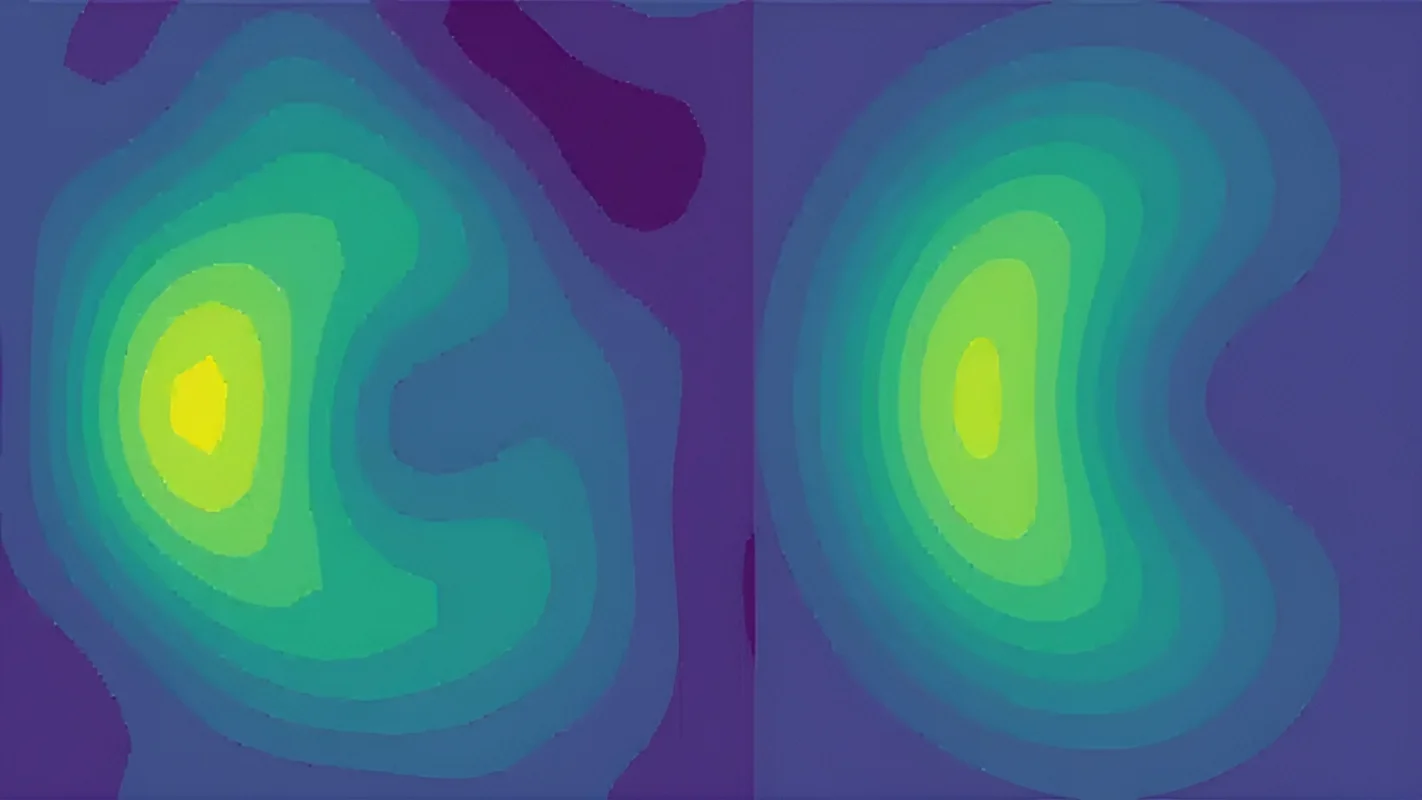

- Trapped-ion quantum computers can now directly observe the elusive molecular geometric phase.
- Ions slow down quantum dynamics a billion times, making femtosecond events measurable.
- Independent replication by University of Sydney strengthens confidence in the result.
Jacob Whitlow was trying to measure something that quantum theory said had to exist, but nobody had ever seen.
For decades, chemists studying conical intersections could calculate the geometric phase on paper.
They knew it was there, governing reactions in photosynthesis and human vision, dictating which molecular transformations could and couldn't happen.
The Quantum Effect a Trapped-Ion Computer Could Reach
The problem was scale and speed. The geometric phase operates on femtosecond timescales, across distances measured in atoms, and any instrument probing the system disturbs it.
Key figure
~1 billion times
How much slower trapped-ion dynamics are than the femtosecond timescales of real molecules
Kenneth Brown, the Michael J. Fitzpatrick Distinguished Professor of Engineering at Duke University, put the paradox plainly. "If conical intersections exist," he said, "then the geometric phase has to exist. But what does it mean to say something exists that you can't measure?"
Whitlow, a doctoral student in Brown's laboratory, thought there might be a way around the problem. Rather than observing molecules directly, his team would build a scaled-up replica using trapped ions.
What is a conical intersection?
A conical intersection occurs when two energy surfaces of a molecule meet at a point, like two mountain peaks touching tip to tip. At that junction, quantum effects take over. Certain molecular paths become forbidden, not by energy barriers, but by geometry itself.
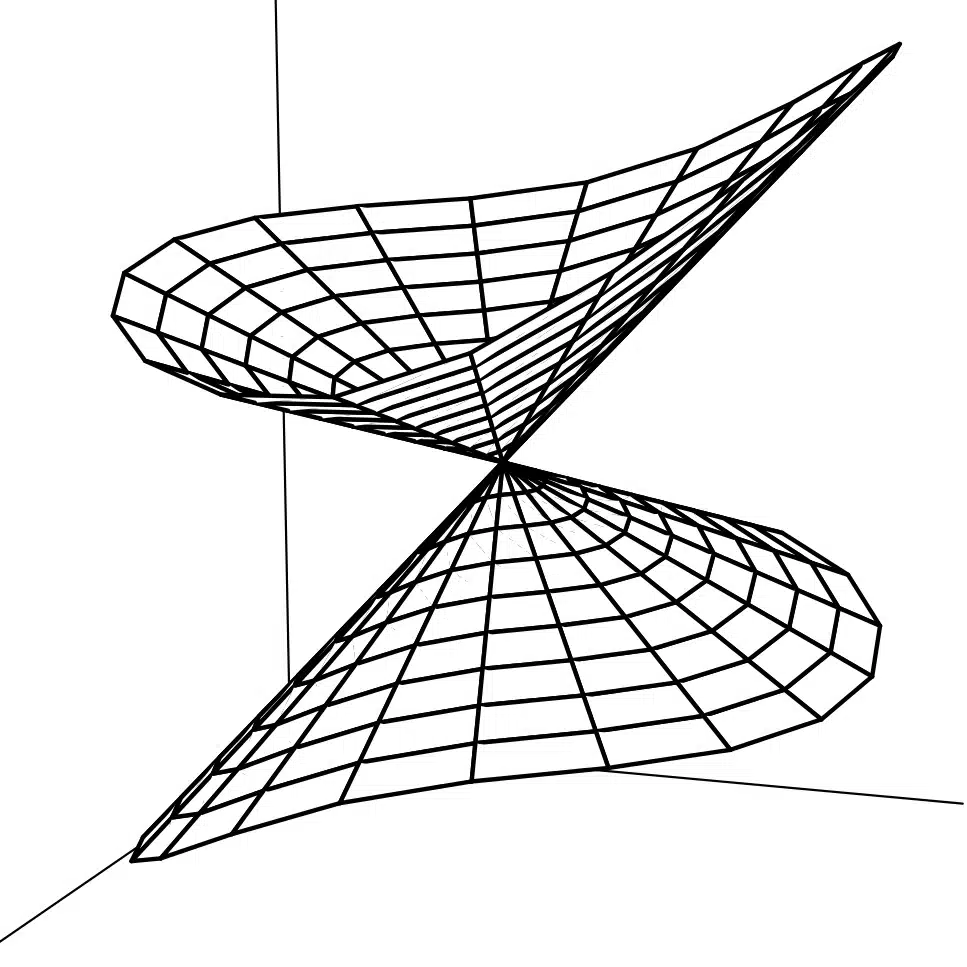
Two energy surfaces of a molecule meet at their tips. The ground state sits below, the excited state above. The geometry of that junction, not energy alone, governs what a molecule can and cannot become. A trapped-ion quantum computer can help chemists study this better. Image credit: Duke University.
Five Ions, One Long-Sought Answer
The instrument the team used was a five-ion quantum computer built by the group of Jungsang Kim, the Schiciano Family Distinguished Professor of Electrical and Computer Engineering at Duke. Lasers manipulate charged atoms suspended in vacuum, providing a level of control that real molecular systems can't offer.
The key advantage was time.
Ion dynamics unfold roughly a billion times more slowly than equivalent molecular dynamics. The geometric phase, normally gone before any detector could register it, became observable.
Results showed a clear interference pattern, resembling a two-dimensional crescent moon: certain configurations on one side of the simulated conical intersection could not reach the other, even though no energy barrier blocked them.
The beauty of trapped ions is that they get rid of the complicated environment and make the system clean enough to make these measurements.
Kenneth Brown, Duke University
Independent Confirmation
The finding was confirmed independently.
More On Quantum Computing

The Quantum AI That Learned To Be Fooled
A quantum-inspired neural network flips between optical illusion interpretations like humans. Making AI "wrong" may unlock human-like perception.
→A team at the University of Sydney, working with a different ion trap design, observed consistent results, with their paper appearing in the same issue of Nature Chemistry. That independent replication matters: conical intersections appear throughout photochemistry, in how plants capture sunlight, how retinal proteins shift during vision, and how catalysts respond to light.
Quantum computers remain far from replacing laboratory chemistry. But Whitlow's experiment, led from Brown's laboratory at the Duke Quantum Center, suggests that even today's limited machines can access quantum phenomena that classical instruments cannot reach.
The geometric phase no longer has to be inferred.
Sources
- Primary Source: Quantum simulation of conical intersections using trapped ions (Nature Chemistry, 2023)
- Additional Context:
- Quantum computer unveils atomic dynamics of light-sensitive molecules (Duke Pratt School of Engineering)

Fact Check: Claim-by-Claim Verification Verified
The article accurately describes the trapped-ion simulations of conical intersections and geometric phase, including the Duke and University of Sydney results, with only minor simplifications appropriate for popular science.
Commentary
- The phrase “had resisted measurement for decades” is accurate for direct observation of the geometric phase in molecular systems, but experts may stress that conical intersections themselves and related effects have been probed experimentally before; also, the “independent confirmation” refers to a closely related but not identical Sydney experiment performed on a different device.
Sources used for verification
Academic/Peer-reviewed:
- Quantum simulation of conical intersections using trapped ions - PubMed
- Quantum simulation of conical intersections using trapped ions - osti.gov
- Simulating conical intersections with trapped ions - arxiv.org
Other reliable sources:
- Quantum computer unveils atomic dynamics of light-sensitive molecules - nsf.gov
- Quantum computer unveils atomic dynamics of light-sensitive molecules - pratt.duke.edu
- Scientists use quantum device to slow chemical process down by factor of 100 billion - sydney.edu.au
- Quantum computer unveils atomic dynamics of light-sensitive molecules - aau.edu
Fact-checked by Perplexity Sonar Pro on 2026-03-07


