


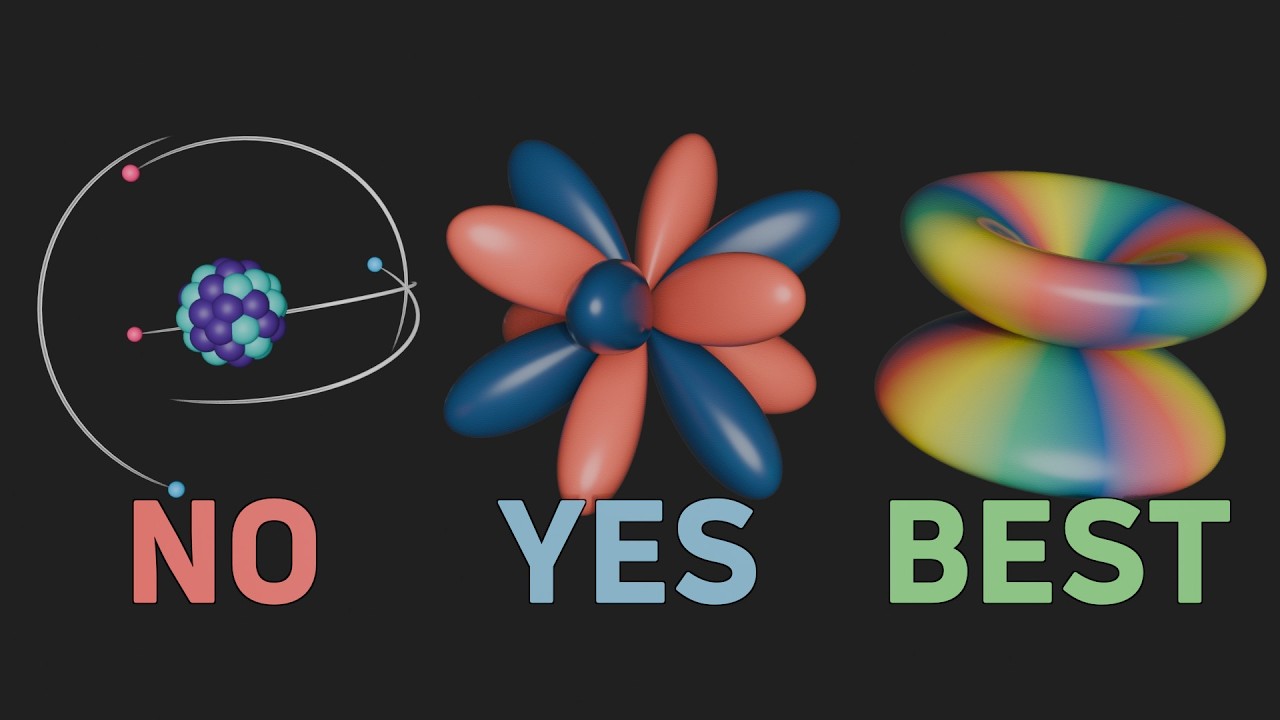

- Electrons exist as standing waves around nuclei, not particles in orbits.
- Quantization arises because only certain wave patterns fit around an atomic nucleus.
- Orbital shapes are governed by spherical harmonics and three quantum numbers.
Forget everything you learned about electrons orbiting like tiny planets.
In this video from But Why?, the exploration begins with a startling revelation: those familiar orbital diagrams showing dumbbell and cloverleaf shapes aren't just artistic representations - they're mathematical necessities.
The key insight?
Everything is waves.
"Everything is waves. Electrons, protons, photons, you and me, we're all waves."
Key figure
3
quantum numbers that determine the shape and orientation of every electron orbital
When Waves Get Trapped
The video demonstrates this through a brilliant analogy.
Clamp one end of a vibrating string and waves reflect back, creating interference patterns. Clamp both ends and something remarkable happens - only specific wavelengths can exist.
This is quantization in action.
A guitar string produces the same notes every time because only certain standing wave patterns fit within its boundaries.
The same principle governs electrons around atomic nuclei, except now we're dealing with three-dimensional wave confinement.
From Guitar Strings to Quantum Mechanics
But Why? walks through the progression from one-dimensional waves to the complex reality of electron orbitals. In 1D, nodes are points where the wave doesn't move. In 2D (like a drum head), nodes become lines. In 3D space around an atom, nodes become surfaces.
Here's where it gets fascinating: electrons don't actually oscillate like acoustic waves.
Since measuring an electron collapses its wave function, we can't determine the wave's phase. Instead, we square the amplitude to get probability densities - regions where you're most likely to find the electron.
The mathematics behind these shapes involves spherical harmonics, characterized by three quantum numbers that determine the number and orientation of nodal surfaces.
What are spherical harmonics?
Spherical harmonics are a set of mathematical functions that describe how waves behave on the surface of a sphere. In quantum mechanics, they define the angular part of an electron's wave function – essentially setting the shape and orientation of each orbital. The different orbital shapes (s, p, d, f) all arise from different spherical harmonic solutions.
The Real vs Complex Orbital Mystery
The familiar dumbbell shapes from chemistry textbooks aren't the direct mathematical solutions. The true solutions are donut-shaped complex orbitals with rotational symmetry.

Why the switch? The real orbitals point in specific directions, making it easier to visualize how atoms bond together.
"These patterns are dictated by mathematical solutions called spherical harmonics," as the video explains, but chemists prefer the more intuitive representations.
What makes this significant is how it reveals the deep connection between wave physics and atomic structure. Those strange orbital shapes aren't arbitrary - they're the only patterns that waves can form when confined to the tiny space around a nucleus.
The electrons aren't little balls following tracks.
They're probability clouds shaped by the fundamental mathematics of wave interference, constrained by the same principles that make guitar strings ring with specific pitches.

Fact Check: Claim-by-Claim Verification Verified
The article accurately represents the core quantum mechanical concepts: electrons as waves, quantization via standing wave patterns, spherical harmonics determining orbital shapes, and the distinction between complex and real orbitals. All major claims are supported by reliable sources.
Commentary
- The article states electrons "don't actually oscillate like acoustic waves"—this is nuanced but accurate. Electrons are described by wavefunctions in quantum mechanics, not classical mechanical oscillations.
- The claim that "the true solutions are donut-shaped complex orbitals with rotational symmetry" is partially imprecise. The most general solutions are complex orbitals, but these have various shapes depending on quantum numbers (not just donuts). The article's intended point—that real orbitals like dumbbell shapes are mathematical combinations, not the direct solutions—is correct.
- The article appropriately simplifies wave mechanics for a popular audience while remaining factually sound. Hedging language ("probability clouds," "shaped by mathematics") is appropriate for the level of certainty in quantum mechanics.
Sources used for verification
Academic/Peer-reviewed:
- Chemistry LibreTexts - Spherical Harmonics - LibreTexts
- Purdue University - Wave Particle Duality (de Broglie) - Purdue.edu
- Chemistry LibreTexts - Orbital Angular Momentum and p-Orbitals - LibreTexts
- Wikipedia - Atomic Orbital - Wikipedia.org
Other reliable sources:
- Science Ready Australia - de Broglie's Matter Wave Duality - scienceready.com.au
- West Texas A&M University - What is the Shape of an Electron - wtamu.edu
- Chemistry LibreTexts - Quantum Mechanics and Atomic Orbitals - LibreTexts
Fact-checked by Perplexity Sonar Pro on 2026-01-05


