


Updated May 24, 2026
- All living tissue emits a faint visible glow called ultraweak photon emission.
- The glow comes from metabolism and collapses at death even at constant temperature.
- A 2025 Calgary study imaged it in mice and stressed plants, not humans.
In a darkened room at the University of Calgary, a camera sensitive enough to count single photons spent two hours staring at a mouse. The animal was alive. Then it was not. The light it had been giving off, faint beyond anything an eye could register, faded with it.
That experiment, published in The Journal of Physical Chemistry Letters and led by quantum physicist Daniel Oblak with his colleague Christoph Simon, gave a precise answer to a strange question: do living things really glow?
They do.
The glow is called ultraweak photon emission, or biophotons, and it sits in the visible part of the spectrum, the same range our eyes respond to. It is simply far too dim to see.
The German physicist and YouTuber Sabine Hossenfelder picked up the finding and asked the question the paper did not. If we glow, what color are we?
What is ultraweak photon emission?
A faint visible glow that living cells give off as a byproduct of normal metabolism. It is millions of times dimmer than bioluminescence and invisible to the eye, but single-photon cameras can capture it. Crucially, it is distinct from body heat, which radiates in the infrared.
Living Things Have Been Caught Glowing Before
The idea is older than it sounds. In the 1920s, the Russian embryologist Alexander Gurwitsch reported faint ultraviolet emissions from onion roots and decided they stimulated cell division. He called them mitogenetic rays.
He was mostly wrong about the cause, and the field spent decades tangled up with claims that never replicated. One of the more hopeful ones held that meditation made your photon emission more coherent, as if a calm mind could turn you into a low-grade laser. It did not survive a second look.
What survived was the core observation. Living tissue emits a trickle of visible light, on the order of a few to a thousand photons per square centimeter each second. That is roughly fifteen orders of magnitude fainter than the green flicker of a firefly, which runs on a dedicated chemical reaction. This is something else entirely.
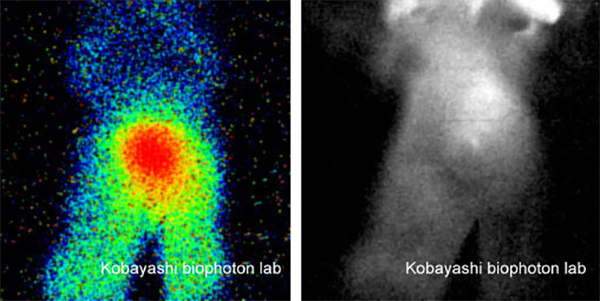
Cancer transplanted mouse shows the enhancement of biophoton emission along with the growth of tumor. The correlation between biophoton intensity and growth rate is observed, representing the higher metabolic activity of cancer cells and the state of oxidative stress in cancer cells. Image credit: Kobayashi Biophoton Lab
Biophotons Come from Metabolism, and the Glow Stops at Death
The light is a byproduct of staying alive. Energy moving through a cell occasionally bumps an electron into a higher band. When the electron drops back down, it releases a photon. Multiply that across trillions of busy cells and you get a steady, almost imperceptible shimmer.
The 2025 study set out to prove the metabolic origin by the most direct route available. Oblak's team imaged four mice with single-photon cameras, then euthanized them and kept the bodies at the same temperature.
Key figure
15 orders of magnitude
how much brighter ultraweak photon emission is than the visible tail of body heat
The emission collapsed once the animals died, even though the heat did not. That separation matters.
Warm objects glow in the infrared no matter what, but this visible light tracked life itself, not temperature. Some organs, including the brain and liver, kept glowing faintly for up to an hour, shutting down at their own pace.
The team also pressed injured leaves of thale cress under the cameras. The damaged areas glowed brighter than the healthy tissue, for all sixteen hours of imaging.
So What Color Are We?
The paper did not assign the glow a color. Hossenfelder did the arithmetic herself, and this is where honesty about sources matters: the number is her interpretation, not a measured result from the study.
Two processes dominate the emission. Bonds between carbon and oxygen, called carbonyl groups, scatter light broadly across 350 to 550 nanometers, in the cyan range. Oxygen-oxygen bonds tucked inside larger molecules emit around 630 to 700 nanometers, in the red.
The red contributes roughly 75 percent, the cyan about 25 percent. Mix those bands and you land on a specific shade. It happens to be the web color formally named tomato.
We're really all tomato coloured.
Sabine Hossenfelder, physicist
There is a second act. Step out of a bright room and, for a minute or two, molecules called flavins, derived from vitamin B2, release a leftover grass-green afterglow before everyone settles back to tomato. It is a small, faintly comic detail, the kind that makes the physics feel less remote.
A Camera That Reads Metabolism
The practical interest is not the color. It is that a passive camera, touching nothing, can watch metabolism in real time. Oblak has framed the appeal plainly: if the glow tracks stress or disease, it could become a diagnostic tool that never breaks the skin.
That promise comes with a caution worth stating clearly. The study imaged mice and plants, not people, and human ultraweak photon emission has been measured before only in narrow, controlled conditions. The leap to a clinic is real but unmade.
One critic of the experiment was Hossenfelder herself, who questioned whether the mice needed to die to confirm a result everyone expected. The answer they gave was unambiguous. The living glow, the dead do not, and the difference is metabolism.
The next images will be of stressed leaves and skin, not of life switching off.
Sources
- Primary Research: Imaging Ultraweak Photon Emission from Living and Dead Mice and from Plants under Stress (Salari, Simon, Oblak et al., The Journal of Physical Chemistry Letters, 2025)
- Original Source: We Have an Aura Of Visible Light, Here is what it looks like (Sabine Hossenfelder, YouTube)
- Additional Context:
- UCalgary scientists go viral with study that shows all living things emit an eerie glow (University of Calgary)
- Ultra weak photon emission, a brief review (NIH / PMC)

Fact Check: Claim-by-Claim Verification Verified
Verified the core claims about ultraweak photon emission, the 2025 Calgary/NRC mouse-and-plant study, and the historical context. The only item carrying uncertainty, the specific "tomato" color, is attributed in the text to Sabine Hossenfelder's own calculation rather than the study, which both Claude and Perplexity confirmed is the correct framing.
Sources used for verification
- Imaging Ultraweak Photon Emission from Living and Dead Mice and from Plants under Stress - pubs.acs.org
- PubMed entry for the 2025 study - pubmed.ncbi.nlm.nih.gov
- UCalgary news release - ucalgary.ca
- Ultra weak photon emission, a brief review - ncbi.nlm.nih.gov
- Phys.org coverage - phys.org


