


- Mars had roughly 500 million years to develop life before Earth could.
- LUCA, our common ancestor, lived 4.2 billion years ago within already complex ecosystems.
- LUCA's genome shows no adaptations for surviving interplanetary travel.
The panspermia hypothesis has a timing problem working in its favor.
Writing in The Conversation, chemist Seán Jordan of Dublin City University walks through an uncomfortable possibility: Earth might not be where terrestrial life began. The red planet next door had conditions suitable for biology while our own world was still recovering from a catastrophic collision.
Key figure
500 million years
Head start Mars may have had over Earth for developing life
Earth's Violent Reset
Around 4.51 billion years ago, something roughly Mars-sized struck the proto-Earth. The impact liquefied both worlds, eventually separating into the Earth-Moon system we know today.
Any life that might have emerged before that event would have been obliterated.
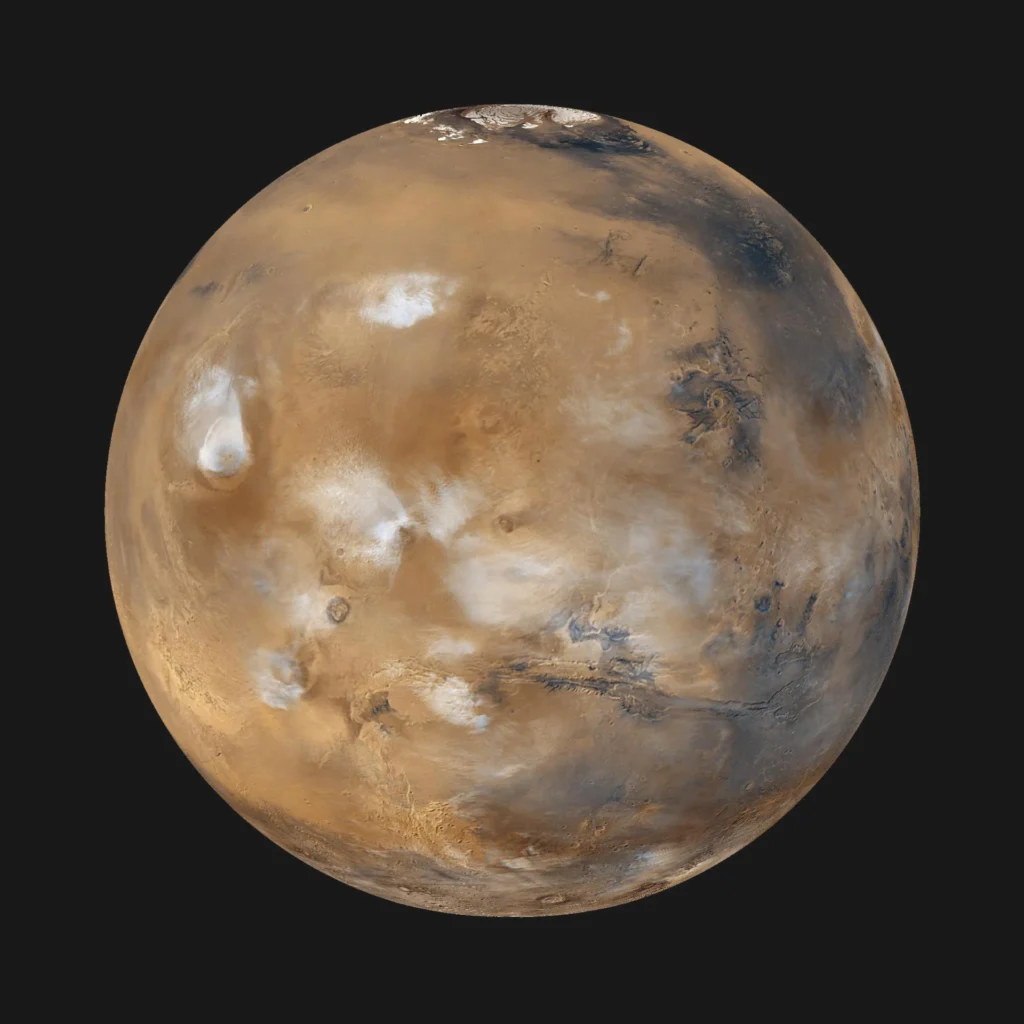
The Red Planet has been a target for the search for life for a long time. Recently, we wrote about a million-year tropical rainfall period on Mars. But could life on Earth have originated there? Image credit: NASA.
Mars never experienced anything comparable. The red planet took plenty of hits during the solar system's chaotic youth, but geological evidence suggests no single impact was severe enough to sterilize the entire surface. Portions of Mars may have remained habitable continuously from the planet's formation.
This creates an asymmetry worth considering. Mars had liquid water, atmospheric protection, and likely hydrothermal vents while Earth was still molten. That head start could amount to roughly 500 million years.
The LUCA Problem
Recent genetic analysis has pushed back estimates for LUCA, the last universal common ancestor of all current life, to approximately 4.2 billion years ago. But LUCA wasn't Earth's first organism. It lived within established microbial ecosystems, competing with other species and defending against viral attacks.
What is LUCA?
LUCA stands for Last Universal Common Ancestor – the single population of organisms from which all life on Earth descends. It was not the first life form, but a survivor: the lineage that outcompeted all others and left every living thing today as its descendant. Reconstructing LUCA's genome from modern species tells us what early life looked like, and what challenges it faced.
If complex ecosystems existed 4.2 billion years ago, the origin of life itself must have occurred earlier, somewhere in the roughly 290 million years between the Moon-forming impact and LUCA's emergence.
The question becomes whether that window was sufficient for chemistry to become biology on Earth.
The Transit Problem
Jordan, who works in origin-of-life research, remains skeptical despite the convenient timing.
Any Martian microbe would need to survive the initial asteroid impact, ejection through atmosphere at escape velocity, at least a year drifting through vacuum while cosmic rays bombarded it, fiery atmospheric entry at Earth, and a second impact onto an unfamiliar surface.
The chances of all of this seem pretty slim to me.
Seán Jordan, Associate Professor in Chemistry, Dublin City University
Studies of extremophile survival suggest only species adapted for radiation resistance and capable of forming protective spores could plausibly make the journey. Some simulations support the idea that microbes buried deep within sufficiently large meteorites might be shielded from the worst conditions, but this remains theoretical.
LUCA's reconstructed genome shows adaptations for high temperatures and UV radiation, both hazards present in early Earth's hydrothermal environments. Nothing in that genome suggests special equipment for surviving interplanetary travel.
Where This Leaves Us
The panspermia hypothesis for Earth's life remains scientifically legitimate but faces a basic parsimony problem.
Jordan frames it directly: the transition from chemistry to biology, however mysterious it appears, seems more straightforward than that same transition occurring on Mars, followed by organisms surviving transit, then adapting to an entirely different planet.
The evidence suggests 290 million years was likely enough time for Earth to generate its own biology without requiring imports.

Fact Check: Claim-by-Claim Verification Verified
The recap accurately summarizes Seán Jordan's article in The Conversation, with claims on Moon-forming impact timing, LUCA age, Mars habitability, and panspermia challenges matching peer-reviewed evidence and the source's arguments.
Commentary
- Exact timing of Moon-forming impact varies slightly (4.43–4.53 Ga in some models), but 4.51 Ga is widely cited and creates ~290 million year window as stated.
- Mars habitability evidence is geological, not direct life detection; panspermia remains hypothetical but legitimate.
Sources used for verification
Academic/Peer-reviewed:
- Early formation of the Moon 4.51 billion years ago - science.org
- Tidally driven remelting around 4.35 billion years ago - PMC
- Our last common ancestor lived 4.2 billion years ago - science.org
Other reliable sources:
- Seán Jordan | Dublin City University - dcu.ie
- Explore: Life on Mars - lpi.usra.edu
- NASA-Funded Study Extends Period When Mars Could Have Supported Life - nasa.gov
Fact-checked by Perplexity Sonar Pro on 2025-12-29


