
- A pulsar wind nebula is the likely source of a powerful galactic cosmic ray accelerator.
- The natural accelerator reaches energies more than 100 times higher than the LHC.
- XMM-Newton X-ray data provided the first strong identification after 113 years.
Victor Hess climbed into a balloon in 1912 and rose to 5,300 meters, carrying primitive radiation detectors. The readings climbed with altitude. Something was bombarding Earth from space.
Hess was awarded the 1936 Nobel Prize in Physics for discovering cosmic rays. But he died in 1964 without knowing where they came from.
“Cosmic rays are a lot more relevant to life on Earth than you might think,” says Shuo Zhang, a Michigan State University assistant professor of physics and astronomy who led the research.
"About 100 trillion cosmic neutrinos from far, far away sources like black holes pass through your body every second. Don't you want to know where they came from?"
Zhang and colleagues at the Michigan State University just brought his 113-year mystery closer to solution. They identified possible evidence of a pulsar wind nebula behind one of the galaxy’s most powerful particle accelerators - what physicists call a "PeVatron."
What is a PeVatron?
A PeVatron is a natural cosmic object that accelerates particles to petaelectronvolt (PeV) energies – one quadrillion electron-volts. These are among the most powerful particle accelerators in the universe, far exceeding anything humans have built. Pulsar wind nebulae, supernova remnants, and certain star-forming regions are leading candidates.
It’s like trying to find which sprinkler created a raindrop after wind has blown it across the garden.
Nature’s Particle Accelerator Reaches Higher Energies
The Large Hadron Collider took 10 years and $4.75 billion to build. It accelerates particles to extraordinary energies.
The pulsar wind nebula MSU identified reaches particle energies more than 100 times higher than the LHC. Continuously. Without engineering.
PeVatrons boost particles to petaelectronvolt energies - one quadrillion electron-volts. They’re natural cosmic accelerators physicists have theorized about but rarely confirmed with confidence. Zhang’s team used 120 kiloseconds of data from the XMM-Newton space telescope to analyze a mysterious high-energy signal first detected by China’s LHAASO observatory.
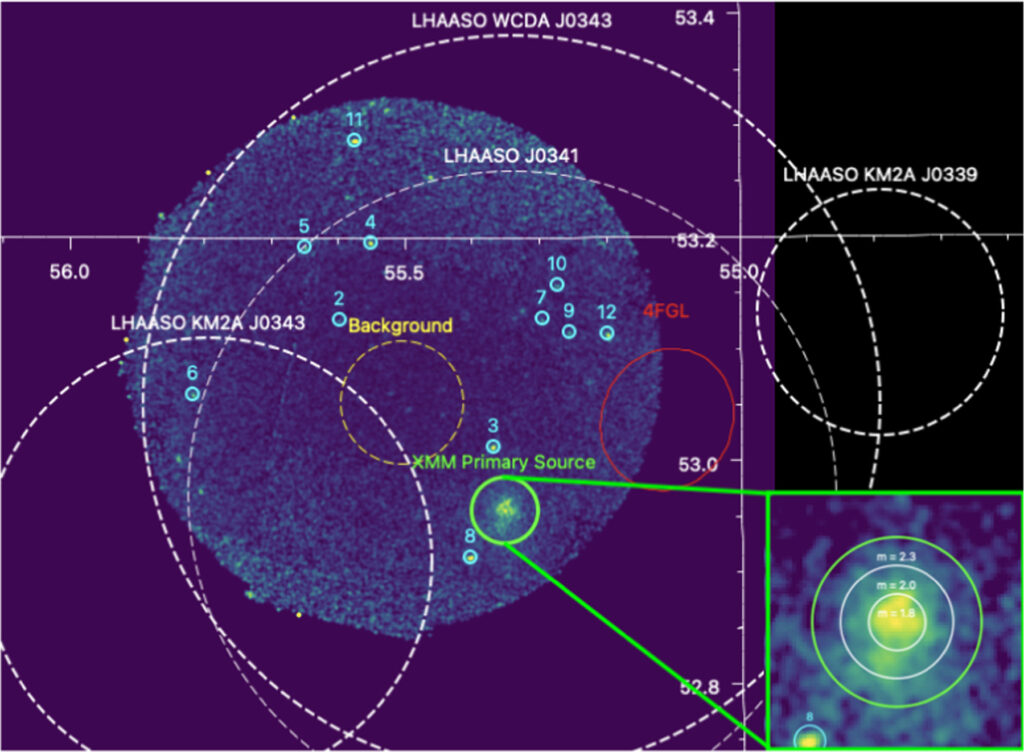
X-ray image of the newly discovered pulsar wind nebular associated with an extreme Galactic cosmic ray source 1LHAASO J0343+5254u, obtained by the XMM-Newton space telescope. Credit: DiKerby, Zhang, et al., ApJ, 983, 21
The X-ray observations revealed characteristic signatures. An expanding bubble of high-energy particles. Power-law spectrum with index 1.9, softening with distance from center. Asymmetric spatial extension reaching 2 arcminutes.
A pulsar wind nebula candidate, powered by a rapidly spinning neutron star, creating relativistic winds that form shocks and efficiently accelerate particles.
"This is one of the better-supported identifications we have so far," Zhang notes.
The Problem Hess Couldn’t Solve
But pinpointing the nature of these extreme accelerators has eluded researchers since Hess’s discovery.
Cosmic rays are charged particles traveling at nearly light speed. Hess detected them. But galactic magnetic fields deflect charged particles, scrambling their paths. You can’t trace them directly back to their origin.
About 100 trillion cosmic neutrinos from far, far away sources like black holes pass through your body every second. Don’t you want to know where they came from?
Shuo Zhang, Assistant Professor of Physics and Astronomy, Michigan State University
It’s like trying to find which sprinkler created a raindrop after wind has blown it across the garden.
LHAASO detects gamma rays produced when cosmic rays collide with interstellar matter. Gamma rays travel in straight lines. They point back to the source region.
The observatory in Sichuan, China, sits at 4,410 meters. It covers 1.4 square kilometers with detector arrays. Since 2021, it’s identified roughly 12 PeVatron candidates.
Identifying candidates is characteristically different from knowing what they are. Most remained mysterious high-energy signals until MSU’s observations revealed this one’s likely nature.
Three MSU undergraduates - Ella Were, Amiri Walker, and Shaan Karim - conducted a complementary study using NASA’s Swift X-ray telescope. They systematically set upper limits on X-ray emissions from five additional LHAASO sources. Some were faint. Some showed nothing.
The work narrows the search systematically.
What Still Needs Solving
Yet this identifies one cosmic ray source. Not all of them.
Scientists don’t yet know whether this particular nebula uses leptonic acceleration (electrons) or hadronic acceleration (protons). Possibly both. They don’t know why some PeVatrons produce neutrinos while others apparently don’t.
The exact mechanism by which pulsar wind nebulae accelerate particles to such extreme energies remains unclear.
Zhang’s team will correlate their X-ray and gamma-ray data with neutrino detections from IceCube Neutrino Observatory in Antarctica. The cross-check between particle physics and astronomy should help reveal whether the acceleration is hadronic.
Hess’s balloon flights revealed cosmic rays existed. 113 years later, we’re finally learning where some of them come from.
The natural particle accelerators were there all along, running at energies we’re only beginning to approach with our most ambitious machines.
Sources
- Primary Research: DiKerby, S., Zhang, S., Ergin, T., et al. (2025). "Discovery of a Pulsar Wind Nebula Candidate Associated with the Galactic PeVatron 1LHAASO J0343+5254u." The Astrophysical Journal, 983(1), 21. https://iopscience.iop.org/article/10.3847/1538-4357/adb7e0
- Additional Context:
- Michigan State University press release (ScienceDaily)
- Cosmic rays discovered 100 years ago (CERN)
- Victor F. Hess – Facts (Nobel Prize)
- Large High Altitude Air Shower Observatory (IHEP)

Fact Check: Claim-by-Claim Verification Verified
The recap accurately represents the primary research paper and MSU press materials, with correct details on the pulsar wind nebula candidate, XMM-Newton observations, and historical context.
Commentary
- The 100 trillion neutrinos figure refers primarily to low-energy solar neutrinos, not high-energy cosmic ones from black holes; the article presents it as a direct quote without correction, which is acceptable for popular recap.
- Source identification as "one of the better-supported" matches paper's candidate status; leptonic vs. hadronic acceleration remains uncertain.
- Headline dramatizes progress ("We May Know Where"), but body appropriately hedges as "possible evidence" and "candidate," aligning with source caution.
Sources used for verification
Academic/Peer-reviewed:
- Discovery of a Pulsar Wind Nebula Candidate Associated with the Galactic PeVatron 1LHAASO J0343+5254u - iopscience.iop.org
- Discovery of a Pulsar Wind Nebula Candidate Associated with the Galactic PeVatron 1LHAASO J0343+5254u - arXiv
Other reliable sources:
- Victor F. Hess – Facts - NobelPrize.org
- Century-old cosmic ray mystery is close to being solved - ScienceDaily
- Large High Altitude Air Shower Observatory - ihep.cas.cn
Fact-checked by Perplexity Sonar Pro on 2025-12-29