


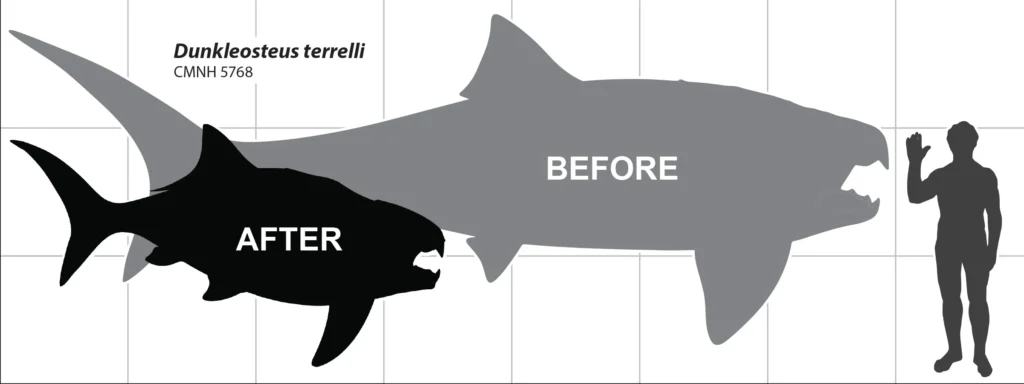
- Dunkleosteus was roughly 4 meters long, not the 10 meters assumed for decades.
- Prototaxites, long classified as a giant fungus, may be an entirely extinct life form.
- Both revisions came from applying new methods to fossils studied for over a century.
Russell Engelman had a problem. The numbers simply would not add up.
The Case Western Reserve University biologist was trying to reconstruct the Devonian predator Dunkleosteus from its fossilized skull plates when every calculation produced the same result: a body shape that made no biological sense.
The animal paleontologists had drawn for a century, sleek and shark-like at perhaps ten meters, appeared to be physically impossible.
Key figure
4.1 m
New estimated length of Dunkleosteus – roughly half the figure assumed for over a century
A Monster That Needed Downsizing
The trouble, Engelman concluded, was that no one had looked carefully at the evidence.
Dunkleosteus belonged to a class of armored fish whose bony skulls survived fossilization well but whose cartilaginous bodies dissolved almost entirely. Researchers had assumed a shark-like body shape for 150 years, borrowing proportions that the evidence never actually supported.
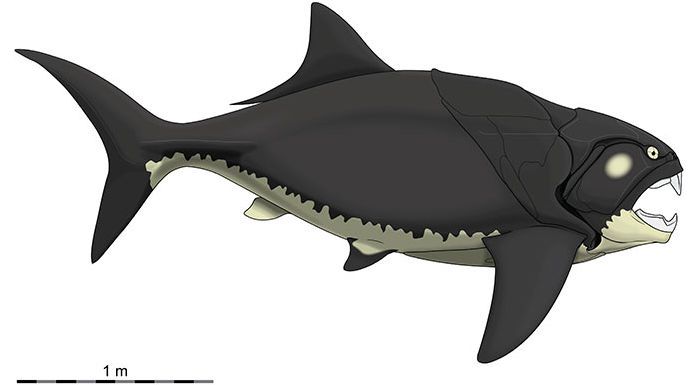
The new size of Dunklosteus made the body more compact. By Russell K. Engelman CC BY 4.0.
When Engelman correlated skull dimensions against dozens of living and fossil fish species, the old estimates collapsed.
What are arthrodires?
Arthrodires were a dominant group of armored fish in the Devonian period (about 400 million years ago), characterized by jointed skull plates that gave them a distinctive two-part biting action. Because their bodies were largely cartilaginous, only their armored heads typically survived fossilization, leaving body shape and size open to educated guesswork for 150 years.
His revised Dunkleosteus was roughly four meters long. Still an apex predator, and built, as Engelman put it, like a wrecking ball. But shaped more like a tuna than a great white shark, short and dense rather than sleek and elongated.
It is not the first time a Devonian giant has refused to stay in the box scientists built for it.
The Organism That Defied Classification
Standing eight meters tall in a landscape of low ferns and primitive vascular plants, Prototaxites would have looked improbable to any observer.
The massive column-like structures first appeared in fossils described in 1859. For over a century they were misidentified as a conifer, then debated as algae, then widely accepted as a giant fungus. A 2007 geochemical analysis seemed to settle the matter, and Prototaxites entered textbooks accordingly.
In January 2026, a team led by Corentin Loron at the University of Edinburgh reopened that settled question. Examining fossils from the Rhynie chert in Scotland, which are some of the best-preserved Devonian material on Earth, the researchers found that Prototaxites lacked the chemical signatures characteristic of fungi. Its internal structure branched and reconnected in ways that matched no known fungal group, living or extinct.
Their conclusion, published in Science Advances, was that Prototaxites may represent an entirely extinct lineage of complex multicellular life.
What the Devonian Actually Teaches Us
The Astrum video that prompted this article takes viewers on an ambitious sweep through Earth's history, from the molten planet of 4.5 billion years ago to the teeming Devonian seas. Presenter Alex McColgan is careful to flag the uncertainty embedded in deep-time reconstruction, reminding viewers that error bars accompany any journey this far into the past.
More On Ancient Animals
Do Lizards and Mice Sleep to the Same Brain-Cleansing Rhythm?
Sleep is vital for our brains’ self-regulating cleansing procedure. Two unrelated papers may reveal a surprising evolutionary connection.
→That epistemic modesty is worth noting.
The Devonian is not, by geological standards, a poorly understood period. Yet within the past three years, two of its most iconic organisms have been substantially revised. Dunkleosteus, the armored sea monster of every prehistoric documentary, turns out to have been roughly half the size anyone thought. Prototaxites, the textbook fungus, may not be a fungus at all.
This is not a failure of science. It is science performing exactly as intended: accumulating evidence, applying new methods, and revising even comfortable conclusions when the data require it. The Devonian remains one of the richest chapters in life's history.
It is also a reminder that our picture of it is still being drawn.
Sources
- Primary Source: The Bizarre Creatures that Lived on Earth Before the Dinosaurs (Astrum / YouTube)
- Additional Context:
- Dunkleosteus size revision – Engelman 2023 (MDPI Diversity)
- Prototaxites – entirely extinct lineage (Science Advances, Loron et al. 2026)

Fact Check: Claim-by-Claim Verification Verified
All major scientific claims in the article are accurately supported by peer-reviewed research; the article correctly reports findings and maintains appropriate scientific hedging.
Commentary
- The article describes the traditional Dunkleosteus as "sleek and shark-like," which is somewhat simplified. The actual problem was not just shark-like proportions but an implausibly elongated body with a head only 8% of total length (versus 18-30% in most non-anguilliform fishes), as detailed in the research.
- The article accurately notes that "no one had looked carefully at the evidence," but the fuller story involves that previous researchers relied on assumptions about shark-like body shapes borrowed from other fish models rather than conducting direct skull-to-body allometric comparisons.
- The Science Advances paper's conclusion that Prototaxites lacked "chemical signatures characteristic of fungi" is correctly presented; the paper found it chemically and structurally distinct from contemporary fungi in the same deposit.
Sources used for verification
Academic/Peer-reviewed:
- Diversity 2023: Dunkleosteus Reconstruction by Engelman - MDPI
- Reconstructing Dunkleosteus terrelli: A New Look for an Iconic Devonian Predator - Palaeontologia Electronica
- Prototaxites Fossils Are Structurally and Chemically Distinct from Extinct and Extant Fungi - Science Advances
Other reliable sources:
- Cleveland Museum of Natural History specimen databases and collections (referenced in Engelman reconstruction)
- Rhynie chert fossil collections at National Museums Scotland and University of Aberdeen (referenced in Loron et al. 2026)
Fact-checked by Perplexity Sonar Pro on 2026-03-04


