- Entanglement experiments confirm quantum mechanics violates Bell inequalities.
- The 2022 Nobel Prize honored fifty years of increasingly precise tests.
- Entanglement enables quantum computing and secure communication.
Quantum entanglement experiments are tests designed to measure correlations between particles whose quantum states are linked, so that measuring one particle's property instantly constrains what can be measured on the other, regardless of distance. These experiments have confirmed that nature violates the limits set by classical physics, earning three physicists the 2022 Nobel Prize in Physics.
Why It Matters
Key figure
2022
Nobel Prize awarded for entanglement experiments
The 2022 Nobel Prize in Physics went to Alain Aspect, John Clauser, and Anton Zeilinger for decades of work proving that entangled particles behave exactly as quantum mechanics predicts. Their experiments ruled out local hidden-variable theories, the idea that particles carry pre-set instructions determining measurement outcomes.
That result matters well beyond the laboratory. Entanglement now underpins quantum computing, where qubits exploit entangled states to perform calculations no classical machine can match. It also enables quantum key distribution, a method of encrypting communications that is physically impossible to intercept without detection.
For a broader look at the theory behind these experiments, see our guide to quantum physics. And for the story of how John Clauser set out to prove Einstein right and ended up proving him wrong, see why entangled particles can't send messages faster than light.
How Entanglement Experiments Work
The story begins with a 1935 paper by Albert Einstein, Boris Podolsky, and Nathan Rosen. Their EPR paper argued that quantum mechanics must be incomplete because it allowed what Einstein called "spooky action at a distance." The authors proposed that unmeasured particles must carry hidden variables, pre-existing values that determine outcomes before anyone looks.
In 1964, the Northern Irish physicist John Stewart Bell changed the debate. Bell devised a mathematical inequality that any local hidden-variable theory must satisfy. If measurements on entangled particles violated that inequality, hidden variables could not explain the results.
Key figure
1,200 km
Longest entanglement distance (Micius satellite, 2017)
The first direct test came in 1972. John Clauser and Stuart Freedman at the University of California, Berkeley, measured polarization correlations of entangled photons produced by calcium atoms. Their results violated Bell's inequality, siding with quantum mechanics.
Alain Aspect and his team at the Institut d'Optique in Orsay, France, refined the approach in 1982. They switched polarizer settings while the photons were still in flight, closing the locality loophole that had left Clauser's result open to challenge. Anton Zeilinger's group at the University of Vienna pushed further in 1997, demonstrating quantum teleportation, the transfer of a quantum state from one photon to another without physical travel of the particle.
A remaining gap was the detection loophole: if detectors miss too many photons, results could be biased. In 2015, Ronald Hanson's team at Delft University of Technology in the Netherlands performed the first loophole-free Bell test. They used entangled electron spins in nitrogen-vacancy centers in diamond, separated by 1.3 kilometers. Teams at NIST and the University of Vienna confirmed the result independently the same year.
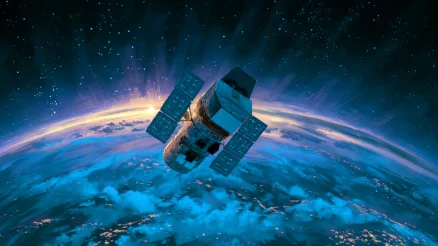
In 2017, China's Micius satellite distributed entangled photons to ground stations 1,200 kilometers apart, setting a distance record that demonstrated entanglement persists far beyond what fiber-optic networks can sustain.
Key Context
Entanglement does not allow faster-than-light communication. Measuring one entangled particle yields a random outcome. The correlation only becomes visible when both measurements are compared using an ordinary, light-speed classical channel. Relativity's ban on superluminal signaling remains intact.
Bell's inequality has been violated in every properly designed experiment to date. The 2022 Nobel citation recognized Aspect, Clauser, and Zeilinger "for experiments with entangled photons, establishing the violation of Bell inequalities and pioneering quantum information science," acknowledging roughly fifty years of increasingly precise tests.
FAQ
What is a Bell test?
A Bell test measures correlations between entangled particles and checks whether the results violate Bell inequalities. If they do, no local hidden-variable theory can explain the outcome, and quantum mechanics wins. Every properly designed Bell test to date has confirmed quantum predictions.
Can entanglement send information faster than light?
No. Measuring one entangled particle gives a random result. The correlation only appears when both measurements are compared over a classical channel, which is limited to the speed of light. Entanglement does not violate relativity.
What was the first quantum entanglement experiment?
John Clauser and Stuart Freedman performed the first direct Bell test in 1972 at the University of California, Berkeley. They measured polarization correlations of photons emitted by calcium atoms and found results that violated Bell's inequality, supporting quantum mechanics over local hidden variables.
What does loophole-free mean in a Bell test?
Earlier Bell tests left open the possibility that detector inefficiency or communication between measurement stations could explain the results without quantum mechanics. A loophole-free test closes all known gaps simultaneously. The first was performed by Ronald Hanson's team at Delft University of Technology in 2015.
Related Reading


Sources
- Primary Research: The Nobel Prize in Physics 2022 (Nobel Prize Committee, 2022)
- Additional Context:
- Bell's Theorem (Stanford Encyclopedia of Philosophy)
- Experimental Test of Local Hidden-Variable Theories (Freedman & Clauser, Physical Review Letters, 1972)
- Satellite-based entanglement distribution over 1200 kilometers (Yin et al., Science, 2017)

Fact Check: Claim-by-Claim Verification Verified
All 11 factual claims verified against primary sources and cross-checked via Perplexity sonar-pro-search. Key claims about the EPR paper (1935), Bell's theorem (1964), Freedman-Clauser experiment (1972), Aspect's switching experiment (1982), Zeilinger's teleportation (1997), Delft loophole-free test (2015), Micius satellite (2017), and the 2022 Nobel Prize are fully supported.
Sources used for verification
- Nobel Prize in Physics 2022 Press Release - nobelprize.org
- Bell's Theorem - Stanford Encyclopedia of Philosophy
- Experimental Test of Local Hidden-Variable Theories - Physical Review Letters
- Satellite-based entanglement distribution over 1200 km - Science