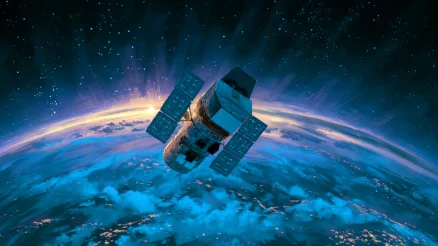

- Entangled particles share a single quantum state across any distance
- Experiments violated Bell's inequalities, ruling out hidden variables
- The 2022 Nobel Prize confirmed entanglement is genuinely quantum
Quantum entanglement is a physical phenomenon in which two or more particles share a single quantum state. Measuring one particle instantly determines the state of the other, regardless of the distance between them.
The correlation is a property of the system they share, not a signal traveling between them.
Why It Matters
Key figure
1935
Year Einstein, Podolsky, and Rosen described the paradox, and Schrodinger named it
Quantum entanglement was once a philosophical embarrassment for physics. Albert Einstein, working with Boris Podolsky and Nathan Rosen at the Institute for Advanced Study in Princeton, described it in their 1935 paper as evidence that quantum mechanics must be incomplete. The correlations were too perfect, too immediate.
Something, Einstein argued, had to be carrying the information in advance.
That argument held for nearly three decades. Then in 1964, John Bell, a Northern Irish physicist on sabbatical from CERN, devised a mathematical test. Bell's theorem showed that if hidden variables existed, the correlations between entangled particles would obey a strict numerical limit. Quantum mechanics predicted they would not.
Experiments settled the question. Stuart Freedman and John Clauser at UC Berkeley violated Bell's inequality in 1972. Alain Aspect at Universite Paris-Sud in Orsay tightened the case in 1981 and 1982 by addressing the locality loophole.
In 2022, the Nobel Committee awarded Aspect, Clauser, and Anton Zeilinger the Nobel Prize in Physics for settling the question experimentally. Einstein's embarrassment had become prizewinning physics.
Quantum entanglement is no longer a puzzle about whether quantum mechanics is real. It is becoming engineering infrastructure. Quantum computers use entangled qubits to perform calculations that classical machines cannot. Quantum key distribution uses entanglement to detect eavesdropping on encrypted channels.
Quantum sensors exploit entangled states for measurements more precise than any classical instrument allows. The transition from "Is this real?" to "What can we build with it?" is already underway.
Entanglement does not allow faster-than-light communication. The correlation only becomes visible when measurements are compared through ordinary channels.
How It Works
Key figure
1,200 km
Micius satellite entanglement distribution distance, 2017
Consider two photons produced together in a process called spontaneous parametric down-conversion. A laser strikes a special crystal, and out come two photons whose polarizations are linked by conservation laws.
Neither photon has a definite polarization until one is measured. At that moment, both polarizations become definite, correlated according to the shared quantum state.
The two photons are described by a single mathematical object, a joint wave function, that cannot be separated into independent parts. Measuring one half of this object collapses the whole thing.
The correlation was always there, written into the math from the moment the photons were created.
The distances involved have grown dramatically. In 2017, a Chinese team using the Micius satellite demonstrated entanglement distribution between ground stations separated by 1,200 kilometers, the farthest confirmed distance. The particles remained correlated, confirming that entanglement holds regardless of scale.
Key Context
Erwin Schrodinger coined the German word Verschrankung (entanglement) in 1935, the same year as the EPR paper. He considered it not "one but rather the characteristic trait of quantum mechanics," in his paper published in the Proceedings of the Cambridge Philosophical Society. Of all the strangeness quantum theory introduced, this was the feature he found most defining.
The path from paradox to prize took 87 years. The 2022 Nobel citation specifically credited "experiments with entangled photons, establishing the violation of Bell inequalities and pioneering quantum information science." Each laureate addressed a different loophole in proving that entanglement was genuinely quantum and not a classical trick.
FAQ
Can quantum entanglement be used to send messages faster than light?
No. Entanglement produces correlations, not signals. When one entangled particle is measured, the result appears random. The correlation only becomes visible when both measurements are compared, and that comparison requires classical communication at light speed or slower. This is known as the no-communication theorem.
How is quantum entanglement different from quantum superposition?
Superposition means a single particle exists in multiple states at once until measured. Entanglement means two or more particles share a joint state, so their measurement outcomes are correlated. A particle can be in superposition without being entangled, but entangled particles are always in a superposition of their combined states.
What did the 2022 Nobel Prize in Physics recognize about entanglement?
The prize went to Alain Aspect, John Clauser, and Anton Zeilinger for decades of experiments proving that entangled particles violate Bell's inequalities. Their work confirmed that quantum correlations are real, not the result of hidden variables, and laid the experimental foundation for quantum information science.
How is quantum entanglement used in quantum computing?
Quantum computers use entangled qubits to represent and process information in ways classical bits cannot. Entanglement allows qubits to influence each other's states, enabling parallel computation across superposed states. This property is what gives quantum algorithms, like Shor's factoring algorithm, their advantage over classical approaches for specific problems.
Related Reading


Sources
- Entanglement (Caltech Science Exchange)
- What Is the Spooky Science of Quantum Entanglement? (NASA Science)
- Quantum Entanglement and Information (Stanford Encyclopedia of Philosophy)
- 2022 Physics Prize press release (NobelPrize.org)
- Entanglement (University of Maryland Quantum Atlas)
- Bell's 1964 paper (CERN)
- Physics Nobel recognizes Berkeley experiment (UC Berkeley News)
- Satellite-based entanglement distribution over 1200 kilometers (Yin et al., Science, 2017)

Fact Check: Claim-by-Claim Verification Verified
Core physics accurately described. Four factual corrections applied: 12,900 km claim corrected (conflated QKD with entanglement), Freedman/Clauser institution corrected to UC Berkeley, Aspect institution corrected to Université Paris-Sud at Orsay, Schrödinger attribution corrected from "correspondence" to "published paper."
Established physics, well-documented in all authoritative sources.
Sources used for verification
Academic/Peer-reviewed:
- EPR Paradox - Stanford Encyclopedia of Philosophy
- Bell's Theorem - Stanford Encyclopedia of Philosophy
Other reliable sources:
- 2022 Nobel Prize in Physics - NobelPrize.org
- Physics Nobel Recognizes Berkeley Experiment - Berkeley News
- Fifty Years of Bell's Theorem - CERN
- 12,900 km QKD Link - ScienceDaily