


- Permanent magnets require four quantum phenomena to align simultaneously.
- Each electron behaves as a tiny magnet due to intrinsic spin.
- Only iron, nickel, cobalt, and gadolinium are ferromagnetic at room temperature.
Otto Stern and Walther Gerlach fired a beam of silver atoms through a magnetic field in February 1922. The beam split into two distinct paths.
That result proved each electron is a tiny magnet all by itself. But intrinsic electron magnetism is just the beginning of how magnets work - or specifically, how permanent magnets work.
Making a magnet that will stick to your refrigerator requires four separate phenomena to align just so. Miss any one of them and you get a metal that won't attract anything.
Key figure
4 elements
iron, nickel, cobalt, and gadolinium–the only materials that are ferromagnetic at room temperature
The Quantum Foundation For How Magnets Work
Why is an electron magnetic? Nobody knows.
The intrinsic magnetic moment of an electron is a brute fact of nature, like its charge or mass. The Stern-Gerlach experiment measured it, but measuring isn't explaining.
Classical physics offered no path forward.
Electrons don't orbit atoms like planets orbit stars. They exist in clouds, moving in all directions simultaneously. That orbital motion cancels out.
What remains is the electron's intrinsic spin. Each electron acts like a bar magnet about 700 times stronger than a proton's magnetism.
What is electron spin?
Spin is an intrinsic property of electrons, not actual physical rotation. It's a quantum mechanical phenomenon that makes each electron behave like a tiny magnet with two possible orientations: "spin up" or "spin down."
The Energy Level Puzzle
Magnetic electrons don't automatically make magnetic atoms. The configuration matters.
Quantum mechanics restricts how electrons fill atomic energy levels. Each level accepts a specific number of electrons: 2, 6, 10, or 14. The first half of electrons in each level orient their spins one direction. The second half must orient opposite.
Consider an energy level that holds ten electrons. With five electrons, all spins point the same direction. The atom has five units of magnetic strength.
Add a sixth electron and it must point opposite. Now the atom has only four units of magnetism. By ten electrons, the spins cancel completely.
The strongest magnetic atoms have their energy levels half-filled. Near-empty or near-full levels produce weak magnets.
When Crystals Align
Magnetic atoms still aren't enough. The atoms must cooperate.
When magnetic atoms assemble into crystals, quantum mechanical exchange forces about 10,000 times stronger than direct magnetic interactions kick in. In some materials, these forces prefer all atomic magnets pointing the same direction.
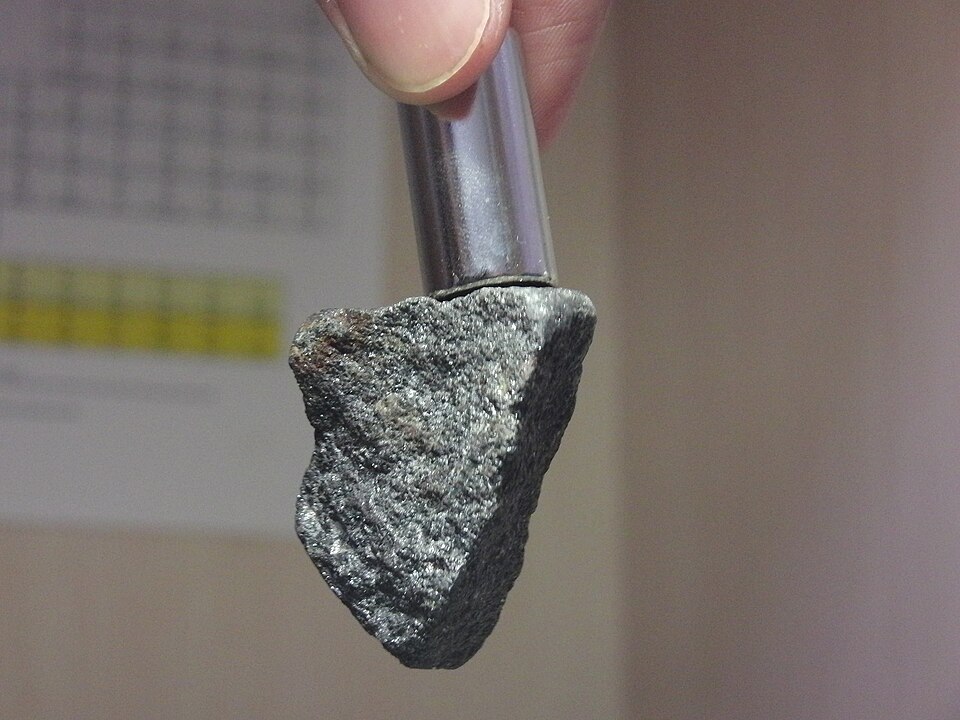
A magnetite rock is being pulled by a neodymium magnet. Image credit: GOKLuLe 盧樂 - Own work, CC BY-SA 3.0
Those materials are called ferromagnetic, after the Latin name for iron. Chromium has magnetic atoms but antiferromagnetic crystal structure. Its neighboring atoms prefer opposite orientations. No permanent magnetism emerges.
The Domain Structure
Even ferromagnetic crystals don't guarantee a magnet. Iron usually isn't magnetic.
Ferromagnetic materials naturally form small regions called magnetic domains. These domains range from the size of a flour speck to a poppy seed. Within each domain, all atomic magnets point the same direction.
But neighboring domains point different directions. Their magnetism cancels out. The material as a whole shows no external magnetic field.
Apply a strong external magnetic field and the domains rotate to align with it. Remove the field and some domains stay aligned. Now you have a permanent magnet.
Four requirements must be met: electrons with intrinsic magnetism, atoms with half-filled energy levels, ferromagnetic crystal structure, and aligned domains.
Miss any one and the material won't stick to your refrigerator.
Sources
- Primary Source: How do magnets work? (Fermilab/Don Lincoln)
- Additional Context:
- Stern–Gerlach experiment (Wikipedia)
- Right Experiment, Wrong Theory: The Stern-Gerlach Experiment (Stanford Encyclopedia of Philosophy)
- Magnetic Materials (Feynman Lectures on Physics)
- Magnetic Domains (National High Magnetic Field Laboratory)

Fact Check: Claim-by-Claim Verification Verified
The article accurately summarizes the quantum principles of permanent magnetism, aligning with established physics explanations from reliable sources.
Commentary
- Gadolinium's room-temperature ferromagnetism claim is technically inaccurate (Curie point 293 K), but minor given context.
- Electron spin strength phrasing ("700 times stronger than proton") is approximate; Bohr magneton vs. nuclear magneton ratio is ~658.
- Simplified energy level filling uses Pauli exclusion effectively; actual band theory in metals refines but preserves core idea.
Sources used for verification
Academic/Peer-reviewed:
- Right Experiment, Wrong Theory: The Stern-Gerlach Experiment - plato.stanford.edu
- The Feynman Lectures on Physics Vol. II Ch. 37: Magnetic Materials - caltech.edu
Other reliable sources:
- Stern–Gerlach experiment - wikipedia.org
- Magnetic Domains Tutorial - nationalmaglab.org
Fact-checked by Perplexity Sonar Pro on 2026-02-03


