


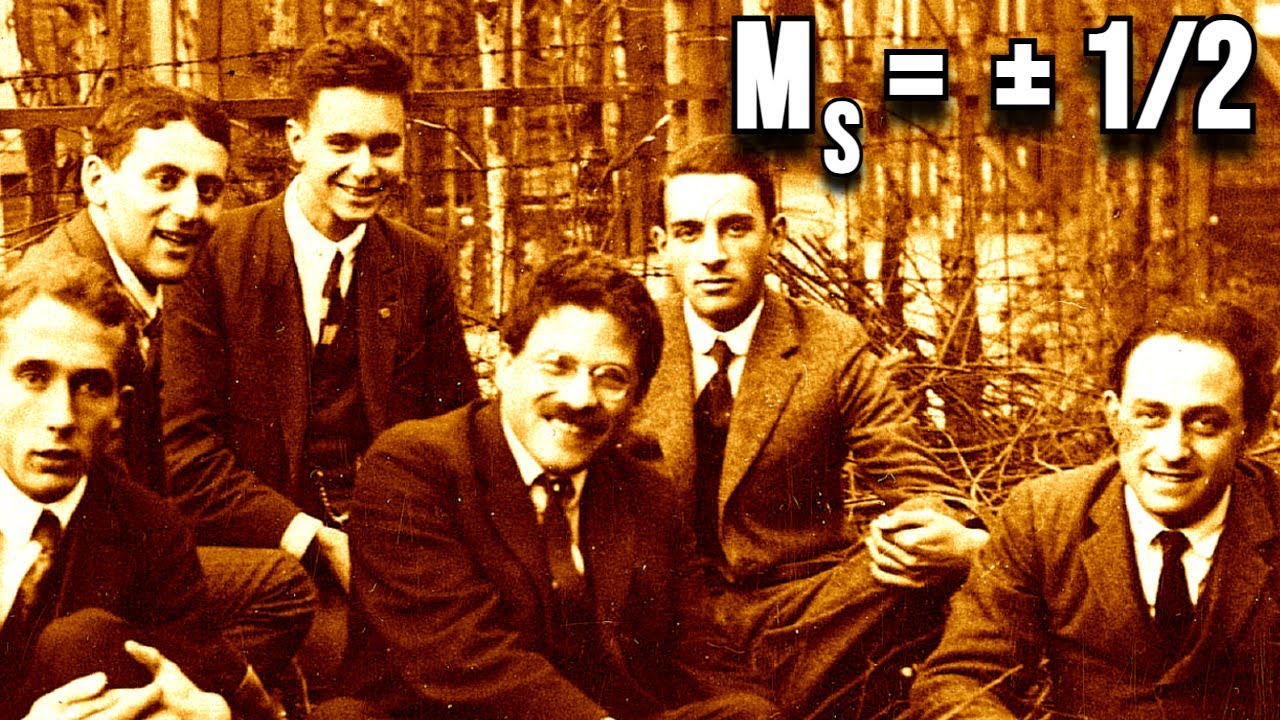

- Two graduate students discovered electron spin in 1925 under Ehrenfest's mentorship
- The Stern-Gerlach experiment unknowingly provided the first evidence years earlier
- Their calculations were off by a factor of two, later explained by Thomas precession
When George Uhlenbeck heard about Wolfgang Pauli's exclusion principle in 1925, he had an instant revelation that would reshape physics forever.
In a video from the Rational Thinker YouTube channel, the remarkable story unfolds of how two Dutch graduate students accidentally discovered electron spin - one of quantum mechanics' most fundamental properties.
Key figure
2
Components the silver atom beam split into – the first evidence of electron spin
The Mystery That Started It All
The puzzle began decades earlier when Albert Michelson and Edward Morley noticed something strange while studying hydrogen's spectral lines. Using Michelson's interferometer, they expected smooth interference patterns as they adjusted wavelengths.
Instead, the intensity unexpectedly picked back up after fading. The emission lines were splitting into pairs separated by tiny wavelength differences.
This "fine structure" baffled scientists for decades. Niels Bohr's atomic model couldn't explain it. Arnold Sommerfeld's addition of elliptical orbits and relativity helped, but still fell short.
The Stern-Gerlach Surprise
Otto Stern and Walter Gerlach designed an experiment to test whether atoms had magnetic moments. They shot silver atoms through a magnetic field, expecting either a concentrated beam or a split based on competing theories.
The beam split into exactly two components. They thought they'd proven Sommerfeld's quantum theory correct.
They had actually discovered evidence of electron spin - but wouldn't realize it for years.
What is electron spin?
Electron spin is an intrinsic property of electrons, like mass or charge. Despite the name, the electron is not physically rotating – spin is a quantum property with no classical equivalent. Each electron spins either "up" or "down," giving it a tiny magnetic moment. This two-valued nature explains why atomic beams split in two and why electrons pair up inside atoms.
The Students Who Connected the Dots
Samuel Goudsmit and George Uhlenbeck were studying under Paul Ehrenfest at Leiden University. Ehrenfest was legendary for encouraging wild ideas and creating collaborative environments where students could freely exchange thoughts.
When Pauli proposed his exclusion principle requiring a mysterious fourth quantum number with "two possible states," Uhlenbeck immediately grasped the implication.
The electron must be spinning.
But don't you see what this implies? It means that there is a fourth degree of freedom for the electron. It means that the electron has a spin - that it rotates.
George Uhlenbeck, Dutch-American Physicist
Ehrenfest published their findings despite Uhlenbeck's last-minute panic about potential errors.
The Factor of Two Problem
There was indeed a mistake - their calculations were off by exactly a factor of two. Werner Heisenberg immediately wrote asking about this discrepancy.
The error actually strengthened their case. When Llewellyn Thomas worked out the relativistic correction called "Thomas precession," it perfectly explained the factor of two.
Even Wolfgang Pauli, initially the biggest opponent of electron spin, finally accepted the concept.
More On Electrons
Why Electron Orbitals Look Nothing Like Planetary Orbits
Forget the solar system model - electrons exist as standing waves in strange globular shapes that emerge from pure mathematics.
→The Stern-Gerlach experiment was reinterpreted as the first experimental evidence of electron spin. The silver atoms split not because of orbital motion, but because electrons possess intrinsic angular momentum that creates magnetic moments.
Goudsmit and Uhlenbeck succeeded where others failed partly because of Ehrenfest's mentorship. As Goudsmit noted, if Ralph Kronig had stayed with Ehrenfest instead of being discouraged by Pauli, "things would have taken another course."
Sometimes the most fundamental discoveries come from students brave enough to publish "crazy" ideas - and mentors wise enough to encourage them.

Fact Check: Claim-by-Claim Verification Verified
The recap closely follows the Rational Thinker video and standard historical accounts of the discovery of electron spin, with only minor simplifications typical of popular science.
Commentary
- The opening line about Uhlenbeck’s “instant revelation” when hearing Pauli’s exclusion principle is a dramatized reconstruction of his insight, but it reflects the actual historical link between Pauli’s two-valued quantum number and the spin proposal rather than contradicting the source.
- The article says Michelson and Morley “noticed something strange” while adjusting wavelengths with the interferometer; historically they measured fine-structure splittings with high precision, and the video similarly dramatizes their observations, so this is a stylistic simplification rather than a factual error.
- The statement that the Stern–Gerlach experimenters “thought they’d proven Sommerfeld’s quantum theory correct” compresses a more nuanced theoretical context; still, it mirrors how the video frames their interpretation and is not misleading within that popular-level context.
- Attributing Pauli’s initial strong skepticism about spin and his later acceptance after the Thomas precession correction is historically sound, though the article (like the video) does not go into Pauli’s detailed objections or later theoretical work.
Sources used for verification
- Rational Thinker – How Electron Spin Was Discovered (YouTube)
- Lorentz Institute (Leiden) – Discovery of electron spin
- Fine structure – background on Michelson & Morley’s hydrogen measurements
- Shankland – Michelson–Morley experiment and hydrogen fine structure
- LibreTexts – Stern–Gerlach experiment
- Stern–Gerlach experiment – historical context
- Pauli exclusion principle – history and identification with spin
- CERN Courier – Historical discussion of Pauli, Kronig, Goudsmit, Uhlenbeck, and Thomas
- Rowdy Boeyink – George Uhlenbeck and the discovery of electron spin (historical PDF)
Fact-checked by Perplexity Sonar Pro on 2025-12-15


