


Updated April 7, 2026
- Heaviside's 1876 telegrapher's equations solved the signal distortion plaguing early telegraphs.
- He identified inductance as the missing factor in electrical signal transmission.
- His equations replaced Thomson's diffusion model, enabling reliable long-distance communication.
Oliver Heaviside had never attended university.
In 1876, the 26-year-old recluse published a paper called "On the Extra Current" in the Philosophical Magazine. Working from his parents' home in London, he had done something no trained scientist had managed: he had derived equations explaining how signals actually travel through wires.
The problem Heaviside solved had crippled communications for two decades.
When the first transatlantic telegraph cable connected Ireland to Newfoundland in August 1858, Queen Victoria's celebratory message to President James Buchanan took more than sixteen hours to transmit.
The cable failed within weeks.
Key figure
16+ hours
Time for Queen Victoria's 98-word telegram to cross the Atlantic in 1858
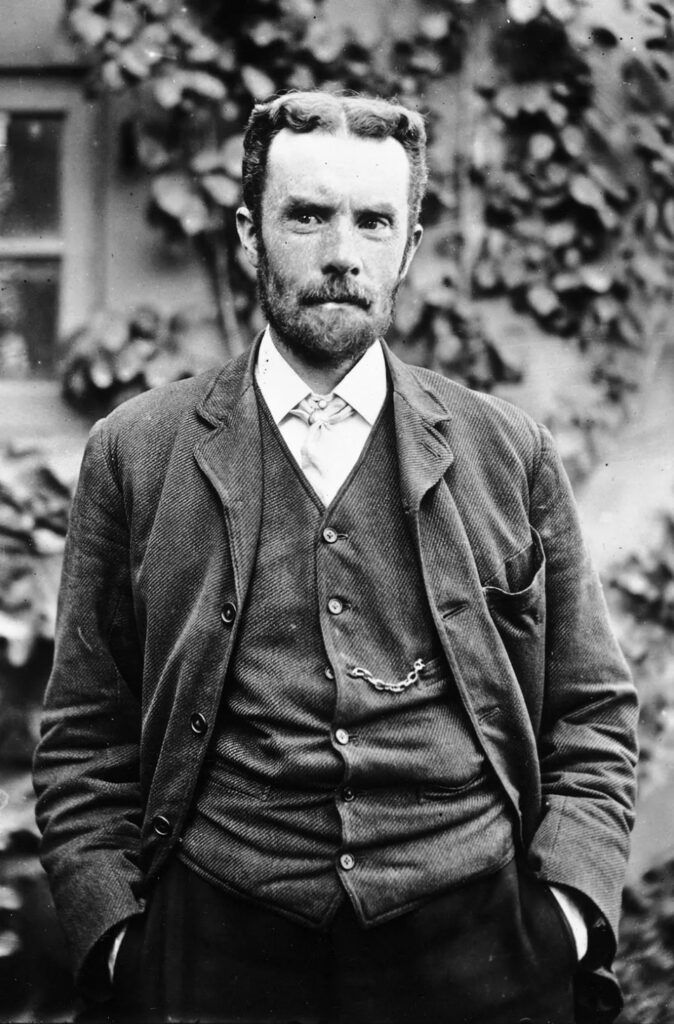
Oliver Heaviside (1850-1925), British mathematician and electrical engineer.
What Thomson Got Wrong
William Thomson, later Lord Kelvin, had built the theoretical foundation for that cable. His 1855 model treated electrical signals like heat spreading through metal. Voltage diffuses along a wire the way warmth spreads through a rod.
Thomson's mathematics worked well enough for short cables. Over 2,000 miles of ocean, the equations predicted exactly what happened: signals smeared into unreadable noise.
What is signal diffusion?
In diffusion, different frequencies travel at different speeds. High frequencies arrive first but decay fastest. Low frequencies arrive last. By the time a pulse crosses the Atlantic, the frequencies have separated so completely that the original signal disappears.
The transatlantic cable proved Thomson right about diffusion. It also proved his theory incomplete.
What Heaviside Found in Maxwell
Heaviside had taught himself mathematics by studying Maxwell's 1873 Treatise on Electricity and Magnetism. Most physicists found Maxwell's work impenetrable. Heaviside saw something transformative.
I remember the first look at the great Treatise of Maxwell when I was a young man... I saw that it was great, greater and greatest, with prodigious possibilities in its power. I was determined to master the book and set to work.
Oliver Heaviside, 1923
Maxwell had shown that accelerating charges create electromagnetic waves. Heaviside realized this applied to telegraph cables.
When current accelerates through a wire, it creates a voltage drop that Thomson's model ignored. Heaviside named this property inductance. The effect changes everything.
In Thomson's diffusion model, what goes in always spreads out. With inductance, the voltage along the wire matches the voltage at the source. The signal maintains its shape.
This is no longer diffusion. It is a wave.
The Equations That Still Work
More on Signals

Gravitational Wave Hunters Find Hidden Signals on a Desktop
While physicists waited decades for space missions, tabletop detectors cracked open a frequency band that was supposed to be unreachable from Earth.
→Heaviside published equations incorporating both phenomena. Signals in real cables both diffuse and propagate as waves. The balance depends on the cable's physical properties.
His work explained why the transatlantic cable failed. More importantly, it showed how to build cables that would work. Add enough inductance, and signals travel without distortion at any distance.
Heaviside spent decades expanding these ideas. He reduced Maxwell's twenty equations to four. He invented vector calculus to express them cleanly. He predicted the ionosphere.
The scientific establishment largely ignored him. Heaviside never held an academic position. He became increasingly reclusive, eventually dying in poverty in 1925.
His equations govern every cable carrying internet traffic across oceans today. The self-taught telegrapher had solved transmission lines forever.
The Man They Tried to Silence
Heaviside's theory had a powerful enemy. William Preece, Chief Engineer of the General Post Office, had publicly declared self-inductance the "bête noire" of clear transmission. Heaviside's work proved exactly the opposite: inductance was the solution, not the problem.
Preece could not allow that contradiction to stand. In 1887, he blocked Heaviside's paper on inductive loading from reaching the wider scientific community.
Heaviside turned to The Electrician, a trade journal whose editor, C.H.W. Biggs, had published his work since 1882. Through the summer of 1887, Heaviside sent caustic letters attacking "the eminent scienticulist," as he called Preece. Biggs, though sympathetic, feared a libel suit and declined to publish them.
That October, Biggs was abruptly removed as editor. Heaviside was convinced Preece had engineered the sacking. His long-running series of articles stopped cold.
Two physicists rescued his reputation. George FitzGerald of Trinity College Dublin and Oliver Lodge, then at University College Liverpool, championed Heaviside's ideas in forums where a self-taught recluse could not. Lodge called his writings evidence of "singular insight" and "a masterly grasp of a most difficult theory."
In 1891, The Electrician resumed publishing Heaviside's work. That same year, the Royal Society elected him a Fellow. Preece's campaign had failed, though it cost Heaviside three productive years.
Predicting the Invisible Shield
In December 1901, Guglielmo Marconi transmitted a radio signal from Cornwall to Newfoundland. The demonstration was spectacular, but it posed a problem. Radio waves travel in straight lines. The Earth curves. Something must have bent the signal around 2,000 miles of ocean.
Heaviside proposed an answer in December 1902: a conducting layer in the upper atmosphere that reflected radio waves back toward the surface. Arthur Kennelly, a former assistant to Thomas Edison working at Harvard, published the same idea independently nine months earlier, in March of that year.
Neither man could prove it. The technology to test the hypothesis did not yet exist.
It took another two decades. In December 1924, the Cambridge physicist Edward Appleton and his graduate student Miles Barnett devised an experiment using BBC radio transmissions. By measuring how signals faded in and out as frequency shifted, they calculated that reflections were returning from roughly 100 kilometers above the Earth's surface.
The conducting layer was real. It became known as the Kennelly-Heaviside layer, later understood as part of the broader ionosphere. Appleton received the 1947 Nobel Prize in Physics for the discovery.
The name lingers in an unexpected place. T.S. Eliot referenced the Heaviside Layer in drafts for Old Possum's Book of Practical Cats. Andrew Lloyd Webber built the climax of his 1981 musical Cats around it: a chosen cat ascends to the Heaviside Layer to be reborn. A reclusive Victorian engineer, immortalized in a Broadway show tune.
Why Your Phone Still Uses His Math
Heaviside's telegrapher's equations describe voltage and current as coupled waves moving through any linear transmission medium. That description did not expire with the telegraph.
Every printed circuit board in a modern smartphone treats its copper traces as transmission lines when signals exceed a few hundred megahertz. Engineers use Heaviside's equations to calculate trace impedance, predict signal reflections, and prevent the ringing that corrupts data. At 28 GHz, the frequencies used by 5G millimeter-wave networks, current flows in a skin depth of roughly one micrometer. Getting the math wrong by a fraction means the signal never arrives.
The same framework governs RF and microwave circuit design, where transmission line models determine how antennas, filters, and amplifiers behave. Analogues of the telegrapher's equations describe pulse broadening in fiber optic cables, the medium that now carries 95% of intercontinental data traffic.
Roughly 550 submarine cables crisscross the ocean floor today. Their engineering still begins where Heaviside began: with the balance between resistance, inductance, capacitance, and conductance along a line.
Heaviside received no patent royalties. In 1899, a decade after Heaviside published his inductive loading theory, the Serbian-American engineer Michael Pupin patented the practical application and sold the rights to AT&T for $500,000. Heaviside died in 1925 with almost nothing. His equations earned fortunes for others.
Sources
- Primary Source: The Story of the Telegrapher's Equations (Visual Electric)
- Additional Context:
- Oliver Heaviside's electromagnetic theory (Royal Society Philosophical Transactions)
- Oliver Heaviside: A first-rate oddity (Physics Today)
- The Rivalry Between Sir William Henry Preece and Oliver Heaviside (DX Engineering)
- Oliver Heaviside biography (MacTutor, University of St Andrews)
- Edward Appleton Nobel Lecture, 1947 (Nobel Prize)
- Cats and the Heaviside Layer (Science Museum Blog)
- Oliver Heaviside and the Heaviside layer (Royal Society Philosophical Transactions)
- Oliver Heaviside (Encyclopedia.com)

Fact Check: Claim-by-Claim Verification Verified
The article accurately represents historical facts about Oliver Heaviside's contributions to telegraph equations, signal transmission, and related events, with appropriate simplifications for popular science.
Commentary
- The quote attributed to Heaviside about Maxwell's Treatise aligns with his documented admiration, though exact 1923 phrasing unverified; context is accurate.
- Telegrapher's equations were further developed in series through 1880s; 1876 paper initiated the core insight on "extra current" (self-induction).
- Thomson's model date given as 1855 (article says 1855); aligns with law of squares derivation for cables.
- Dramatic phrasing like "solved signal transmission" and "recluse" is suitable for popular science without factual inaccuracy.
Sources used for verification
Academic/Peer-reviewed:
- Oliver Heaviside's electromagnetic theory - royalsocietypublishing.org
- Oliver Heaviside: A first-rate oddity - pubs.aip.org
- A derivation of Maxwell's equations using the Heaviside notation - royalsocietypublishing.org
- The missing elements in the telegraph equations - arxiv.org
- Oliver Heaviside Biography - st-andrews.ac.uk
Other reliable sources:
- Telegrapher's equations - wikipedia.org
- Transatlantic Cable - ethw.org
Fact-checked by Perplexity Sonar Pro on 2026-02-21


