


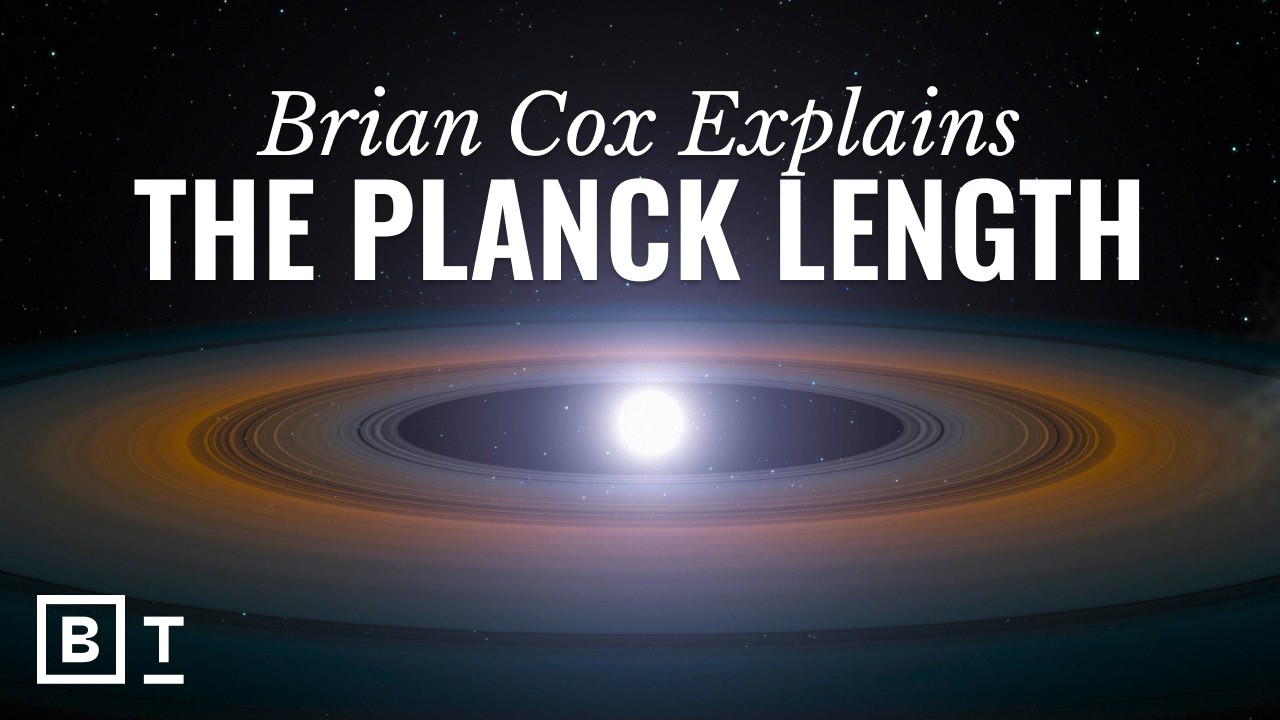

- The Planck length is the smallest measurable distance in physics.
- Observing anything smaller creates a black hole.
- Black hole entropy is measured in square Planck lengths.
The Planck length is the smallest distance that physics can describe. In a Big Think interview, Brian Cox, the University of Manchester particle physicist, argues that our familiar units tell us nothing fundamental about nature.
The metre, the foot, the inch: these are biological accidents. They reflect cell size, body proportion, the particular gravity of one planet.
The real unit of distance, Cox suggests, comes from the universe itself.
Max Planck Found a Length Hidden in Three Numbers
In the late nineteenth century, the German physicist Max Planck spotted something peculiar. Three constants (the speed of light, the gravitational constant, and his own quantum constant) could be combined into a single length.
More On Black Hole Physics

Black Hole Information Paradox: Could Spacetime Remember?
Physicist Florian Neukart proposes spacetime stores quantum information at the Planck scale, offering a new approach to the black hole information paradox.
→The formula is deceptively compact. Take Planck's constant multiplied by Newton's gravitational constant, divide by the cube of the speed of light, then take the square root.
The result is absurdly small. The Planck length measures roughly 10⁻³⁵ metres.
That number would be a mathematical curiosity if it stayed on paper. It did not.
Try to See Anything Smaller, and You Create a Black Hole
Here is where the physics becomes genuinely strange. To observe something tiny, you must bombard it with light of a correspondingly short wavelength.
Shorter wavelengths mean higher-energy photons. Cox explains that as you approach the Planck scale, the energy concentrated in that region becomes so extreme that it collapses spacetime.
You form a black hole. Push harder, and the black hole grows.
The Planck length appears to be the smallest distance at which observation remains possible. Below it, the act of looking destroys what you are trying to see.
What is the Planck length?
A natural unit of distance derived from three fundamental constants: the speed of light, Newton's gravitational constant, and Planck's constant. At roughly 10⁻³⁵ metres, it represents the scale where quantum mechanics and gravity collide, making further measurement physically impossible.
Black Holes Store Information in Planck-Sized Pixels
In the 1970s, the American-Israeli physicist Jacob Bekenstein demonstrated something remarkable. A black hole's entropy (the total information hidden inside it) equals the surface area of its event horizon measured in square Planck lengths.
Cox calls this result "astonishing," and the adjective fits.
It suggests that the Planck length is not merely a limit of observation. It may be a building block of space itself.
Key figure
10⁻³⁵ metres
The Planck length: the smallest scale at which physics can still describe reality.
Cox is characteristically careful with this claim. "It would seem so," he says of the pixel interpretation, "but this is where we're at the edge of our current understanding."
A Dying Star Confirms the Constants Matter
The most striking connection Cox draws links the Planck scale to something visible through a telescope. In the 1930s, the Indian-American astrophysicist Subrahmanyan Chandrasekhar calculated the maximum mass a white dwarf star can sustain before collapsing further.
The answer: 1.4 times the mass of the Sun. It depends on exactly the same three constants that define the Planck length.
Cox describes this as "the best example I know of the relationship between these rather abstract quantities and something that you can look at in a telescope."
The Chandrasekhar limit equals, roughly, the Planck mass cubed divided by the proton mass squared. Three numbers from quantum mechanics and gravity predict how massive a star can be before its electrons can no longer hold it up.
It's a very, very beautiful calculation, but it's the best example I know of the relationship between these rather abstract quantities and something that you can look at in a telescope.
Brian Cox, University of Manchester
Extra Dimensions Could Change the Number
Cox adds one important caveat. Theories involving extra spatial dimensions, tested at facilities like the Large Hadron Collider, could shift the effective strength of gravity at high energies. If those dimensions exist, the Planck length might be larger than 10⁻³⁵ metres.
The Planck length itself appears fundamental. Its precise numerical value depends on measurements that future experiments could revise.
Three constants define the smallest meaningful distance in physics. The universe apparently enforces it with black holes.
Whether that distance also reveals the grain of space remains, as Cox puts it, "at the edge of our current understanding."
Sources
- Primary Source: Brian Cox: The Planck scale is where physics breaks (Big Think, 2025)
- Video: Brian Cox breaks down the most mysterious scale in the cosmos (Big Think YouTube)
- Additional Context:
- Planck units (Wikipedia)
- Planck length (Britannica)

Fact Check: Claim-by-Claim Verification Verified
All major factual claims are accurate: the Planck length value (10⁻³⁵ m), the three constants used to derive it, Bekenstein's 1970s work on black hole entropy and surface area, Chandrasekhar's 1930s calculation of the 1.4 solar mass limit, and the general physics principles described.
Commentary
- The article correctly attributes Bekenstein's work to "the 1970s" without specifying 1973. This is standard for popular science and not inaccurate.
- The statement that Planck length marks "the smallest distance physics can describe" is appropriate for popular science, though more precisely it represents a scale where quantum gravity effects become dominant rather than a hard minimum imposed by physics itself. The article contextualizes this appropriately through Cox's discussion of measurement and black hole formation.
- The Chandrasekhar limit description as "maximum mass a white dwarf star can sustain before collapsing further" is accurate, though the article does not specify that it collapses into neutron stars or black holes—a reasonable omission for scope.
- The article's explanation of black hole formation through high-energy measurement reflects the semiclassical calculation combining quantum uncertainty (Heisenberg principle) with the Schwarzschild radius, which is standard in physics education.
Sources used for verification
Academic/Peer-reviewed:
- Black Holes and Entropy - Physical Review D (Bekenstein, 1973)
- CODATA Value: Planck length - NIST (2022 CODATA recommended values)
- Bekenstein-Hawking Entropy: A Brief Overview - arXiv
Other reliable sources:
- Planck Length - COSMOS (Centre for Astrophysics and Supercomputing)
- Chandrasekhar Limit - COSMOS
- Planck time and length - The Open University
- The Planck scale - Symmetry Magazine
Fact-checked by Perplexity Sonar Pro on 2026-03-11


