



- AI cannot solve physics' core problem: the experiments needed don't yet exist.
- Quantum computers generate genuinely new data — Hossenfelder's one source of real hope.
- AI trained on bad theoretical physics will learn to reproduce it, not transcend it.
Sabine Hossenfelder has a simple answer to the optimists: the bottleneck in physics is not analysis, and no amount of AI can fix a data shortage.
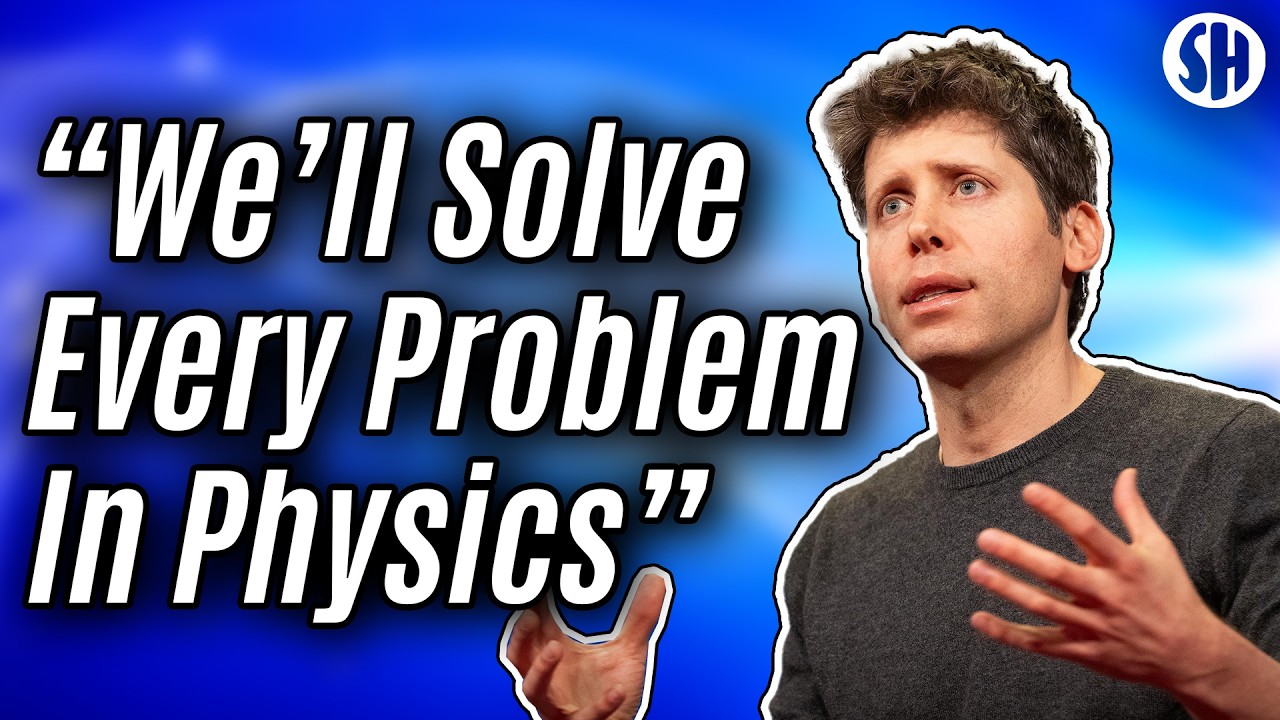
In June 2025, OpenAI CEO Sam Altman wrote that by 2035 we might go from solving high-energy physics one year to beginning space colonization the next.
In a characteristically precise video, the Munich-based physicist and Science with Sabine host walks through what AI could plausibly do for the hardest open problems in physics, and where the optimism breaks down.
The Problem Is Not the Analysis
Hossenfelder's central argument is blunt: the bottleneck in fundamental physics is not analytical power. It is data.
Dark matter, quantum gravity, the origin of the universe - none of these problems are stuck because physicists lack clever tools to process existing observations. They are stuck because the observations needed to distinguish between competing theories do not yet exist.
What are the foundations of physics?
Physicists use "the foundations" to mean the deepest layer of how the universe works: quantum mechanics, gravity, the nature of space and time. The Standard Model of particle physics, completed in the mid-1970s, remains the last successful theory at this level. Everything since - dark matter candidates, string theory, loop quantum gravity - has produced no confirmed predictions beyond what was already known.
High-energy physics, she notes, is the one area with genuinely large datasets. Particle collisions at the Large Hadron Collider produce staggering volumes of information. Physicists there have used machine learning for decades. Hossenfelder is skeptical that any new AI system will squeeze something genuinely new from that data. There just, as she puts it, isn't anything left to find there.
Key figure
50+ years
Since the Standard Model was completed in the early 1970s – the last confirmed advance in fundamental physics
One more promising exception she mentions: quantum computers. They generate genuinely new data, the kind that may contain surprises no one has spotted yet. Hossenfelder says this gives her real hope. It is, notably, the most measured hope she offers in the entire video.
When Math Meets Physics
The stronger part of Hossenfelder's argument concerns theory generation. It builds on a distinction between mathematics and physics that deserves careful attention.
AI has made striking progress in mathematics. In May 2025, Scientific American reported on a gathering of thirty of the world's leading mathematicians at Berkeley. They spent two days designing problems to stump a reasoning model powered by OpenAI's o4-mini. By the end, some were struggling to find questions it couldn't handle.
Ken Ono, a number theorist then at the University of Virginia and one of the meeting's judges, told the magazine that colleagues were saying the models were approaching mathematical genius. Ono found the experience unnerving enough that he has since left academia to join Axiom Math, a Silicon Valley startup dedicated to building AI tools for mathematical research.
Physics, Hossenfelder argues, is a different matter entirely.
Mathematical proofs are, at their core, logical structures. Feed an AI enough proofs and it can learn the methodology. Physics requires something more: a theory must not only be logically consistent, it must correspond to measurable reality. There is no shortage of mathematically elegant theories that fail this second test completely.
Almost all the theories in the foundations of physics are junk. They're mathematical fiction. They have no relation to reality.
Sabine Hossenfelder, "Will AI Save Physics?"
This is not a minority position. In a separate interview with FirstPrinciples, Hossenfelder described the existing theory pipeline in blunt terms: simulate numbers, invent a particle with no independent motivation, submit, publish. AI trained on that literature will, she argues, learn to reproduce it faithfully. That is not progress. It is automated noise.
What Hossenfelder Says AI Might Actually Change
Hossenfelder is not dismissive of AI as a scientific tool. She finds genuine promise in two areas that don't require new data or new theory.
The first is literature synthesis. The volume of published papers now exceeds what any individual can track. It is plausible, she suggests, that a solution to some foundational problem already exists in the literature, unrecognized because no one has connected the right threads. An AI capable of reading across fields might surface those connections. She considers this possibility real but unlikely, as the field tends to recycle the same approaches in the same communities.
The second is more speculative. A sufficiently intelligent future AI might learn from the history of successful physics to find a better methodology altogether – not just more theories, but a better way to generate theories worth testing. Hossenfelder thinks this is possible. She also thinks it is far off.
The Gap No One Wants to Talk About
What Hossenfelder is describing is a structural asymmetry. The parts of science that AI handles well, like pattern recognition, proof construction, and literature retrieval, are not the parts blocking fundamental physics. But generating genuinely novel theoretical frameworks that make contact with scarce, expensive, hard-to-obtain data - those are precisely the parts AI cannot yet touch.
There is something quietly important in Ono's trajectory. A mathematician who spent years gently mocking AI hype changed his mind when confronted with the evidence at Berkeley. His field is genuinely under pressure. Hossenfelder's field (physics) is not, by her own careful account. At least not for the same reasons, and not yet on the same timeline.
The Standard Model has stood unchallenged for more than fifty years. What breaks it open will require, in some form, new experimental access to regimes physics has not reached. Whether AI accelerates the path to that data through better instrument design, smarter analysis of quantum computing outputs, or some approach not yet conceived, is an open question.
Hossenfelder's answer, for now, is: watch the quantum computers, and ask again in five years.
Go Deeper
- The Gentle Singularity – Sam Altman - The June 2025 blog post that prompted Hossenfelder's response, outlining Altman's timeline for AI-driven scientific discovery
- Inside the Secret Meeting Where Mathematicians Struggled to Outsmart AI – Scientific American - The Berkeley gathering where thirty top mathematicians tested an AI reasoning model, with Ken Ono as judge
- Sabine Hossenfelder on AI, Bad Physics & Science Reform – FirstPrinciples - Extended interview covering Hossenfelder's broader critique of AI-generated theory papers

Fact Check: Claim-by-Claim Verification Verified
All claims verified against named sources: Sam Altman's blog, Scientific American, FirstPrinciples interview. Researcher affiliations and quotes confirmed.
Commentary
- Ono took a "leave" from UVA rather than fully leaving academia; he still supervises students remotely.
- Hossenfelder's Munich affiliation may have ended in 2025.
- The article is primarily commentary/review, not a research article, so claims are mostly attributed opinions rather than empirical facts.
Sources used for verification
Other reliable sources:
Fact-checked by Perplexity Sonar Pro on 2026-03-15


