


- Super-recognisers make more fixations and sample faces more broadly than typical viewers.
- Their gaze patterns capture identity information of higher computational value.
- Short training programs cannot replicate super-recogniser ability in average people.
Some people can glance at a stranger's face once and recall it perfectly years later. They're called super-recognisers, and researchers in Australia just figured out part of their secret.
Robin Kramer, a psychologist who works with facial recognition, writes in The Conversation how the team used eye-tracking technology to record exactly where super-recognisers look when learning a new face.
What is eye-tracking technology?
Eye-tracking uses infrared sensors or cameras to record exactly where a person's gaze lands on a screen or image, and for how long. It maps the sequence of fixation points – the spots the eye pauses on – to reveal what information someone actually processes, rather than what they say they look at.
They then reconstructed those gaze patterns to see what information they actually captured.
Key figure
9 DNNs
Separate AI neural networks all confirmed super-recognisers sample more useful face identity information
More Stops, Less Eye Contact
Super-recognisers make more fixations across a face - they stop and focus on more points - while spending less time staring at the eyes compared to typical viewers. Their attention spreads broadly, sampling information from the whole face rather than zeroing in on familiar landmarks.
The Australian researchers took this a step further. They compiled all the regions each participant viewed into a composite image, then tested whether those composites contained enough useful identity information to distinguish between photos of the same person versus different people.
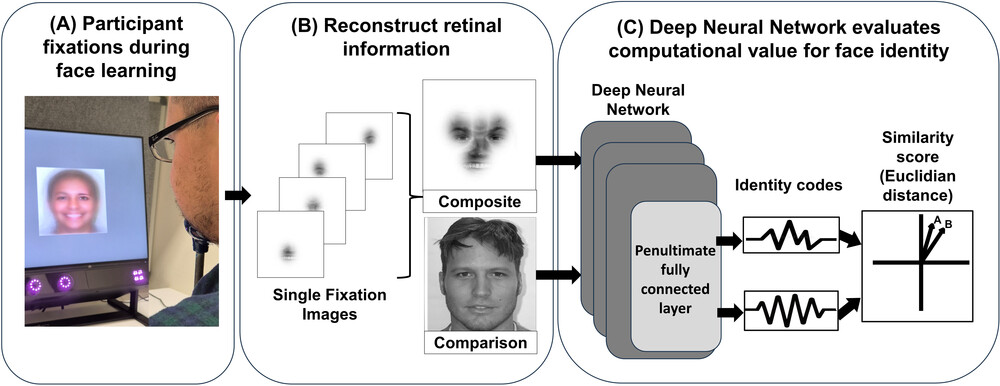
Super-recognisers accessed more valuable information. Even after accounting for the fact that they simply looked at more of the face, the quality of their information was still higher.
Why Training Doesn't Work
What makes this significant is that super-recognisers look at faces differently from the very earliest stages of viewing. This ability appears to have a strong genetic basis, which explains why short training programs consistently fail to improve average people's face recognition skills.
Our study shows that active visual exploration behaviour when learning new faces is functional for the task of face recognition.
Quote from the November 25 Research Paper
There's an exception: forensic facial examiners. These professionals perform just as well as super-recognisers when comparing unfamiliar face images, presumably because of extensive training focusing on useful features like ears and facial marks. That lengthy process takes years, not weeks.

Super-recognizers sample more retinal information during face learning. Top panel shows composite images by spotlight size and sampling type. Bottom panel shows nine DNNs achieved higher identity matching accuracy (AUC scores) across six spotlight sizes when using super-recognizer-sampled information versus typical viewers or random generation. Credit: The authors
So there may be two types of face experts - those with natural ability and those with intensive training. Or examiners might pursue this career precisely because they start with innate talent.
The other extreme exists too. People who struggle to recognize even close friends and family are called prosopagnosic or face blind, either from birth or after brain injury.
Although researchers have known about super-recognisers for nearly two decades, studies like this one are still uncovering what makes them excel.
The way someone explores a face during those first few seconds of learning appears to play a crucial role in how well they'll recognize that person later - whether they're naturally gifted or somewhere in the middle with the rest of us.

Fact Check: Claim-by-Claim Verification Verified
All claims verified against the primary paper in Proceedings of the Royal Society B, UNSW press materials, and independent sources. Study methodology, key findings, and broader context (genetics, training, prosopagnosia) all confirmed. Old inline fact-check block removed.
Commentary
- "Recall perfectly" is slightly hyperbolic — super-recognisers excel but are not infallible in all scenarios.
- The study used still images in lab tasks, not real-world dynamic encounters, though the pattern is consistent across multiple studies.
- The framing of "two types of face experts" (innate vs trained) is a simplification; many forensic examiners may start above average ability.
Sources used for verification
Academic/Peer-reviewed:
- Dunn et al. (2025) - Proceedings of the Royal Society B
- Face recognition heritability - PNAS 2010
- Forensic examiners vs super-recognisers - PMC
- Facial examiner expertise - PNAS
Other reliable sources:
- UNSW press release
- Super-recognisers coined - Harvard Gazette
Fact-checked by Perplexity Sonar Pro on 2026-03-14


