




Updated May 24, 2026
- Alcubierre's 1994 drive moves space around a ship, not the ship itself.
- The original design needs negative energy no known matter supplies.
- A 2024 positive-energy design works, but only below light speed.
Miguel Alcubierre was a graduate student in Wales, half-watching Star Trek, when he started wondering whether the Enterprise had a point. Not the dialogue. The warp drive.
In 1994 the Mexican theoretical physicist wrote down a solution to Einstein's equations that did something the equations were not supposed to allow: it moved a spacecraft faster than light without breaking a single local rule.
His trick was to leave the ship still and move space instead. Contract spacetime in front, expand it behind, and ride the distortion like a surfer on a wave nobody is paddling.
The occupants feel nothing. From inside the bubble, as cosmologist Paul Sutter of Johns Hopkins University writes for Space.com, they are not moving at all. The destination simply arrives.
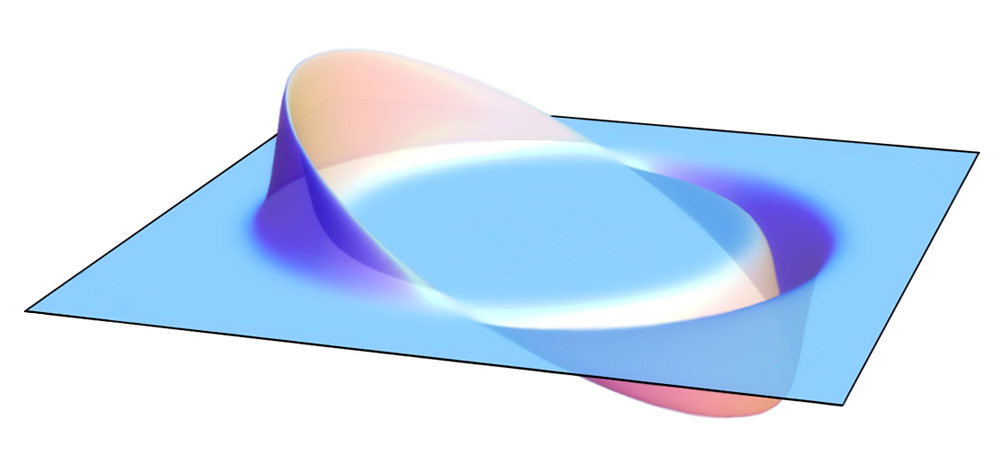
Two-dimensional visualization of an Alcubierre drive, showing the opposing regions of expanding and contracting spacetime that displace the central region. Image credit: AllenMC. CC BY-SA 3.0.
Why the Math Demanded Something That Does Not Exist
The catch surfaced almost immediately. To bend space the way Alcubierre wanted, you need negative energy, a substance with less than nothing in it. Physics has no shelf where such material sits.
The early numbers were absurd. In 1997 Michael Pfenning and Larry Ford applied the rules of quantum field theory to the design and concluded that a galaxy-crossing bubble would need negative energy on a scale comparable to the mass of the entire visible universe. Their verdict: physically unreasonable.
A 30-meter bubble, Sutter notes, would by one estimate demand ten times more negative energy than all the positive energy in existence.
Key figure
30 years
Since Alcubierre proposed his warp drive, and the negative-energy version still has no physical fuel
Physicists chipped at the figure for years. Chris Van Den Broeck showed that radically reshaping the bubble, a tiny outer shell wrapping a large inner volume, could slash the requirement by many orders of magnitude. Each refinement made the engineering less insane, but none of it conjured negative matter into being.
The Casimir effect offered a tease. Two metal plates held close in a vacuum trap fewer quantum fluctuations between them than outside, producing a sliver of genuine negative energy density.
What is negative energy?
In everyday physics, energy is always positive or zero. Negative energy means a region with less energy than empty space itself, an idea that quantum mechanics permits in tiny, fleeting amounts but that no known material supplies in bulk. The Casimir effect produces it between metal plates, though only in quantities far too small to warp space.
The amount is real. It is also vanishingly small, the wrong tool by something like sixty orders of magnitude. For three decades, that gap is where the dream stalled.
The Loophole: Trade Light Speed for Real Physics
Then the question changed. Instead of asking how to find negative energy, a few physicists asked what a warp drive could do without it.
In 2021 Alexey Bobrick and Gianni Martire argued that a whole family of warp bubbles could be built from ordinary positive energy, provided they stayed below light speed. The same year Erik Lentz described soliton-based drives running on positive energy, a claim other physicists still contest.
The decisive paper came in 2024. A team led by Jared Fuchs at the company Applied Physics, working with researchers at the University of Alabama in Huntsville, published a "constant velocity physical warp drive" that satisfies all of general relativity's energy conditions. No exotic matter required.
Their bubble works like a conveyor belt. Large amounts of perfectly normal energy circulate rapidly around the passenger volume, dragging the interior along.
The price is honesty about speed. The Fuchs design is subluminal. It can carry passengers smoothly at high velocity with no acceleration felt inside, but it cannot beat the photon. The faster-than-light fantasy is precisely the part that still demands fuel we do not have.
To construct a warp drive, we'd need 10 times more negative energy than all of the positive energy in the universe.
Paul Sutton (writing in Space.com)
Where Quantum Mechanics Still Stands in the Doorway
Even the positive-energy designs walk into a quantum thicket. Some calculations suggest that when a warp engine switches on, quantum fields at the bubble's edge could blow up toward infinity. Others find that ramping the engine slowly might tame the blowup.
More On Space Flight

Space Exploration: From Our Moon to the Edge of the Solar System
Space exploration has transformed from Cold War ambition into a global scientific enterprise. From Mars rovers to interstellar probes, here is what we have found,…
→There is a darker wrinkle. As far back as the 1990s, Allen Everett showed that warp bubbles could be chained into closed timelike curves, paths that loop back through time. Most physicists suspect that some not-yet-written law of quantum gravity forbids this. Suspecting is not proving.
So the verdict sits where it has sat, only sharper. A faster-than-light drive remains a mathematical object with no physical fuel. A merely fast one now exists on paper, built from energy that actually exists.
Fuchs and his collaborators are now refining the model and probing exactly how much energy a realistic version would demand. The honest answer to whether we can build a warp drive has shifted from "no" to "not the kind from television, but perhaps the kind from a careful reading of Einstein."
So, well - warp drives are possible, in a relative way.
Sources
- Primary: 30 years after warp drives were proposed, we still can't make the math work (Paul Sutter, Space.com)
- Additional Context:
- Constant Velocity Physical Warp Drive Solution (Fuchs et al., 2024)
- Alcubierre drive (Wikipedia overview, energy estimates and history)
- The unphysical nature of warp drive (Pfenning & Ford, 1997)

Fact Check: Claim-by-Claim Verification Verified
Core physics claims verified against the primary source and the peer-reviewed literature via Claude and Perplexity (sonar-pro-search). Three weakly-sourced energy figures flagged in review were corrected or attributed before publication.
Sources used for verification
- 30 years after warp drives were proposed - space.com
- Constant Velocity Physical Warp Drive Solution - arxiv.org
- The unphysical nature of warp drive - arxiv.org
- Alcubierre drive - wikipedia.org
- Warp drive and causality - inspirehep.net


