




- Cambridge built the first lanthanide nanoparticle LEDs, long considered impossible.
- Organic antenna molecules transfer energy into insulating nanoparticles with 98% efficiency.
- The LEDs emit pure NIR-II light that can distinguish tumors from nerves and muscle.
When surgeons remove tumors, they work largely blind. Current cancer surgery imaging can show where cancer is before the operation. But once the scalpel is in hand, surgeons rely mainly on sight and touch to find tumor edges and scattered metastases.
Fluorescence-guided surgery could change that. Inject a dye that accumulates in tumors, shine a light, and cancer tissue glows while healthy tissue stays dark. The technique already works in the near-infrared range, helping surgeons spot some cancers during operations.
But there's a problem with going deeper.
The second near-infrared window, wavelengths between 1,000 and 1,700 nanometers, penetrates tissue far better than current imaging. It produces almost no background glow from healthy tissue. Sharp, pure wavelengths in this range could distinguish tumor from muscle from nerve with precision current tools lack.
What is the NIR-II window?
The second near-infrared window is a band of light with wavelengths from 1,000 to 1,700 nanometers – just beyond what the eye can see. At these wavelengths, light penetrates several centimetres into human tissue and produces almost no background glow from healthy cells, making tumours and other structures far easier to distinguish than with visible or shorter infrared light.
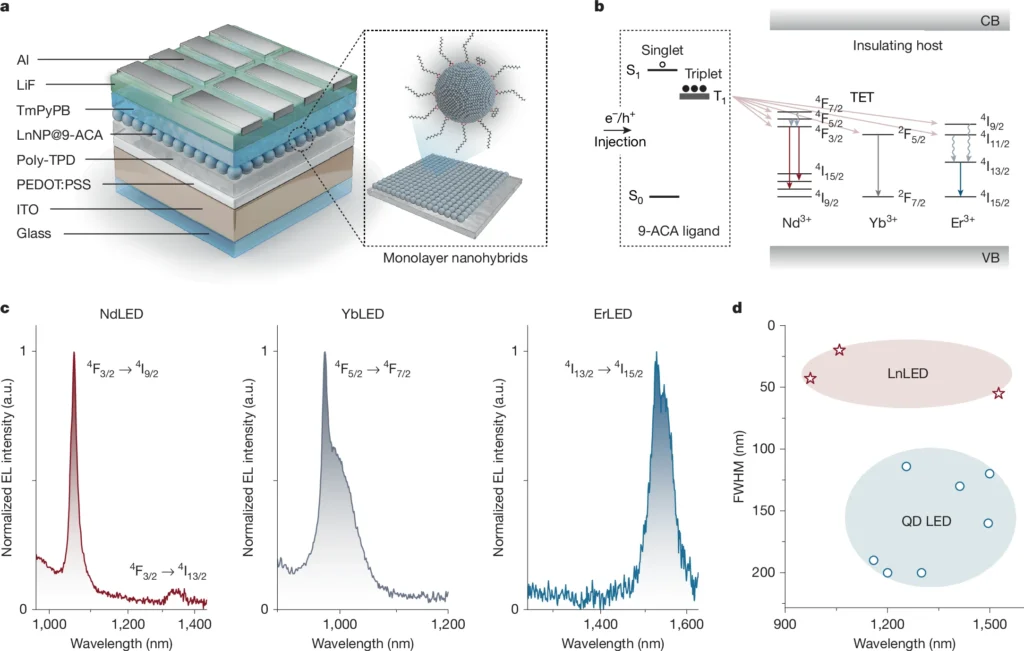
The best light sources for this window are lanthanide-doped nanoparticles. They emit extraordinarily pure light, with spectral widths of 20 to 55 nanometers compared to 150 or more for quantum dots. But lanthanide nanoparticles have a fatal flaw for practical devices: they're insulators.
Key figure
98%
Energy transfer efficiency from organic antenna molecules to lanthanide nanoparticles
The Barrier That Blocked a Field
Lanthanide nanoparticles sit in crystalline hosts with energy gaps around 8 electron volts. For comparison, silicon, the backbone of electronics, has a gap of just 1.1 electron volts.
That 8-volt barrier meant these nanoparticles couldn't conduct electricity. You could excite them with lasers. You could make them glow beautifully in laboratory settings. But you couldn't wire them into a compact LED that a surgeon could hold.
The field needed lanthanide LEDs. Physics seemed to forbid them.
Lasers work, but they're expensive, bulky, and can damage eyes and tissue. LEDs would be cheap, safe, and small enough to integrate into surgical cameras. The field needed lanthanide LEDs. Physics seemed to forbid them.
Molecular Antennas Open a Back Door
A team at Cambridge's Cavendish Laboratory, led by physicist Akshay Rao, found a workaround. They coated lanthanide nanoparticles with organic molecules called 9-anthracenecarboxylic acid.
These molecules act as antennas. They accept electrical charges that the insulating nanoparticle core would reject. The charges form what physicists call triplet excited states in the organic coating. Then the energy transfers inward to the lanthanide ions, which emit light.
"We've essentially found a back door to power them," Rao explains. "The organic molecules act like antennas, catching charge carriers and then 'whispering' it to the nanoparticle through a special triplet energy transfer process, which is surprisingly efficient."
The organic molecules act like antennas, catching charge carriers and then 'whispering' it to the nanoparticle.
Akshay Rao, Cavendish Laboratory, University of Cambridge
Surprisingly efficient turns out to be an understatement. The team measured energy transfer rates exceeding 98 percent.
Here lies a quiet irony. Triplet states are usually the enemy of LED efficiency. In most organic light-emitting devices, triplets represent wasted energy, photons that never escape. In this design, triplet states carry the entire load. The problem became the solution.
The resulting devices turn on at around 5 volts. They emit tunable wavelengths from 976 to 1,533 nanometers, depending on which lanthanide dopant the team uses: neodymium, ytterbium, or erbium.
The problem became the solution.
Why Sharp Light Matters in Cancer Surgery
Lead author Zhongzheng Yu, a postdoctoral researcher at Cambridge, points to the medical implications. "The purity of the light in the second near-infrared window emitted by our LnLEDs is a huge advantage," Yu says. "For applications like biomedical sensing or optical communications, you want a very sharp, specific wavelength."
In fluorescence-guided surgery, that purity could matter significantly. Current NIR-I imaging penetrates only about 8 millimeters into tissue. Tumors deeper than that remain invisible. Liver tissue auto-fluoresces in the NIR-I range, creating background noise that obscures tumor boundaries.
NIR-II wavelengths penetrate several centimeters. They produce almost no tissue autofluorescence. Studies have shown NIR-II imaging can detect metastases as small as 1 millimeter during surgery for ovarian and liver cancers.
But current NIR-II imaging relies on laser excitation. Compact LED-based surgical cameras would need exactly what Cambridge has now demonstrated: electrical excitation of sharp-emission NIR-II light sources.
First Generation, Long Road Ahead
The Cambridge devices are proof-of-concept, not surgical tools. Peak external quantum efficiency reaches only about 0.6 percent. Brightness remains modest.
The team acknowledges clear limitations. The nanohybrids form only single layers. Antenna molecule coverage on the nanoparticle surface sits below 10 percent. The ultrasmall nanoparticles have inherently low quantum yields.
Each constraint has a plausible path forward.
Each constraint has a plausible path forward. Multilayer structures, denser molecular coatings, and optimized nanoparticle sizes could improve performance substantially.
A companion paper in the same Nature issue, from researchers spanning Singapore, China, and Hong Kong, reported similar results through a parallel approach. Professor Liu Xiaogang at the National University of Singapore summarized his team's path: "It took us more than 14 years to make an insulator shine."
Two independent teams, converging on the same answer through different routes, suggests the barrier has genuinely fallen. The back door to powering lanthanide light is open. What surgeons might eventually see through it remains years away, but the physics no longer forbids asking.
Sources
- Primary Research: Yu, Z. et al. (2025). Electrically driven lanthanide-doped nanoparticle LEDs. Nature. https://www.nature.com/articles/s41586-025-09601-y
- Additional Context:

Fact Check: Claim-by-Claim Verification Verified
All major claims verified against the primary Nature paper, Cambridge press materials, and independent sources. Technical specifications (energy transfer, wavelengths, bandgaps) and attributions (Rao, Yu, Liu Xiaogang) confirmed.
Commentary
- All technical claims derive from a peer-reviewed Nature paper with corroborating press materials from Cambridge and NUS.
- NIR-I penetration depth and metastasis detection size are approximate values that vary by tissue type and probe.
- The devices are proof-of-concept; clinical translation is years away, which the article accurately conveys.
Sources used for verification
Academic/Peer-reviewed:
- Yu, Z. et al. (2025) - Nature - Primary research paper
- Companion paper - Nature - Singapore/China/HK team
- NIR-II nanoprobes for surgery - Nature Communications
- NIR-I/II fluorescence imaging - Frontiers in Bioengineering
Other reliable sources:
- Cambridge press release - ScienceDaily
- Cavendish Laboratory news - Cambridge Physics
- NUS press release - National University of Singapore
- EurekAlert coverage - EurekAlert
Fact-checked by Perplexity Sonar Pro on 2026-03-14


