



- Frank Drake's equation organises what we don't know about alien life.
- NASA's lunar mining robots can dig more than their own weight.
- Deep-sea extremophiles suggest life could thrive on distant worlds.
Frank Drake kept orchids. One species, a stanhopea, blooms only two days a year. Miss those two days, and you might conclude the plant never flowers at all.
Drake made this observation to Brian Cox during a conversation about SETI, the search for extraterrestrial intelligence. It was, characteristically, both a metaphor and a rebuke.
We have barely looked, Drake argued. We have no right to draw conclusions yet.
Cox's BBC documentary, "The Next Space Frontier," follows this thread across continents. From radio telescopes to the deep ocean floor, from lunar mining robots to the Atlas Mountains at night, it asks whether we are searching widely enough and patiently enough to find what may be waiting.
The Drake Equation: Organising What We Don't Know
In 1961, Drake, then a young radio astronomer at the National Radio Astronomy Observatory, devised what became the most famous equation in astrobiology. The Drake equation does not solve anything. It organises ignorance.
On one side sits the number we want: how many communicating civilisations share our galaxy. On the other, a chain of probabilities. How many stars form each year? How many have planets? How many of those planets could support life?
The Drake Equation
A framework for estimating the number of detectable civilisations in the Milky Way. Each term represents a probability, from star formation rates to the likelihood of intelligence evolving. When Drake first wrote it, most terms were unknown. Several remain so.
When Cox asked Drake whether he had expected a signal by now, the astronomer was candid. "I would have said yes," he admitted. "I'm disappointed, but not surprised." The searching, Drake explained, needed to be far more comprehensive than anyone imagined fifty years ago.
Drake died in September 2022 at the age of 92. He never heard the signal. The silence itself has a name: the Fermi Paradox.
Robots That Dig More Than Their Own Weight
Cox's documentary traces the practical side of this search with unexpected warmth. At a NASA facility, robotics engineer AJ Nick demonstrates a lunar mining robot with a peculiar talent: it can excavate more than its own weight.
The trick is elegant. Two scooping drums rotate in opposite directions, pinning the lightweight machine to the surface.
In lunar gravity, where everything weighs a sixth of its Earth weight, conventional digging is nearly impossible. The counter-rotating drums cancel the excavation forces, letting the robot dig without floating away.
Key figure
1/6
Lunar gravity compared to Earth's, the engineering constraint that forced NASA to redesign how robots dig
Senior technologist Robert Mueller showed Cox what comes next. Lunar regolith, the fine dust covering the Moon's surface, can be heated into solid rock or mixed with plastic for 3D printing. Mueller's team has already printed blast walls and habitat domes from simulated lunar soil.
"Everything is there," Mueller told Cox. "The only two things missing are technologies and imagination."
Two Kilometres Down, the Rules of Life Change
The most striking sequence takes Cox two kilometres beneath the Sea of Cortez in Alvin, the deep-ocean research submarine. The parallels to space exploration are literal, not rhetorical. At 100 atmospheres of pressure, in total darkness, with no solar energy, life should not exist.
It thrives.
If life can not only survive but flourish in these conditions, you have to feel it is much more likely that life can survive and flourish out there in the solar system.
Brian Cox
The organisms living near hydrothermal vents, known as extremophiles, survive on chemical energy from the Earth's interior. Conditions on the deep ocean floor resemble those on distant worlds more closely than they resemble the surface two kilometres above.
This observation carries weight for the search for life on Europa, Jupiter's ice-covered moon. NASA's Europa Clipper mission, launched in 2024, will search for biosignatures in the moon's subsurface ocean. Astrobiologists are also expanding their search criteria, looking for biosignatures on planets that look nothing like Earth.
The Longest View
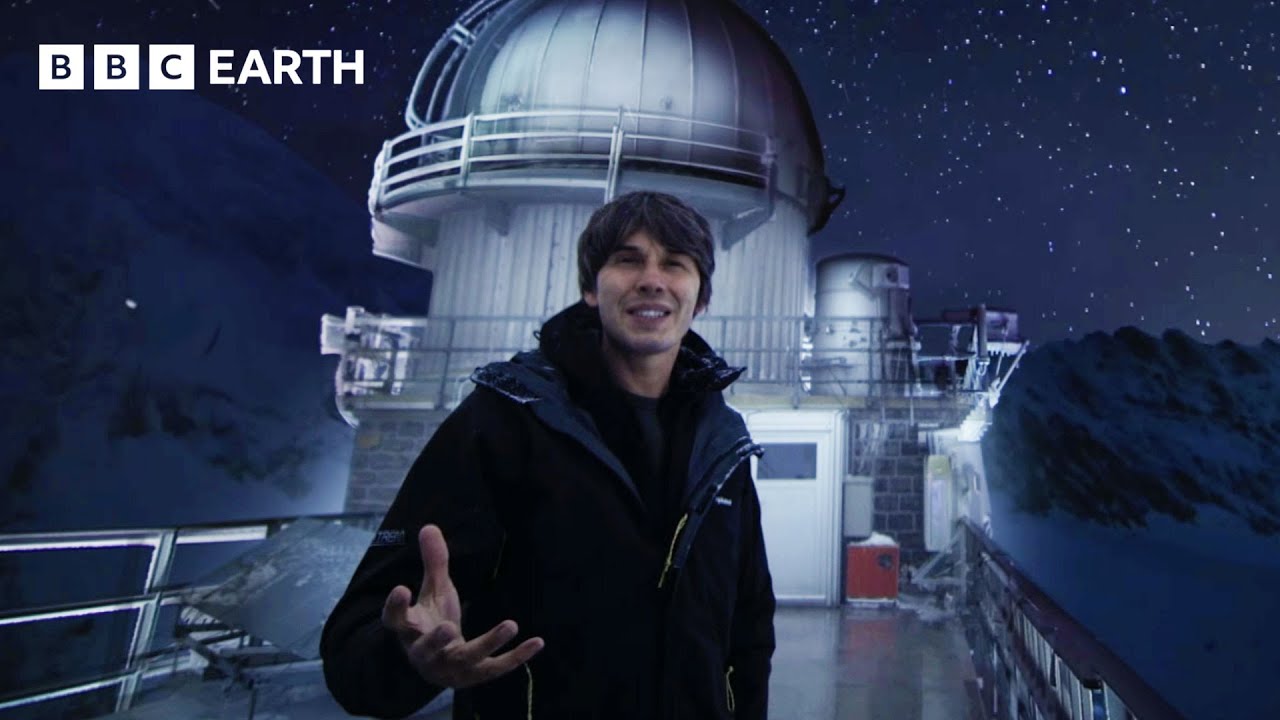
Cox filmed part of the documentary in the Atlas Mountains of North Africa. Without light pollution, the sky reveals itself as our ancestors knew it.
From there, stars appear to rotate around Polaris, exactly as the ancients believed: Earth at the centre, the universe wheeling around it.
It took more than 2,000 years to understand retrograde motion, the occasional backward drift of Mars across the sky. The explanation required displacing Earth from the centre of everything.
Key figure
2,000+ years
The time it took humanity to correctly explain why Mars appears to reverse direction in the night sky
Drake's orchid carries the same lesson. Patience is not passive. It is the discipline of looking long enough, in enough places, with enough precision, to let the evidence arrive on its own schedule. The Europa Clipper is now en route.
The orchid may yet bloom.
Sources
- Primary Source: Brian Cox: The Next Space Frontier (BBC Earth Science, YouTube)
- Additional Context:
- Europa Clipper Mission (NASA)
- Frank Drake (Wikipedia)
- The Drake Equation (SETI Institute)




