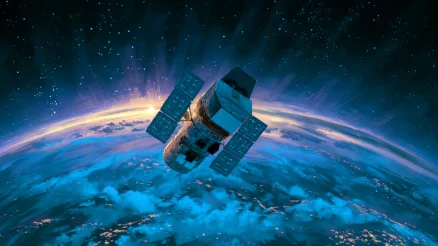
- Exponential self-replication could build a Dyson swarm in 31 years.
- Mercury provides enough raw material to construct the entire swarm.
- The real bottleneck is building the first self-replicating machine.
Freeman Dyson got the idea for what became the Dyson swarm from a novel. In 1960, the British-American theoretical physicist published a short paper in Science proposing that an advanced civilisation might surround its star with orbiting collectors to capture nearly all its energy.
He credited Olaf Stapledon's 1937 science fiction novel Star Maker as his inspiration. The concept bore Dyson's name from that point forward, though the version he described looked nothing like the rigid shell most people imagine.
The more practical design is a swarm: millions of individual mirrors orbiting independently, each intercepting a fraction of the star's output. No solid shell, no impossible structural loads. Just geometry and patience.
The patience, however, has always been the problem.
What is a Dyson swarm?
A Dyson swarm is a cloud of orbiting mirrors or solar collectors surrounding a star, each capturing a portion of its energy. Unlike the popular image of a solid shell, a swarm avoids the impossible engineering of a rigid megastructure. The concept dates to Freeman Dyson's 1960 paper, though he himself preferred the swarm interpretation.
The Sun Delivers Thousands of Times What Humanity Consumes
Earth intercepts roughly 5.5 x 1024 joules of solar energy per year. Global energy consumption sits at about 6 x 10²⁰ joules. The Sun, put plainly, delivers to our planet's cross-section alone some 9,000 times the energy humanity uses from all sources combined.
Meanwhile, the fossil fuel reserves powering most of that consumption may last another century or two, depending on which fuel you count.
Those numbers define a strange predicament. Humanity depends on a dwindling fuel source while orbiting an almost incomprehensibly large one.
A full Dyson swarm would capture not just the sliver hitting Earth but the star's entire output. The energy gain would be roughly 20 trillion times current levels. That is enough to push a civilisation from Type 0.7 on the Kardashev scale to Type 2, from a species that has not yet harnessed its own planet to one commanding its star.
The arithmetic is not new. What has changed is that people are starting to take it seriously.
Key figure
31 years
The time required to build a Dyson swarm around the Sun using exponential self-replication, down from 425,000 years without it
Mercury Has the Raw Material for a Dyson Swarm
The engineering question for a Dyson swarm is where to get the material. Building one at Earth's orbital distance, even with panels less than a millimetre thick, would require roughly 6% of Earth's total volume.
That approach fails on inspection.
Alex McColgan, creator of the space education channel Astrum, worked through a tidier alternative. Mercury orbits closer to the Sun, meaning mirrors placed there intercept more energy per unit area. And Mercury itself, with a radius of about 2,440 kilometres, contains enough raw material to construct the swarm.
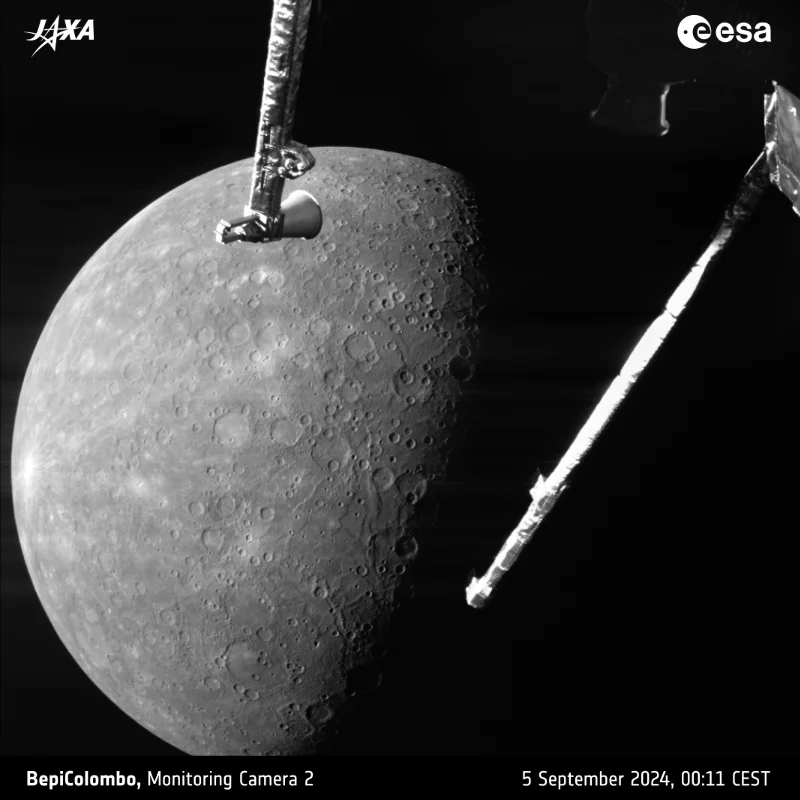
Could Mercury be used as material for a Dyson swarm? Mercury photographed by the European Space Agency's BepiColombo spacecraft in 2024. Image credit: ESA/BepiColombo/MTM. CC BY-SA 3.0 IGO
The obstacle is gravity. Mercury's gravitational binding energy, the minimum energy needed to pull the planet apart, is approximately 1.8 x 1030 joules. Using only the solar energy falling on Earth's cross-section, lifting mirrors off Mercury would take around 425,000 years.
Here the calculation takes a genuinely startling turn. If each completed mirror contributes energy to building the next, capacity doubles with every cycle.
Exponential self-replication, the same mathematics behind compound interest and bacterial growth, collapses the timeline. McColgan's figures put the total construction time at 31 years.
Thirty-one years. Half an adult lifetime to dismantle a planet and capture a star.
"Something that takes half a lifetime to complete is certainly ambitious, and the initial cost might indeed be great," McColgan noted. "There really aren't very many barriers left towards attaining the immense energy of the Sun."
The candid optimism runs through the whole video. McColgan's delivery throughout carries the cheerful confidence of someone who trusts the maths even when the engineering sounds preposterous.
Physicists Are Modelling What Used to Be Science Fiction
The gap between arithmetic and engineering remains vast. Self-replicating machines at planetary scale do not yet exist. Neither does the autonomous manufacturing infrastructure to process an entire world.
The 31-year figure assumes each doubling proceeds without delay, breakdown, or material loss.
Yet the Dyson sphere has begun attracting serious physical modelling. In January 2026, Colin McInnes, an astrodynamics researcher at the University of Glasgow, published calculations in the Monthly Notices of the Royal Astronomical Society showing that Dyson bubbles and stellar engines could achieve gravitational stability.
The reflectors, McInnes found, would naturally rearrange into stable configurations under certain density conditions.
That particular result had a quiet elegance to it. The megastructures do not need active station-keeping. They hold themselves together.
Meanwhile, the search for existing Dyson spheres has produced its own puzzles. Project Hephaistos, a systematic survey of over 5 million stars, identified seven candidates in 2024. All were red dwarfs with unexplained infrared excess.
The excitement was short-lived. Follow-up observations traced some of the infrared anomalies to contamination by background active galactic nuclei. By early 2025, high-resolution imaging of one candidate revealed that its radio source belonged to a distant AGN, not to the star itself. (A related analysis explores why such structures might self-destruct before detection.)
The Bottleneck Is the First Replicator, Not the Last
The mathematics of exponential growth are seductive precisely because they make the end look easy. Once the process is running, each doubling is as effortless as the last.
The challenge concentrates at the beginning. Someone must build a machine that can reliably copy itself from raw planetary material, in hard vacuum and intense radiation near Mercury's orbit.
More Space & Astronomy

Is the Moon a Planet? The Definition Debate Explained
Whether the Moon qualifies as a planet depends on who you ask. The debate reveals how hard it is to draw lines between categories in…
→That first replicator does not exist. No one has built one, demonstrated a credible prototype, or published a complete design. The 31-year timeline starts its clock after a problem no one has solved.
McInnes is already extending his stability models to different stellar types. Several groups involved in Project Hephaistos are refining their candidate filters to screen out AGN contamination before the next survey round. The theoretical scaffolding, at least, is being built.
Still, the arithmetic carries a quiet provocation. If exponential self-replication works at any scale, the Kardashev ladder becomes less of a thought experiment and more of a schedule. The distance between Type 0.7 and Type 2 is not measured in centuries of slow accumulation.
It is measured in the time it takes to build one machine that can build another.
Sources
- Primary Source: How to Build a Dyson Swarm (Alex McColgan, Astrum)
- Additional Context:
- Dyson sphere (Wikipedia)
- Gravitational stability of Dyson bubbles and stellar engines (McInnes, 2026, MNRAS)
- Project Hephaistos: Dyson sphere candidates (Suazo et al., 2024, MNRAS)

Fact Check: Claim-by-Claim Verification Verified
Article accurately reports historical facts, calculations from its primary source, and recent peer-reviewed research on Dyson swarms with appropriate context on assumptions.
Commentary
- 31-year timeline is theoretical, assuming perfect exponential replication without delays, losses, or engineering failures; real bottlenecks include building the first self-replicator.
- Article appropriately notes gaps between math and current technology, avoiding presentation of speculation as fact.
- Numbers like energy ratios and GBE are approximations but consistent with standard calculations and source video.
Sources used for verification
Academic/Peer-reviewed:
- Search for Artificial Stellar Sources of Infrared Radiation - Science.org
- Stellar engines and Dyson bubbles can be stable - MNRAS
- Project Hephaistos II. Dyson sphere candidates - MNRAS
- High-resolution imaging of Project Hephaistos candidate - MNRAS
Other reliable sources:
Fact-checked by Perplexity Sonar Pro on 2026-03-08