


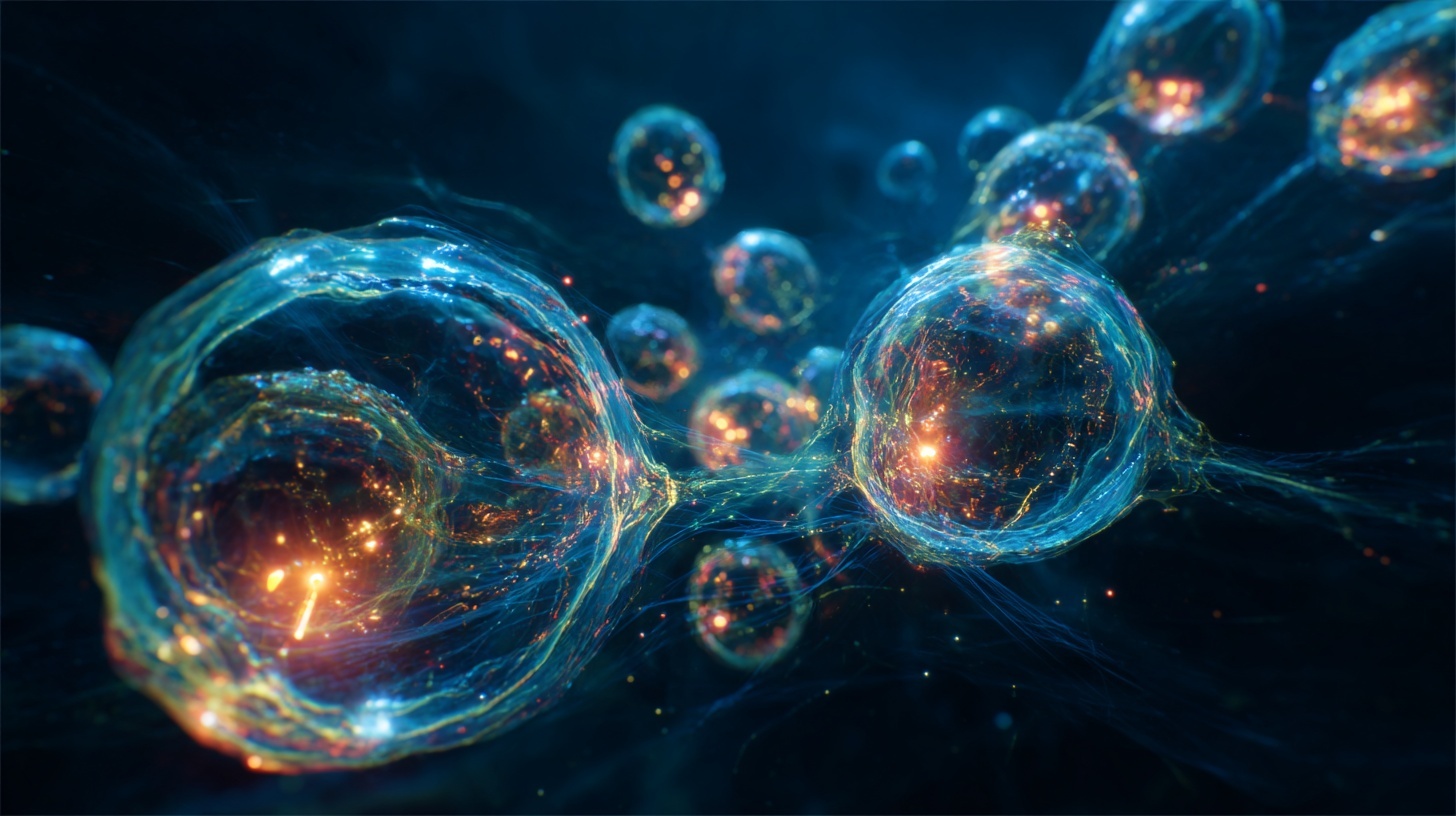

- Harvard scientists made cells that reproduce and evolve using four simple molecules and light.
- No DNA or proteins were involved — the process runs on pure chemistry.
- Daughter cells varied from parents, producing a primitive form of Darwinian evolution.
Juan Pérez-Mercader was staring at a test tube full of glowing vesicles when he realized he might be looking at how life began. The 77-year-old physicist, who describes himself as a "kid" still chasing fundamental questions, had spent decades working on grand unified theories and superstrings.
Now his ambitions were grander still.
His team at Harvard's Origins of Life Initiative had done something that shouldn't have worked.
They mixed four ordinary carbon-based molecules with water, flashed green LED lights at the vial, and watched as the chemicals organized themselves into structures that metabolize, reproduce, and evolve.
No DNA. No proteins. No biology at all.
Key figure
4 billion years
Approximate age of earliest known microbial fossils, the gap this research helps explain
Simple Chemicals, Startling Behavior
The experiment's elegance lies in its simplicity. Previous attempts to create artificial life required complex biochemical molecules.
Pérez-Mercader's approach uses materials similar to those drifting in the interstellar medium, the cosmic debris left over from dying stars.
What is polymerization-induced self-assembly?
A process where disordered nanoparticles spontaneously organize themselves into structured objects at scales of millionths of a meter. Think of it as chemical Lego that builds itself when given energy.
When the green lights flash, the molecules form amphiphiles, structures with both water-loving and water-repelling parts.
These self-assemble into tiny spheres called micelles, which trap fluid inside and develop into cell-like vesicles. The process happens spontaneously, driven only by light energy.
Reproduction Without Biology
What happened next surprised even the researchers. The vesicles began ejecting components like spores. Some burst open entirely, releasing material that formed new generations of structures.
These daughter cells differed slightly from their parents, with some variants proving better at surviving and reproducing.
The team had accidentally created a primitive form of Darwinian evolution. Not in living cells, but in bubbles of organized chemistry.
Stephen Fletcher, a chemistry professor at Oxford who was not involved in the study, called the PNAS paper significant. It demonstrates that lifelike behavior can emerge from simple chemicals spontaneously when light energy is provided.
Darwin's Pond, Recreated
Pérez-Mercader came to Harvard in 2010 after founding Spain's astrobiology center and overseeing the country's contribution to NASA's Mars Science Laboratory. His goal was direct: understand why life exists at all.
He had worked out mathematical equations describing life's basic physics and chemistry. The problem was demonstrating them experimentally. The development of polymerization-induced self-assembly finally gave him the tools to test his theories.
The implications reach beyond Earth. If life can emerge from simple interstellar molecules and starlight, the universe may be more hospitable to biology than we assumed.
Or perhaps to something that isn't biology at all, but behaves exactly like it.
Sources
- Primary Research: Katla, S.K., Lin, C., & Pérez-Mercader, J. (2025). Self-reproduction as an autonomous process of growth and reorganization in fully abiotic, artificial and synthetic cells. Proceedings of the National Academy of Sciences, 122(22).
- Additional Context:
- A step toward solving central mystery of life on Earth (Harvard Gazette)
- Self-reproducing synthetic cells (Chemical & Engineering News)

Fact Check: Claim-by-Claim Verification Verified
All claims verified against the PNAS paper, Harvard profile, and press coverage. Researcher background, experimental description, and citation details confirmed.
Commentary
- "Metabolize" is interpretive — the vesicles consume monomers via polymerization, not biochemical metabolism.
- "Darwinian evolution" is used analogically for heritable variation in abiotic vesicles.
- Earliest microbial fossil age is debated; 3.5 Ga is more widely accepted than 4 Ga.
Sources used for verification
Academic/Peer-reviewed:
Other reliable sources:
Fact-checked by Perplexity Sonar Pro on 2026-03-15


