

- A jazz guitarist with no formal training discovered a brand-new mineral in a rooftop micrometeorite.
- Larsen proved urban environments are valid sites for collecting cosmic dust specimens.
- Only five natural aluminum-copper intermetallic alloys have ever been found on Earth.
Jon Larsen was having strawberries for breakfast on his Oslo terrace in 2009 when a shiny black dot appeared on the white table. The jazz guitarist picked it up, examined it under a microscope, and saw something extraordinary: a micrometeorite, freshly fallen from space.
What made the find remarkable wasn't the object itself but where he found it - on an urban rooftop, in a place the scientific establishment had declared impossible to search.
That breakfast discovery would eventually lead to a new mineral species named jonlarsenite, honoring the musician who spent a decade proving conventional wisdom wrong.
Key figure
5,500
verified micrometeorite specimens in Larsen's Project Stardust collection

Jon Larsen is one of Norway's most accomplished jazz guitarists.
Credit: Tore Sætre - Own work, CC BY-SA 4.0
When Scientists Said It Couldn't Be Done
For more than a century, researchers believed micrometeorites - tiny particles from asteroids and comets - could only be recovered from pristine environments like Antarctic ice or deep ocean sediments. Urban areas, they insisted, contained too much industrial contamination to distinguish space particles from terrestrial debris.
Larsen approached the problem with a musician's patience and a surrealist painter's eye for pattern. He spent seven years systematically cataloging every type of particle he found in Norwegian roof gutters. Space dust, industrial spherules, terrestrial minerals - all of it went under the microscope, photographed, categorized, cross-referenced.
By 2017, working with Matthew Genge at Imperial College London, he had identified morphological signatures that proved urban micrometeorite hunting was viable.
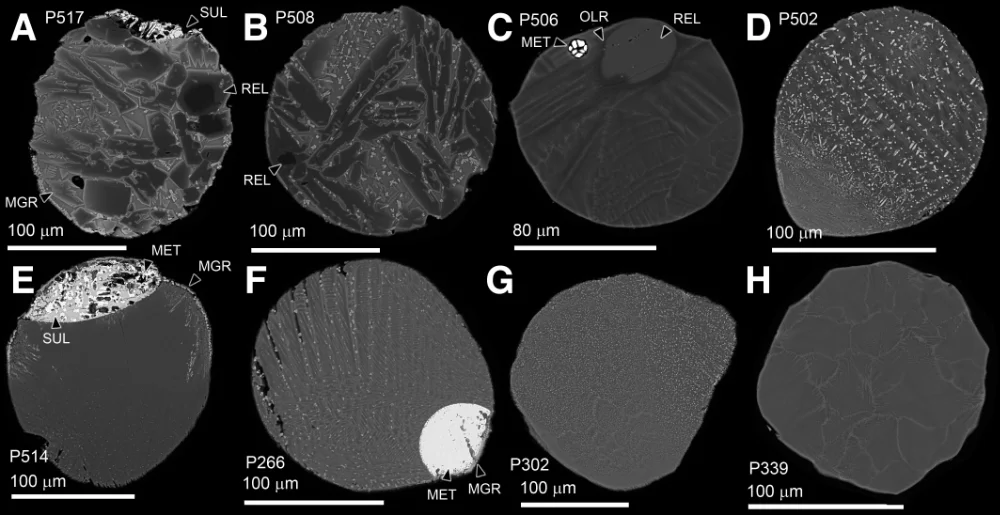
It was the texture that was the key. Larsen noticed that genuine micrometeorites showed vesicular surfaces and barred olivine structures that industrial particles couldn't replicate. It was the kind of visual distinction that conventional analytical chemistry might miss but that someone trained in artistic observation could spot.
His collection, part of Project Stardust, has since grown to over 5,500 verified specimens.
A Rooftop Find Becomes a Mineral
Seven years after proving the skeptics wrong, Larsen found specimen NMM/L2. He collected the 200-micrometer spherule on August 15, 2022, from the roof of an industrial facility near Skedsmokorset, just north of Oslo. Under the microscope it showed the characteristic scoriaceous texture - vesicle-filled, slightly melted surface - of a micrometeorite that had survived atmospheric entry.
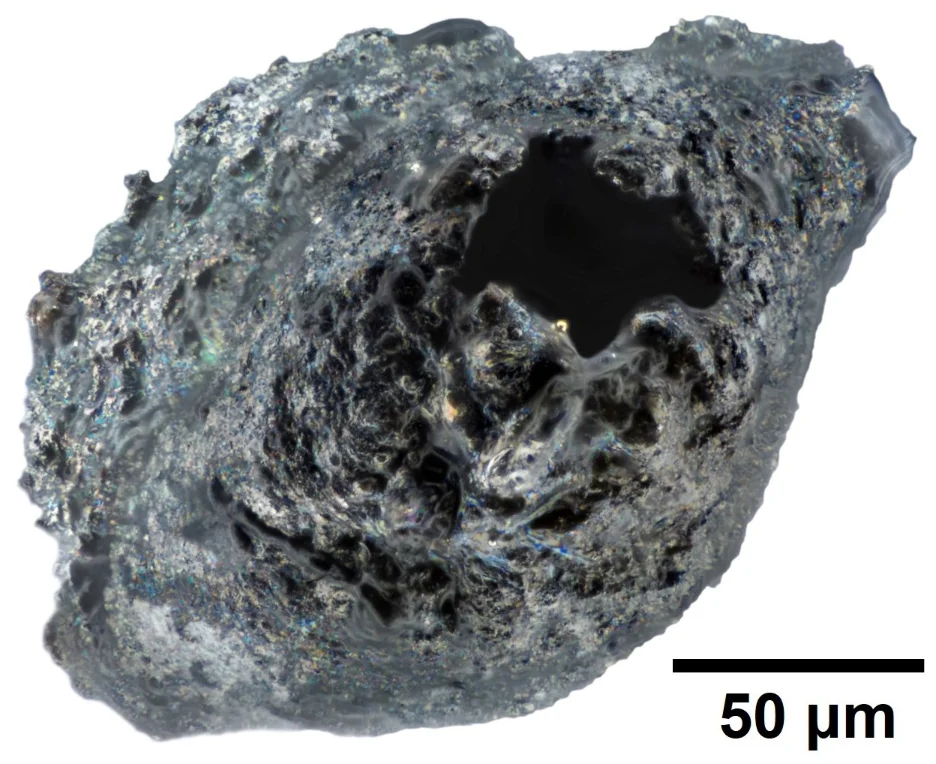
Optical (reflected-light) image of micrometeorite NMM/L2.
Credits: Luca Bindi et al.
Inside, working with Luca Bindi at the University of Florence, researchers found something unexpected.
The spherule contained grains of an aluminum-copper alloy with Al4Cu9 stoichiometry. The grains measured just 2 micrometers across - too small for conventional analysis. Using focused ion beam milling and transmission electron microscopy, Bindi's team at Princeton and Caltech characterized the crystal structure: cubic, space group P-43m, matching a phase previously known only from laboratory synthesis.
Nobody had seen natural gamma-Al4Cu9 before.
What is an intermetallic alloy?
An intermetallic alloy is a compound made of two or more metals bonded in a precise, fixed ratio – unlike ordinary alloys where metals simply mix together. The atoms arrange themselves into a specific crystal structure, giving the material distinct properties. Jonlarsenite (Al4Cu9) is one such compound: its exact ratio of aluminum to copper atoms creates a crystal geometry that had never been observed in nature before this discovery.
The International Mineralogical Association approved the new mineral species in 2024 under the name jonlarsenite. A jazz musician with no academic credentials when he started hunting micrometeorites now had a mineral named after him.
What Makes Aluminum-Copper Alloys Exotic
Jonlarsenite joins an exclusive group. Only five cases of natural Al-Cu intermetallic alloys have been documented: the Khatyrka meteorite from Siberia, micrometeorite KT-01 from Sudan, FB-A1 from Italy, NG-1 from the Congo, and now Larsen's NMM/L2 from Oslo.
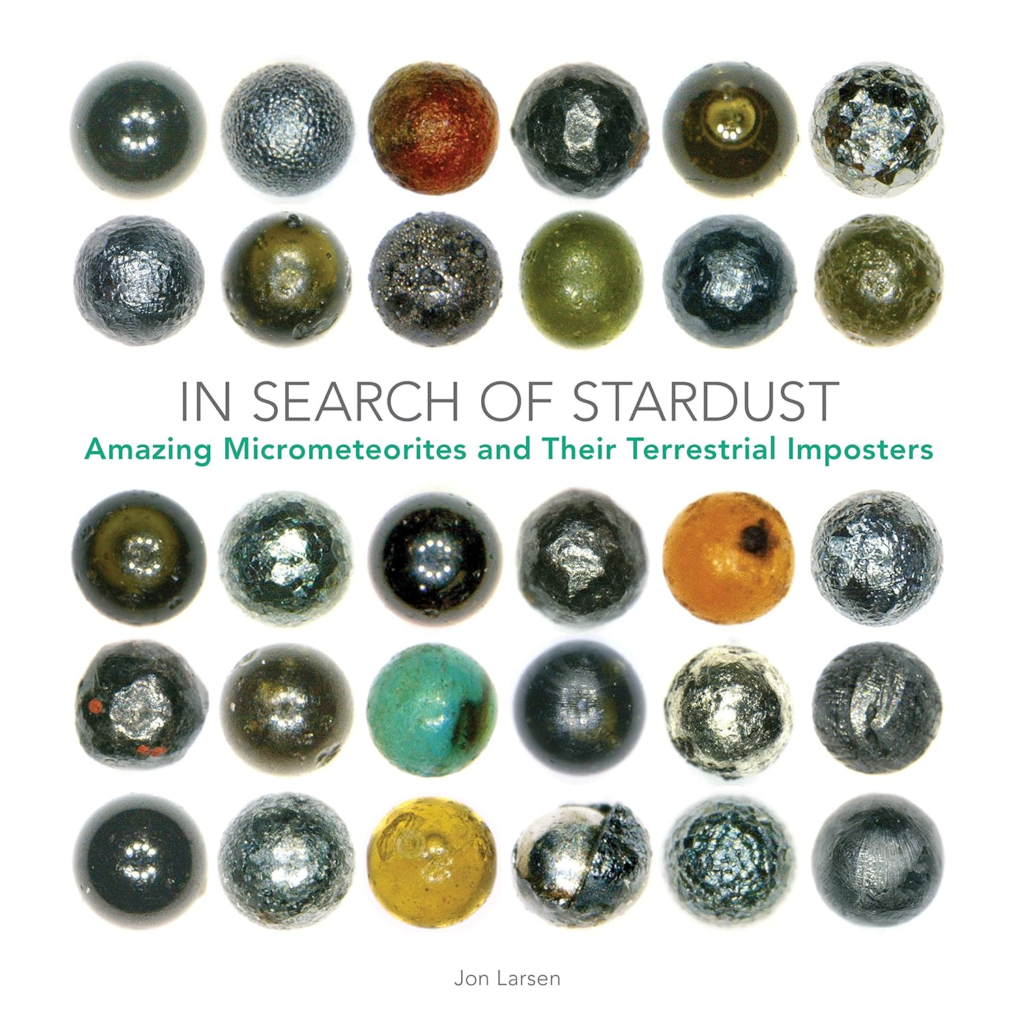
The cover of Jon Larsen's book about micrometeorites.
Credit: Jon Larsen / Amazon.
When Larsen first learned what NMM/L2 contained, he understood he'd found something that required extreme formation conditions. The intimate association between jonlarsenite and copper-rich aluminum suggests rapid quenching from a melt or vapor phase under severely non-equilibrium conditions. Such environments likely formed during hypervelocity impacts in the early solar system - moments when asteroids collided and vaporized metal under reducing conditions.
Oxygen isotope measurements from the olivine crystals in NMM/L2 plot along the carbonaceous chondrite anhydrous mineral line, confirming its extraterrestrial origin. The chemistry matches primitive asteroid material that formed before planets did.
The Outsider Who Became the Authority
The path from jazz guitarist to mineral namesake wasn't straightforward. When Larsen started showing his findings to academic conferences in the early 2010s, he encountered skepticism. He had no geology degree, no institutional affiliation, no formal training in meteoritics.
It is possible to find the most exotic, small rocks in the entire universe in your roof's rain gutter.
Jon Larsen, Project Stardust founder
What he had was 5,500 specimens, seven years of systematic documentation, and photographs that showed exactly what he'd found and where. The evidence eventually proved more persuasive than credentials. He now collaborates with researchers at NASA, Imperial College London, the University of Florence, and the Institute of Space Sciences in Barcelona.
Three labs are currently examining other specimens from the Project Stardust collection for additional exotic phases. The systematic survey suggests that Al-Cu alloys, while rare, might appear more frequently in the cosmic dust flux than the handful of known cases implied.
Larsen keeps the original breakfast terrace micrometeorite in his collection, cataloged and photographed but otherwise unremarkable among thousands of similar specimens. That shiny black dot started everything.
In 2020, shortly before the jonlarsenite discovery, the International Astronomical Union named asteroid 63788 Jonlarsen in his honor. A jazz musician noticed a speck of space dust on his breakfast table. Fifteen years later, his name orbits the sun on a rock several kilometers wide.
Sources
- Primary Research: Bindi, L., et al. (2025). Jonlarsenite, Al4Cu9, a new intermetallic phase in the Al–Cu system discovered in a micrometeorite from Oslo, Norway. European Journal of Mineralogy, 37(5), 783-791. https://ejm.copernicus.org/articles/37/783/2025/
- Additional Context:

Fact Check: Claim-by-Claim Verification Verified
All major claims verified against the primary EJM paper, Geology paper, and NASA/JPL databases. Two minor corrections applied: collaboration date (2015→2017) and citation page range (792→791). Old inline fact-check block removed.
Commentary
- The specific collection date of August 15, 2022 comes from the primary paper but could not be independently verified online.
- The 2020 year for the asteroid naming could not be independently confirmed but the asteroid's existence and naming are verified via NASA/JPL.
- The breakfast discovery story is consistently told across multiple sources but relies on Larsen's own account.
Sources used for verification
Academic/Peer-reviewed:
- Bindi et al. (2025) - Jonlarsenite - European Journal of Mineralogy
- Genge et al. (2017) - Urban micrometeorites - Geology
Other reliable sources:
- Asteroid 63788 Jonlarsen - NASA/JPL
- Urban Stardust - Science Friday
- Project Stardust - This is Colossal
Fact-checked by Perplexity Sonar Pro on 2026-03-14