- Double‑ring odd radio circle forces rethink of galaxy‑evolution models.
- Superwinds and black‑hole jets likely sculpt these enormous radio rings.
- All three giants sit in massive clusters, interacting with hot gas.
Astronomers discovered the most distant and powerful odd radio circle ever found, but the real surprise lies in what this cosmic mystery reveals about galaxy evolution. The discovery challenges current theories about how these enormous ring structures form around galaxies.
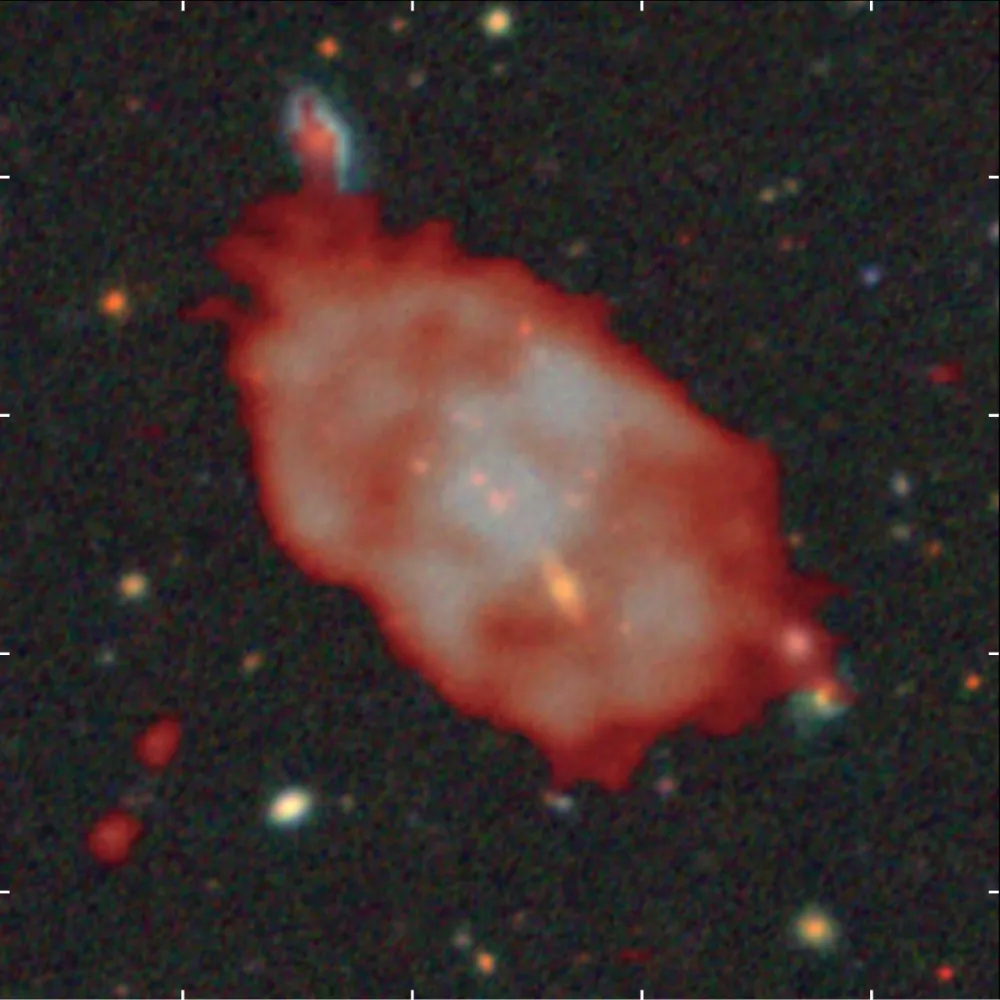
According to research published in Monthly Notices of the Royal Astronomical Society, citizen scientists working with the RAD@home Astronomy Collaboratory found something unprecedented: an odd radio circle with two intersecting rings.
Credit: RAD@home Astronomy Collaboratory (India)
Key figure
25×
larger than the Milky Way – the span of one of the newly found giant radio galaxies
The source, designated RAD J131346.9+500320, exists at redshift 0.94. This means astronomers observe it as it appeared when the universe was half its current age.
What is redshift?
Redshift measures how much the light from a distant object has been stretched by the expansion of the universe. The higher the redshift number, the farther away the object is – and the further back in time we are seeing it. A redshift of 0.94 means we see this galaxy as it looked roughly 7.7 billion years ago, when the cosmos was about half its present age.
The Double Ring Discovery
Odd radio circles represent one of astronomy's newest phenomena. Scientists first detected these structures just six years ago.
Only a handful of confirmed examples exist. Most measure 10-20 times larger than the Milky Way galaxy.
What makes RAD J131346.9+500320 extraordinary is its dual structure. Only one other odd radio circle has shown two intersecting rings.
The discovery emerged through an unusual collaboration. Citizen scientists using the RAD@home platform worked alongside professional astronomers operating LOFAR, the world's largest low-frequency radio telescope.

Rethinking Formation Theories
Previous research suggested odd radio circles form from shockwaves created by merging supermassive black holes or colliding galaxies. The new findings propose a different mechanism entirely.
The research team, led by the University of Mumbai, argues these rings result from superwind outflows from spiral host radio galaxies. This explanation better accounts for the observed characteristics.
ORCs are among the most bizarre and beautiful cosmic structures we've ever seen – and they may hold vital clues about how galaxies and black holes co-evolve, hand-in-hand.
Dr Ananda Hota, RAD@home Astronomy Collaboratory
The team also discovered two additional cosmic giants. RAD J122622.6+640622 spans nearly three million light-years across - more than 25 times the Milky Way's size. One of its jets bends sideways before creating a radio ring 100,000 light-years wide.
RAD J142004.0+621715 stretches 1.4 million light-years and shows similar ring structures at jet endpoints. Both galaxies exist within dense galaxy clusters.
Implications for Cosmic Evolution
All three objects reside in galaxy clusters containing about 100 trillion solar masses. This pattern suggests interactions between relativistic plasma jets and surrounding hot gas shape these ring structures.
More On Cosmic Discovery

Advanced Quantum Simulation Could Reveal Cosmic Mysteries
We've entered an era where quantum simulations outrun what we can verify. Physicists just have to trust the process.
→The discovery method proves significant. Human pattern recognition identified these structures where automated systems failed.
Dr Pratik Dabhade from the National Centre for Nuclear Research explained the broader implications: "These discoveries show that ORCs and radio rings are not isolated curiosities – they are part of a broader family of exotic plasma structures shaped by black hole jets, winds, and their environments."
Future telescopes like the Square Kilometre Array should reveal many more odd radio circles. Optical surveys including DESI and the Vera Rubin Observatory will help determine how these mysterious structures form and evolve.
What remains unclear is whether the double-ring configuration represents a rare variant or reveals something fundamental about how these cosmic structures develop.
The answer may reshape understanding of galaxy evolution across cosmic time.

Fact Check: Claim-by-Claim Verification Verified
The article accurately summarizes the RAS press release and published research on the discovery of a distant double-ring odd radio circle, with all key claims matching the source.
Commentary
- Article appropriately hedges on formation theories ("challenges," "propose," "suggests") and unclear double-ring significance, avoiding presentation as confirmed fact.
- The claim of "rewriting galaxy evolution theory" in title is dramatic but acceptable for popular science as core facts on ORC discovery and implications are sound.
Sources used for verification
Academic/Peer-reviewed:
- RAD@home discovery of extragalactic radio rings and odd radio circles: clues to their origins - MNRAS
- Most powerful 'odd radio circle' to date is discovered - ras.ac.uk
Other reliable sources:
- University of Mumbai (UM-DAE CEBS & CETACS) - umdae.in
Fact-checked by Perplexity Sonar Pro on 2026-03-08