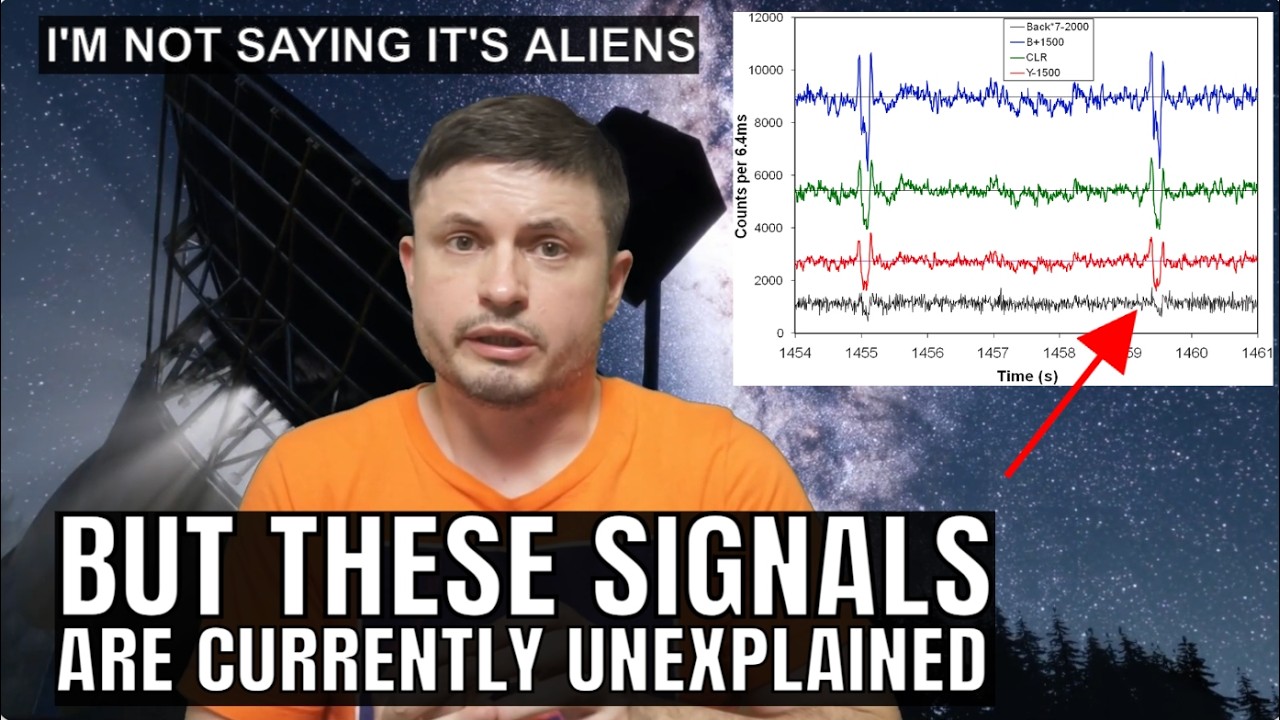

- A retired JPL engineer detected identical light pulses from three separate stars.
- The pulse source is likely within our solar system, not the stars.
- Six years of data show three matching events with no known explanation.
Richard Stanton was monitoring star HD 89389 as part of his optical SETI survey on the night of May 14, 2023, when his photometer registered something his 1,300-star archive had never produced before.
Two pulses of light. Identical to each other. Separated by exactly 4.4 seconds.
Stanton is no casual observer. A veteran of NASA's Jet Propulsion Laboratory, he led engineering for the GRACE gravity-mapping mission and contributed to the Voyager program before retiring and building his own observatory in Big Bear, California. Since then, he has pointed his 30-inch telescope at sun-like stars for well over 1,500 hours.
Not a single anomalous pulse had appeared until that night.
Scale of the search
1,300+
Sun-like stars observed for optical signals over more than 1,500 hours of data collection
A Signal Unlike Anything in the Archive
What made Stanton's data so difficult to dismiss was the internal structure: every fine detail of the first pulse was repeated almost exactly in the second. The star itself brightened, dimmed, then brightened again in roughly 0.2 seconds, representing a 25% increase in total light.
That kind of variation cannot originate from the star itself. HD 89389 is an F-type main sequence star roughly 100 light-years from Earth in the constellation Ursa Major. It is slightly larger and brighter than the sun, but behaviorally unremarkable. Nothing about its known properties suggests it should modulate its own light on the scale of fractions of a second.
What is optical SETI?
Optical SETI searches for pulses of light rather than radio signals. The idea, first proposed in 1961, is that an advanced civilization could send laser pulses powerful enough to briefly outshine their own star. Unlike radio searches, optical SETI requires specialized photometers sampling light at microsecond intervals, fast enough to catch a burst lasting only a fraction of a second.
Stanton compared the pulses against every contamination signature in his archive: airplanes, satellites, meteor flashes, bird crossings, atmospheric scintillation, instrument noise. Nothing matched. The doubled structure, the 4.4-second separation, and the near-identical internal profile were unlike any known interference pattern.
The Same Optical Signature, Twice More
Then he searched his historical data.
On September 30, 2019, his photometer had recorded an almost identical event while observing 51 Pegasi, a G-type star 50.6 light-years away. At the time, the signal had been set aside and tentatively attributed to birds. Reviewing the data, Stanton ruled that out. The pulse structure was too clean and the timing too precise.
51 Pegasi carries its own significance. In 1995, astronomers at the Observatoire de Haute-Provence confirmed the first exoplanet ever found around a sun-like star. The planet, now named Dimidium, made the system one of the most famous in observational astronomy. That history did not explain the pulses, but it made the detection harder to set aside.
A third event arrived while Stanton was finalizing his paper. On January 18, 2025, a matching double pulse appeared in data from HD 12051, an F-type star 81 light-years away. The separation this time was 1.2 seconds rather than 4.4, but the internal structure was recognizably similar to both earlier events.
The Source Is Probably Inside Our Solar System
Stanton draws one firm conclusion from the physics: whatever is causing the modulation is almost certainly not at stellar distances.
The brightness change occurs within a fraction of a second, far too fast to originate from a star over a million kilometres across. By Stanton's analysis, the modulating source is more probably somewhere within our own solar system, passing between the telescope and the star and distorting the light through diffraction or some related mechanism.
His paper in Acta Astronautica lists several candidate explanations: edge diffraction from an unknown solar system body, a gravity wave in Earth's upper atmosphere, or an opaque ring orbiting somewhere in the outer solar system. Extraterrestrial intelligence appears on the list, but Stanton treats it as a last resort rather than a leading hypothesis.
"None of these explanations are really satisfying at this point," he writes. "We don't know what kind of object could produce these pulses or how far away it is."
What Synchronized Telescopes Could Settle
The path forward, Stanton argues, is coordinated observation. Arrays of synchronized optical telescopes separated by several hundred kilometres could capture any future pulse simultaneously and compare arrival times.
More Signal Anomalies

ANITA Anomaly: The Antarctic Signal Nobody Can Explain
ANITA detected radio signals from Antarctica that shouldn't exist. A new study confirms they remain unexplained, and PUEO may finally find the answer.
→That approach would reveal whether a moving object is crossing the field of view, and could help rule out instrument artefacts, still a genuine possibility with a single-telescope study.
Three detections across six years remain unaccounted for. They do not fit the noise. They do not fit any catalogued object. Astronomy has encountered unexplained repeating signals before, and the 22-minute radio signal tracked for 35 years remains another case without a firm answer. These optical pulses are different in character, but the methodological challenge is the same: a pattern that defies every known category.
Whatever produced those three events, patient and methodical observation found it first.
Sources
- Primary Research: Unexplained starlight pulses found in optical SETI searches (Acta Astronautica, 2025)
- Additional Context:
- Not Saying It's Aliens: SETI Survey Reveals Unexplained Pulses (Universe Today)
- Survey of More Than 1,300 Stars Uncovers Unexplained Pulses of Light (Science Alert)

Fact Check: Claim-by-Claim Verification Verified
All major claims in the article are supported by peer-reviewed research and credible reporting; names, dates, distances, and attributions are accurate.
Commentary
- The article correctly notes that Stanton treats extraterrestrial intelligence as "a last resort rather than a leading hypothesis," matching his paper's cautious framing
- The description of HD 89389 as an F-type star "slightly larger and brighter than the sun" is standard characterization in sources [1][7]
- The article appropriately hedges the 1,500+ hours claim and 1,300+ star survey scope, which align with source descriptions [1][10]
Sources used for verification
Academic/Peer-reviewed:
- Unexplained starlight pulses found in optical SETI searches - Acta Astronautica
- 51 Pegasi b - Wikipedia (citing Nature journal discovery article)
- 51 Pegasi - Wikipedia
Other reliable sources:
- SETI survey reveals unexplained pulses from distant stars - Phys.org
- Survey of More Than 1,300 Stars Uncovers Unexplained Pulses of Light - Science Alert
- Strange double starlight pulses revealed in new SETI search - EarthSky
- 'Strange' star pulses detected in search for extraterrestrial intelligence - LiveScience
- No One Knows How to Explain This Behavior - The Debrief
- Nobel Winners Changed Our Understanding with Exoplanet Discovery - NASA Science
Fact-checked by Perplexity Sonar Pro on 2026-03-07