
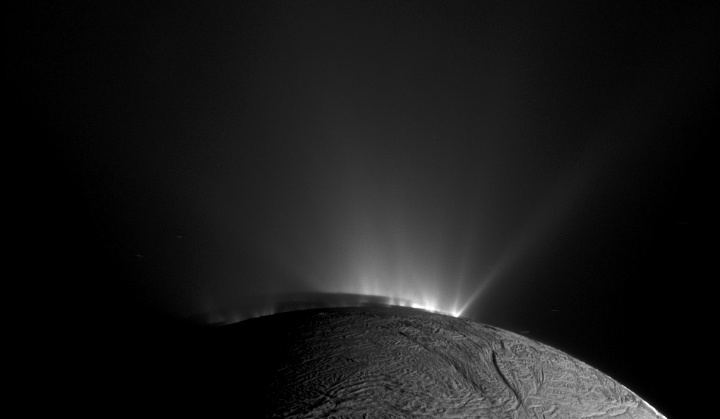
- Cassini's 2008 high-speed flyby revealed organic compounds hidden in Enceladus's ice plumes.
- Organic signatures were masked at lower speeds by interference in the mass spectrometer data.
- Enceladus's subsurface ocean may hold a richer organic inventory than previously measured.
Scientists analyzing data from Saturn's moon Enceladus discovered something unexpected in its ice plumes. Research from the University of Stuttgart reveals that organic compounds were hiding in plain sight, masked by the very instruments designed to detect them.
The breakthrough came from reexamining 2008 data when the Cassini probe flew through Enceladus's plumes at an unusually high speed of 65,000 km/h - nearly twice its typical velocity.
Key figure
65,000 km/h
Cassini's speed during the flyby that finally revealed hidden organic compounds in Enceladus's plumes
The Speed That Revealed Hidden Chemistry
Cassini's Cosmic Dust Analyzer (CDA) works by measuring collision fragments from ice particles. When particles strike the detector, they break apart into charged fragments that create distinctive mass spectra - molecular fingerprints that reveal the original compound's identity.
What is a mass spectrum?
A mass spectrum is a kind of chemical fingerprint. When a molecule is broken apart and its fragments are sorted by weight, the resulting pattern is unique to that molecule – like a barcode. Scientists use these patterns to identify what substances are present in a sample, even in tiny amounts collected from space.
The problem emerged at lower speeds. "If the speed at the moment of collision is too low, there may be interference in some cases in CDA mass spectra," explains researcher Khawaja. "The signatures left behind by the molecules can then no longer be interpreted clearly - they are masked, so to speak."
At Cassini's usual cruising speed of 40,000 km/h or less, organic compounds were present but undetectable. The molecular signatures became scrambled by interfering influences that obscured their true nature.
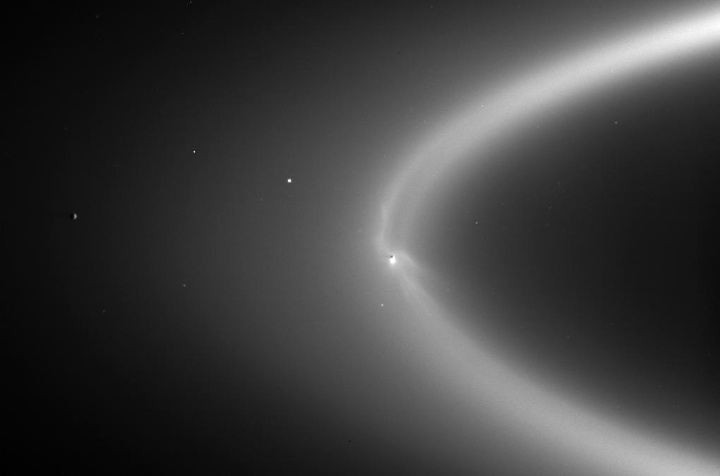
Credits: NASA / JPL / Space Science Institute
What High-Energy Collisions Revealed
The 2008 high-speed encounter changed everything. The increased collision energy eliminated the interfering influences that had been masking organic signatures in previous flybys.
This discovery suggests Enceladus harbors more complex organic chemistry than scientists previously recognized. The moon's subsurface ocean, already considered one of the most promising places to search for life in our solar system, may contain a richer inventory of organic molecules than lower-speed measurements indicated.
The finding also raises questions about other missions. How many organic compounds have remained hidden in data from other icy moons because detection speeds were insufficient to reveal their true signatures?

Fact Check: Claim-by-Claim Verification Verified
All claims verified against the University of Stuttgart press release, ELSI summary, and NASA mission data. No corrections needed.
Commentary
- Khawaja is now at Freie Universität Berlin; the article attributes the work to Stuttgart which is where the research was conducted.
- Some organic compounds had been detected in earlier Cassini data (2018 high-mass organics), but the specific complex signatures in fresh plume grains required the high-speed encounter.
Sources used for verification
Academic/Peer-reviewed:
- Khawaja et al. (2025), Nature Astronomy, DOI: 10.1038/s41550-025-02655-y
Other reliable sources:
- Saturn's moon emits organic compounds - uni-stuttgart.de
- Origins of organic molecules on Enceladus - elsi.jp
Fact-checked by Perplexity Sonar Pro on 2026-03-15