- Tornado-like flux ropes form when fast solar eruptions collide with slower solar wind.
- Previous simulations used million-mile resolution cubes, making flux ropes invisible.
- These vortices carry enough energy to trigger geomagnetic storms damaging power grids.
Space weather forecasters faced a persistent mystery. Geomagnetic storms were striking Earth during periods when no solar eruptions were predicted to hit the planet. The evidence suggested smaller space weather events were forming somewhere between the Sun and Earth.
Researchers discovered the answer in an unexpected place. Tornado-like vortices called flux ropes spin off when massive solar eruptions slam into slower streams of charged particles ahead of them.
Key figure
1,800 mi/s
Speed of interplanetary coronal mass ejections colliding with the solar wind
The Hidden Weather System
These space tornadoes form when interplanetary coronal mass ejections - eruptions traveling at speeds approaching 1,800 miles per second - collide with the solar wind. The collision creates magnetic flux ropes that bundle magnetic fields around each other like twisted rope.
What is a magnetic flux rope?
A magnetic flux rope is a twisted bundle of magnetic field lines that wrap around each other like strands of a rope. In space, these structures form when colliding streams of charged particles force magnetic fields to coil together, creating a coherent, rotating tube of concentrated magnetic energy.
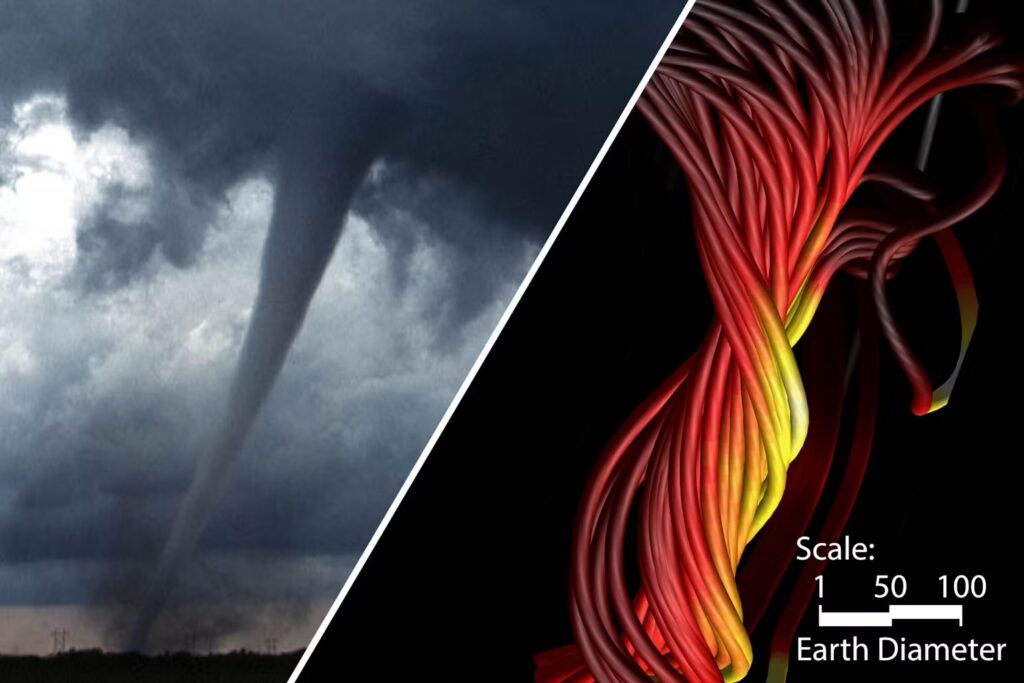
The discovery emerged from high-resolution computer simulations that could resolve features spanning tens of thousands of miles. Previous global simulations used computational cubes representing areas 1 million miles wide, making these smaller structures invisible.
What the enhanced simulations revealed proved more complex than expected. The magnetic fields in these vortices possessed incredible strength and persistence, lasting far longer than researchers anticipated.
Why Previous Models Failed
Current space weather simulations focus on large solar eruptions because these have the most dramatic effects on Earth's infrastructure. The approach treats streams of charged particles and magnetic fields as fluids to reduce computational costs.
The limitation created a fundamental blind spot. Researchers were essentially trying to forecast hurricanes using simulations that only showed global weather patterns - the smaller but significant events remained completely invisible.
The breakthrough came when scientists increased simulation resolution along specific trajectories. This approach revealed multiple flux ropes where previous models showed only faint traces that quickly disappeared.
Implications for Earth
These space tornadoes carry enough magnetic energy to trigger significant geomagnetic storms. When they strike Earth's magnetic field, they can damage power grids, interfere with satellite operations, and create the aurora displays visible in polar regions.
The magnetic fields in these vortices were strong enough to trigger a significant geomagnetic storm and cause some real trouble here on Earth.
Research team findings published in Astrophysical Journal
The discovery explains why some geomagnetic storms occur without warning from traditional space weather monitoring systems. These tornado-like structures would appear as only small blips on current satellite instruments.
Understanding this mechanism requires multiple satellites positioned to observe flux rope formation and movement in three dimensions. Scientists are developing next-generation space missions designed to track these elusive but potentially dangerous space weather phenomena.


Fact Check: Claim-by-Claim Verification Verified
All claims verified against the Astrophysical Journal paper and press coverage. One unit error corrected in stat callout ("mph/s" to "mi/s").
Commentary
- Results are based on computer simulations, not direct observations of flux rope formation in space.
- The article does not name the research team (University of Michigan, led by Chip Manchester) — only attributes findings to "researchers."
- Quote attribution is vague ("Research team findings") rather than naming the specific researcher.
Sources used for verification
Academic/Peer-reviewed:
- Manchester et al. (2025), Astrophysical Journal (specific DOI not found in press coverage)
Other reliable sources:
- Space tornadoes could cause geomagnetic storms - theconversation.com
- Space tornadoes and geomagnetic storms - phys.org
- Space tornado study - popsci.com
Fact-checked by Perplexity Sonar Pro on 2026-03-15