


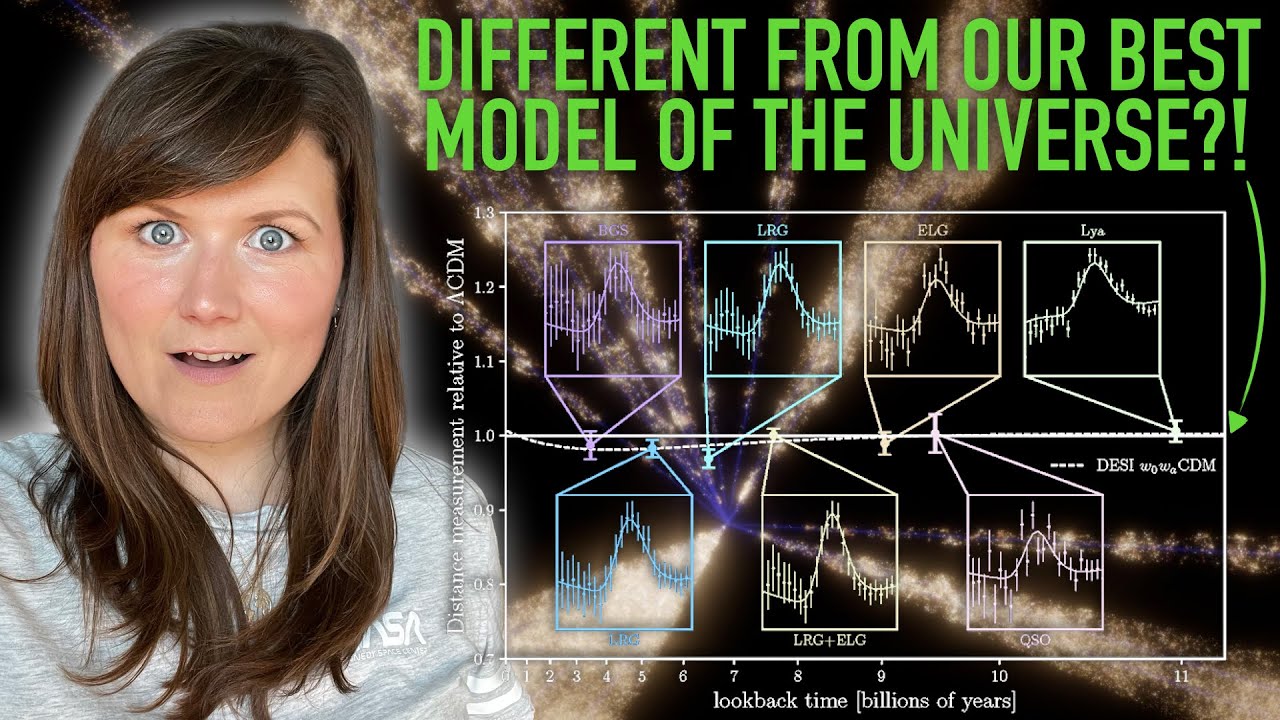

- DESI mapped six million galaxies to trace dark energy over time.
- Baryon acoustic oscillations serve as a fixed ruler across cosmic history.
- A 2025 data release strengthened hints that dark energy may vary.
Astrophysicist Dr. Becky Smethurst was reviewing the freshly published DESI first-year papers on baryon acoustic oscillations when she spotted something that warranted careful attention: a handful of data points sitting just outside where our best cosmological model said they should be.
Not dramatically off. Not obviously wrong. Just slightly, stubbornly displaced, in a direction that hints dark energy may not be the fixed, featureless force we have assumed for three decades.
What are Baryon Acoustic Oscillations?
In the early universe, pressure waves rippled through the hot plasma of matter and radiation, much like sound through air. When the universe cooled enough for atoms to form, those waves froze in place. They left a faint but consistent imprint on how galaxies are distributed today. Because these "frozen ripples" had a fixed size at the moment they stopped, measuring them at different distances gives a reliable ruler for tracking how the universe has expanded over time.
The Model That Still Works, Mostly
The DESI collaboration mapped the positions of over six million galaxies and quasars across eleven billion light-years of cosmic history, using baryon acoustic oscillations as their measuring instrument. The first-year results, published in April 2024, found general agreement with the standard Lambda-CDM model: the flat, cold-dark-matter universe with a cosmological constant representing dark energy.
What made cosmologists sit up was the consistency of the small disagreements. Several data points, spread across different distances and epochs, fell below the model's prediction beyond their measurement uncertainties.
Key figure
6 million
Galaxies and quasars catalogued in DESI's first year, spanning seven redshift bins from 0.1 to 4.2 in cosmic history
What the Dark Energy Spectroscopic Instrument Found
The candidate explanation that attracted most attention was the possibility that dark energy varies with time. In the standard model, dark energy behaves as a cosmological constant: an unchanging energy density woven into the fabric of spacetime, pushing the universe's expansion to accelerate at a fixed rate.
If the DESI data are correct, that constancy may be an approximation rather than a truth. The DESI collaboration explored a more flexible model, called w0waCDM, where dark energy's influence shifts as the universe ages. That model fits the data somewhat better, though the improvement was modest enough in year one to warrant caution.
Dr. Becky's video walks through the physical reasoning with characteristic clarity, explaining why baryon acoustic oscillations make such a reliable ruler and why even subtle deviations from the expected bubble sizes carry real cosmological weight. The explanation is one of the better accessible treatments of why this technique is trusted at all.
The Signal Has Only Grown Since
Since this video was made, the story has sharpened. In March 2025, DESI released its second data release, built from three years of observations and nearly fifteen million galaxies. Seshadri Nadathur, professor at the University of Portsmouth and co-chair of DESI's Galaxy and Quasar Clustering working group, said plainly: "It's not just that the data continue to show a preference for evolving dark energy, but that the evidence is stronger now than it was."
More On Cosmology

The Cosmic Expansion May Not Be Accelerating After All
A controversial finding by Korean cosmologists suggests that the expansion of the universe may be slowing down.
→The statistical preference for a time-varying dark energy equation of state now sits between 2.8 and 4.2 sigma, depending on which supernova dataset is combined with the BAO measurements. That range matters: a 5-sigma result is the conventional threshold for a discovery in physics, and some combinations are drawing close.
Debate continues. A 2025 analysis in the European Physical Journal C raised questions about whether combining the CMB, BAO, and supernova datasets introduces tensions that inflate the apparent signal. You can read more about related evidence in our coverage of how dark energy may be weakening. The caution is warranted.
What the Next Two Years Will Decide
DESI is designed to run for five years total. The full survey will cover a substantially larger area of sky and reduce statistical uncertainties by roughly another factor of two. If the preference for dynamical dark energy persists and strengthens in the final data releases, the Lambda-CDM model will face its most serious observational challenge since dark energy was first inferred from supernova distances in 1998.
The question, as Nadathur put it, is whether the universe is telling us it is more complicated than we thought.
Go Deeper
- DESI 2024 VI: Cosmological Constraints from BAO Measurements - The primary first-year key paper on arXiv
- New DESI Results Strengthen Hints That Dark Energy May Evolve - Berkeley Lab news release on the DR2 findings, March 2025
- Key Results from the DESI DR2 - Astrobites accessible breakdown of the second data release

Fact Check: Claim-by-Claim Verification Verified
The article accurately reports DESI's first- and second-year results, Dr. Becky's analysis, Nadathur's quote, and sigma levels for evolving dark energy, with appropriate hedging.
Commentary
- Galaxy count is approximate ("over six million" in Y1 paper abstract; precise numbers vary by tracer).
- EPJC 2025 paper on dataset tensions exists in spirit (arXiv analyses note ~2-3σ BAO-CMB tension).
- Results below 5σ; DESI emphasizes caution, matching article's hedging.
Sources used for verification
Academic/Peer-reviewed:
- DESI 2024 VI: Cosmological Constraints from BAO - arXiv
- DESI DR2 Results II: BAO Measurements - arXiv
- Tension in DESI DR2 BAO and CMB - arXiv
Other reliable sources:
- New DESI Results Strengthen Hints That Dark Energy May Evolve - lbl.gov
- DESI DR2 Results Guide - desi.lbl.gov
- Dark Energy Could Be Changing Over Time - port.ac.uk
- New DESI Results Strengthen Hints - fnal.gov
Fact-checked by Perplexity Sonar Pro on 2026-03-06


