
Definition
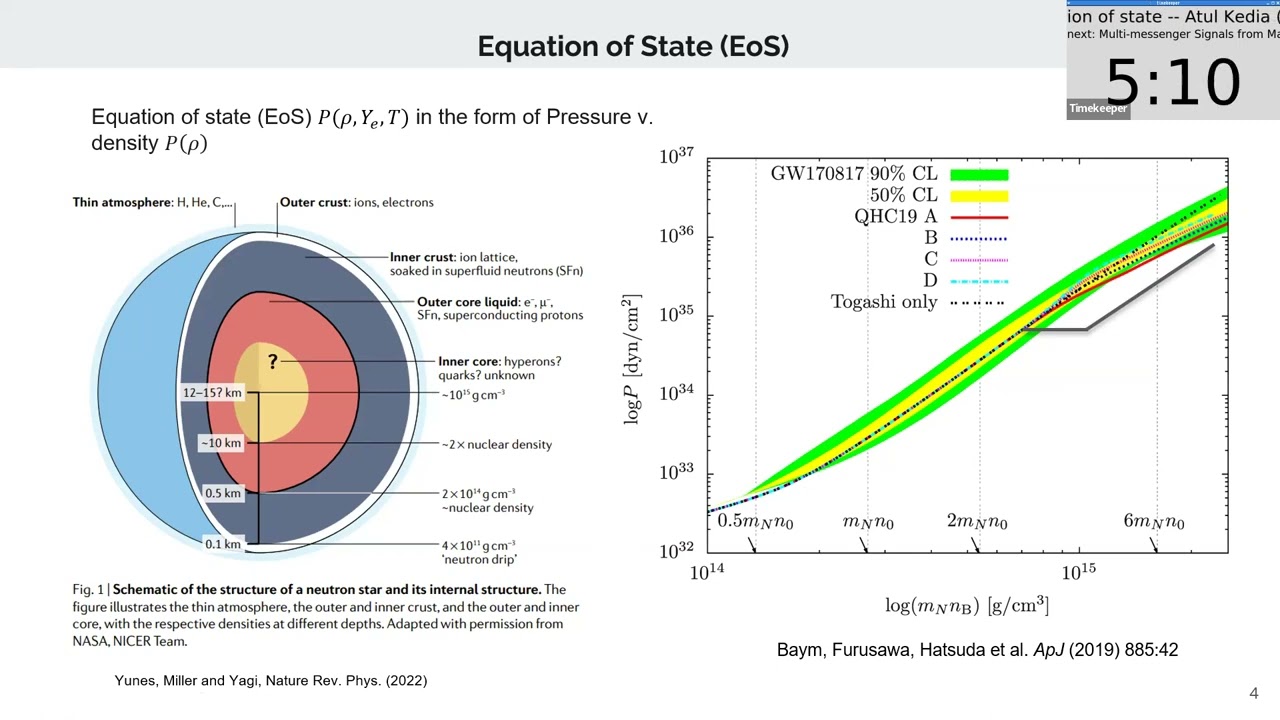
The "Neutron Star Equation of State" refers to the mathematical relationship that describes how matter behaves under the extreme pressures and densities found in neutron stars. This equation helps determine the star's properties, such as its mass, radius, and internal structure.
Etymology
The term is a combination of several concepts: "neutron star," which refers to the remnants of massive stars that have collapsed under gravity, and "equation of state," a term used in physics to describe the thermodynamic properties of matter.
Example usage
'Astrophysicists use the neutron star equation of state to predict the maximum mass a neutron star can have before collapsing into a black hole.'
Interesting fact
The neutron star equation of state is so complex that it requires the use of supercomputers to solve. It incorporates aspects of quantum mechanics, nuclear physics, and general relativity.
Source: National Center for Supercomputing Applications
Explanation and Detail
Understanding Neutron Stars
Neutron stars are the remnants of massive stars that have exploded in supernovae. They are incredibly dense, with a mass greater than that of the Sun but compressed into a sphere only about 20 kilometers in diameter.
Role of the Equation of State
The neutron star equation of state is crucial for understanding these celestial objects. It models the relationship between pressure, volume, and temperature inside the star. This equation helps scientists predict how the matter behaves under extreme conditions, guiding our understanding of the star's mass and radius.
Challenges in the Equation
Developing an accurate equation of state for a neutron star is challenging. It requires integrating knowledge from various fields of physics. The extreme conditions inside a neutron star mean that the matter is in a state not found elsewhere, making direct experimentation impossible. Instead, scientists rely on indirect observations and theoretical models.
Related video