
- 3I/ATLAS emits nickel but no iron, unlike any known comet.
- The CO2-to-water ratio of 7.6 is the highest ever recorded in a comet.
- The source star may be 7.5-9 billion years old, from the Milky Way's thick disc.
Most solar system comets carry iron. So when Rohan Rahatgaonkar, a doctoral researcher at the Institute of Astrophysics in Santiago, trained the Very Large Telescope on 3I/ATLAS, the third interstellar visitor ever confirmed passing through our solar system, he expected iron. His team found nickel instead.
Abundant, unmistakable nickel. And no iron at all.
That absence, between what should have been there and what was, turned a remarkable discovery into a genuine puzzle about chemistry in distant star systems.
A Visitor from an Ancient Star
When 3I/ATLAS was first spotted on July 1, 2025, its speed told astronomers what they needed to know. Moving at over 58 kilometres per second, with an orbital eccentricity of 6.14, the object had not formed here. No solar system process produces trajectories that extreme. The comet had arrived from interstellar space, only the third such confirmed visitor after 'Oumuamua and 2I/Borisov.
Key figure
6.14
The orbital eccentricity of 3I/ATLAS – the most hyperbolic orbit ever confirmed for any solar system object
What made it stranger still was how it behaved before anyone had really noticed it.
Analysis of archival data from NASA’s TESS satellite found that 3I/ATLAS had already been active in May 2025, two months before its official discovery. It was outgassing at a distance of six astronomical units from the sun – beyond Jupiter’s orbit.
Comets from our own solar system typically start releasing gas much closer in. Six AU is too far. Whatever ices this object carried, they were not the water-dominated variety our own comets run on.
The Highest CO₂ Ratio Ever Seen in a Comet
On August 6, 2025, the James Webb Space Telescope observed 3I/ATLAS through its Near-Infrared Spectrograph while the comet was 3.3 astronomical units from the sun. The comet’s coma – the cloud of gas surrounding its nucleus – was dominated by carbon dioxide, with a CO₂-to-water ratio of 7.6.
That figure sits 4.5 standard deviations above the trend observed across all long-period and Jupiter-family comets ever measured.
Carbon monoxide, water ice, and carbonyl sulfide were also present, in amounts consistent with an ordinary comet. Its carbon isotope ratio – the proportion of carbon-12 to carbon-13 – was similar to Earth’s, suggesting its formation environment was not radically alien.
But the CO₂ excess remained unexplained. The most plausible interpretations involve a hotter host star, a more UV-intense radiation environment, or formation beyond the CO₂ ice line in a particularly remote part of its home system.
Trajectory modelling pointed toward the thick disc of the Milky Way as 3I/ATLAS’s origin region. The source star may be between 7.5 and 9 billion years old, roughly twice the sun’s age.
Why does CO₂ matter here?
Carbon dioxide ice evaporates at much lower temperatures than water ice, making it a “hypervolatile” – a substance that starts sublimating far from the sun. A comet dominated by CO₂ rather than water either formed in an unusually cold, remote region of its home system, or was exposed to more UV radiation than our own comets experienced. Either scenario points toward a different kind of stellar environment.
What Nickel Reveals, and What Iron’s Absence Does Not Explain
Nickel itself is not unusual in comets. It has been detected in roughly 20 solar system comets and in 2I/Borisov, the previous interstellar visitor. The curiosity is the mechanism.
Metals like nickel ordinarily sublimate at temperatures above 700 Kelvin. At 3 AU from the sun, where 3I/ATLAS was when the Very Large Telescope detected its nickel emissions, temperatures are nowhere near that range.
The most likely explanation involves nickel tetracarbonyl, a volatile compound in which nickel bonds with carbon monoxide. Think of it as a chemical courier: the compound forms in or on cometary dust, travels outward with the coma, and then dismantles itself in sunlight, releasing nickel atoms without requiring high heat.
Iron carbonyl, the analogous compound for iron, should form under similar conditions. It has been detected in solar system comets. In 3I/ATLAS, it was absent entirely.
Rahatgaonkar’s team offered several candidates. Iron carbonyls might be less stable under the water-rich chemistry of this comet’s coma. They might not have formed in 3I/ATLAS’s original star system. Or they might simply be absent from this comet’s composition entirely.
None of those explanations is yet testable.
The iron absence may be the most significant data point this comet has offered – the thing that resists the tidiest narrative. If the source star was genuinely iron-poor, as older low-metallicity stars sometimes are, that would carry compositional consequences reaching all the way to the comet’s dust.
What the Data Can and Cannot Say
When Rahatgaonkar’s team saw their results being described publicly as evidence of an alien spacecraft, they did not stay quiet. They contacted science communicators directly to push back, noting that the chemical signatures fit natural astrophysical processes well. The nickel-without-iron finding is strange. Strange is not the same as inexplicable.
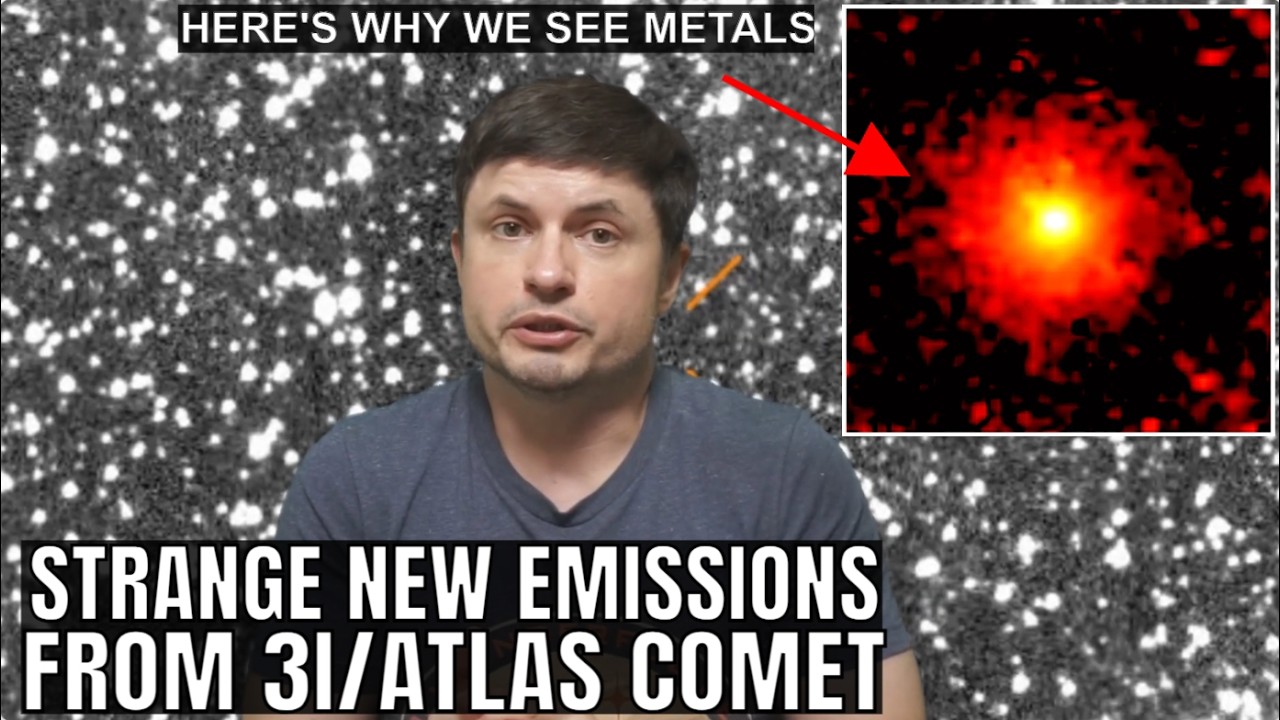
Petrov, whose YouTube commentary on 3I/ATLAS helped bring the science to a wide audience, noted the panspermia idea carefully, keeping it at the level of possibility rather than claim.
Understanding and studying this is obviously quite important… these comets might potentially transfer life from one star to another.
Anton Petrov, science communicator
After perihelion on October 29, 2025 at 1.36 AU, SOHO and the Parker Solar Probe gathered observations as the comet passed behind the sun. By November 6, with 3I/ATLAS at 1.4 AU, it was releasing water at a rate of 3.17 × 10⁻²⁹ molecules per second – a figure that will help calibrate further compositional models.
The comet is now receding through the constellation Gemini.
More On Comets

How a Jazz Guitarist Reinvented the Search for Micrometeorites
Jon Larsen noticed a speck of space dust during breakfast. It led him on a path of amazing discoveries.
→The Vera Rubin Observatory, coming online in the next few years, is expected to detect interstellar visitors far more frequently. Every new arrival offers another chemistry profile from another star system, another data point on whether what we see in our own solar neighbourhood is typical.
3I/ATLAS has already given a provisional answer: not typical. Whether the nickel-without-iron profile reflects the source star’s age, its radiation environment, or something about this comet’s particular billion-year journey remains open.
The textbooks on cometary chemistry may not change overnight. But the telescopes are pointed. The analysis has begun.
Sources
- Primary source: 3I/ATLAS Is Emitting Nickel But Something Doesn’t Add Up (Anton Petrov, What Da Math, 2025)
- Additional context:

Fact Check: Claim-by-Claim Verification Verified
The article accurately represents peer-reviewed findings from primary arXiv sources on 3I/ATLAS, including nickel detection without iron, high CO₂ ratio, and orbital details.
Commentary
- Researcher name "Rohan Rahatgaonkar" and affiliation (Institute of Astrophysics, Santiago) match lead author of VLT paper.
- Iron absence is reported as undetected (no Fe I lines), not impossible; explanations like stability or composition are speculative but appropriately presented as such.
- Article simplifies mechanisms (e.g., nickel tetracarbonyl) consistent with peer-reviewed discussions.
Sources used for verification
Academic/Peer-reviewed:
- JWST detection of a carbon dioxide dominated gas coma surrounding interstellar object 3I/ATLAS - arXiv
- Very Large Telescope Observations of Interstellar Comet 3I/ATLAS: Dramatic Rise of Ni I Emission - arXiv
- Comet 3I/ATLAS - NASA
Other reliable sources:
- Minor Planet Center: 3I/ATLAS - minorplanetcenter.net
Fact-checked by Perplexity Sonar Pro on 2026-03-08